
As we all know, Christmas Eve is a busy night for Santa Claus as he travels the world in his iconic sleigh and delivers presents to all the nice kids.
So what happens if his sleigh is unable to complete the trip? Like if it… ran out of fuel?
Believe it or not, that was a dilemma Saint Nick faced ahead of Christmas in 1942. Due to rationing related to World War II, he had to find an alternative to flying his sleigh. It might not be as majestic or even a sensible choice of vehicle, but it got him where he needed to go down there: a 1937 Nissan Type 70 that the Americans had captured from Japanese forces.
Rationing
December 1942 was the second Christmas for wartime America, over a year after the country entered the conflict. Everyone was expected to do their part one way or another, whether it be serving in the military or supporting them on the home front.
Rationing was one of the biggest ways to contribute to the war effort at home, quickly established in the wake of the attack on Pearl Harbor. Besides food and medication, the government implemented strict measures to conserve tires and fuel so that troops abroad could use them on their vehicles. One such method was to mandate a national speed limit of 35 miles per hour for privately owned cars, which went into effect in October but would be largely enforced by an honor code and initiative by road authorities.
For something that hit a little harder, the Office of Price Administration introduced gas ration cards and stickers that must be affixed to the windshield. Provided they did not have more than five tires in their possession, vehicle owners must submit applications to the OPA for their cards.
Fuel rationing was separated into six categories, primarily by occupation such as professionals (who received a “C” sticker), and those who relied on motorcycles (“M”) and trucks (“T”) for their jobs. Otherwise, the average citizen received an “A” sticker that allocated four gallons of gas to them per week, “B” for eight gallons weekly, or “X” for those who traveled often and therefore needed frequent fuel stops.
You would think Santa qualified for an “X” sticker given how much ground he has to cover in a single night. Alas, doing all that work in one night was not enough to sway the OPA and he was given an “A” card. Alberta Gogel, the daughter of Mr. and Mrs. Frank Gogel of Mariah Hill, Indiana, had the ‘honor’ of placing the designation on his sleigh (bottom left).
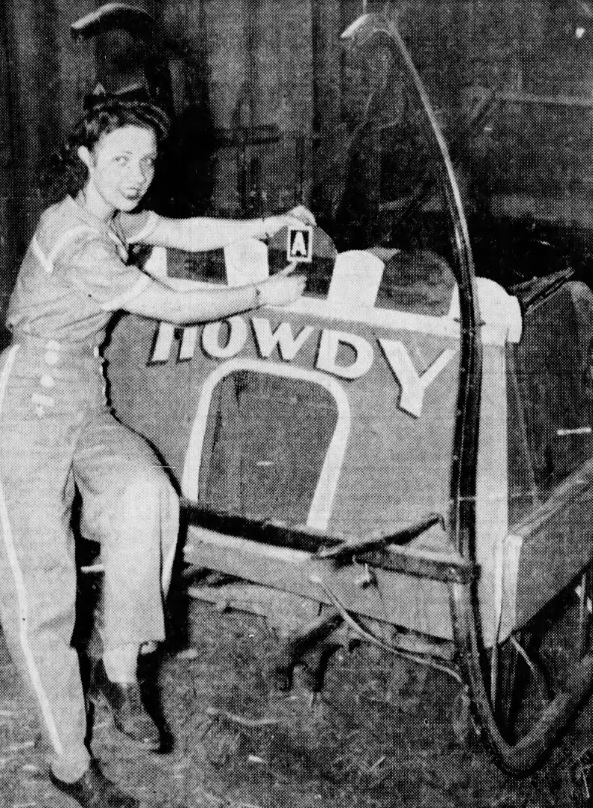
Credit: Evansville Courier & Press, December 20, 1942
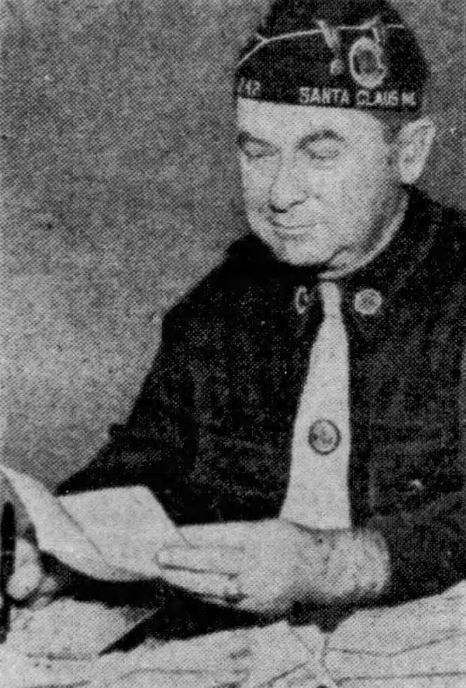
Credit: The Buffalo News, December 20, 1945
The real story behind the sleigh and gas ration fittingly involved the city of Santa Claus, Indiana, where local restaurateur and American Legion member Jim Yellig (top right) traditionally played the role of Saint Nick for kids each Christmas. He didn’t just sit around and have kids on his lap either: he drove a motorized sleigh around the state with reindeer made from papier mâché and an engine from an American Bantam.
Due to the war, Yellig was busy working as a superintendent of mechanical and outfitting inspection at the Evansville Shipyard. Thus, the sleigh was left inside what James Margedant of the Evansville Courier & Press described as a “dusty barn down the graveled street from the Yellig home.”
He resumed his duties at war’s end.
Guadalcanal
With his sleigh out of commission for the forseeable future, how would Santa get around now? Swim? He’s proven he can swim around sharks without issue, after all.
Maybe he did do some of that. Though if American propaganda of the time was any indicator, he hitched a lift by enlisting and being shipped off to the frontline. Maybe not the most expedient way to deliver presents, but at least he wasn’t stuck in one place.
Fortunately, American troops fighting in the Guadalcanal campaign had a ride lined up for him.
The Allies had been waging what was codenamed Operation Watchtower for the past four months in Solomon Islands, taking heavy losses but gaining ground. By the time Christmas rolled around, Japan was unknowingly just three weeks away from having to withdraw from Guadalcanal. With Santa set to arrive, some Marines looked at the trophies they were able to claim from the Japanese, and one seemed perfect for him.
The Nissan Type 70 began production in 1937, relying on equipment from the Evansville-based manufacturer Graham-Paige that had previously been used to make the Graham Crusader Model 80. Nissan had wanted to build a full-sized car similar to what Chevrolet and Ford were producing, while the fledgling Graham-Paige needed the money to stay afloat as the Great Depression took its toll.
Save for a few differences (most notably the engine), the Type 70 was basically the same as a Crusader. The Imperial Japanese Army eventually received its own four-door model in 1938; according to The Graham Legacy: Graham-Paige from 1932, 5,496 of these were built for the war.
One of those 5,496 would be Santa’s vehicle for Christmas Day 1942. During the Allied offensive, they managed to capture a Type 70 for themselves, which they thought would be fun to use for the festivities. The back half of the car’s roof was stripped to allow Santa and his entourage to stand up and take in the atmosphere, while any relevant markings were covered up.
A new moniker for his car was scrawled atop the covering: “Guadalcanal Taxi”.
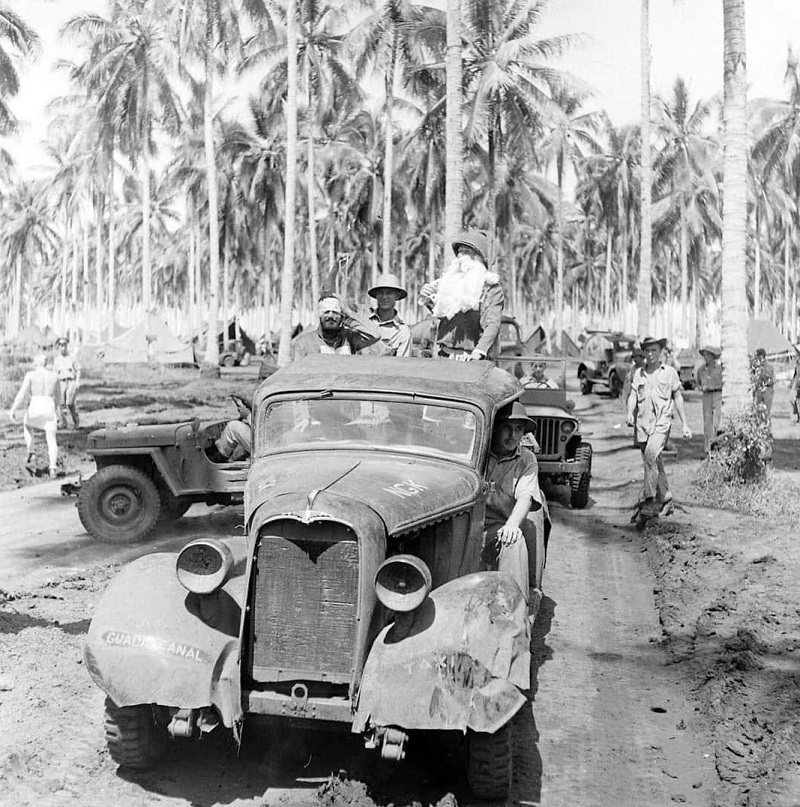
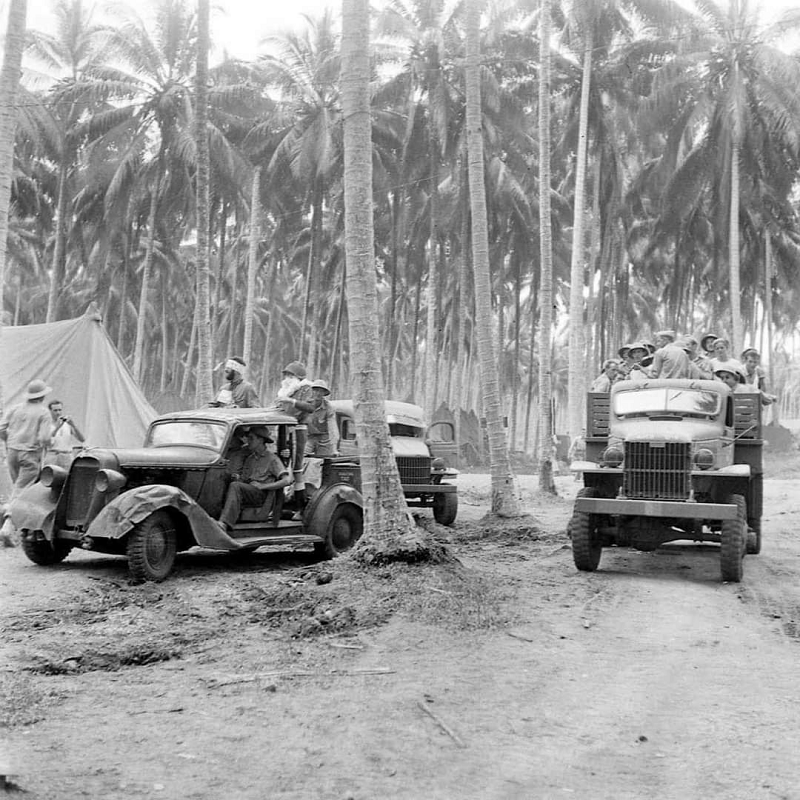
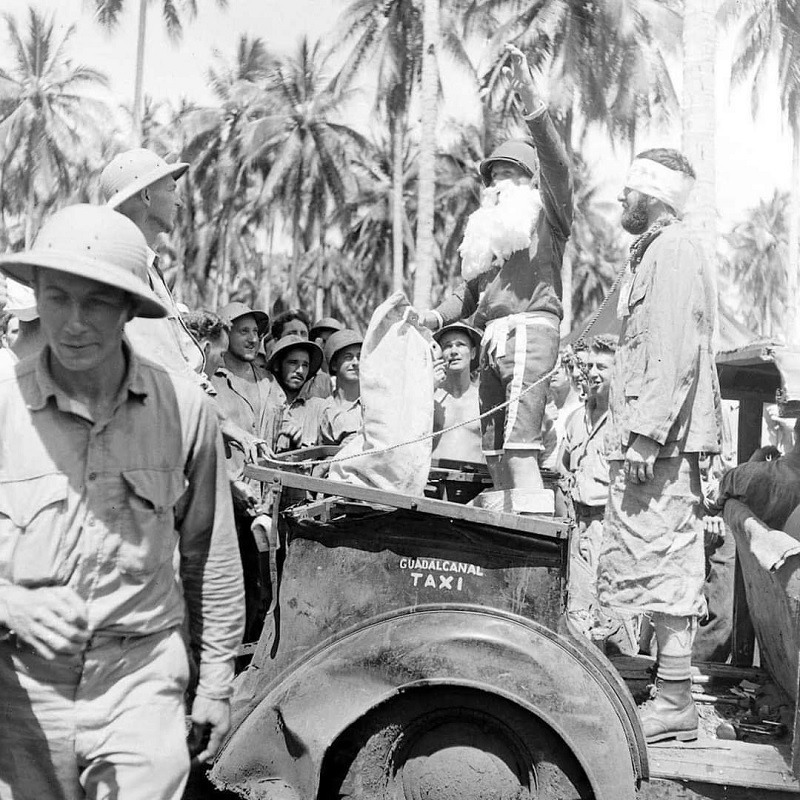
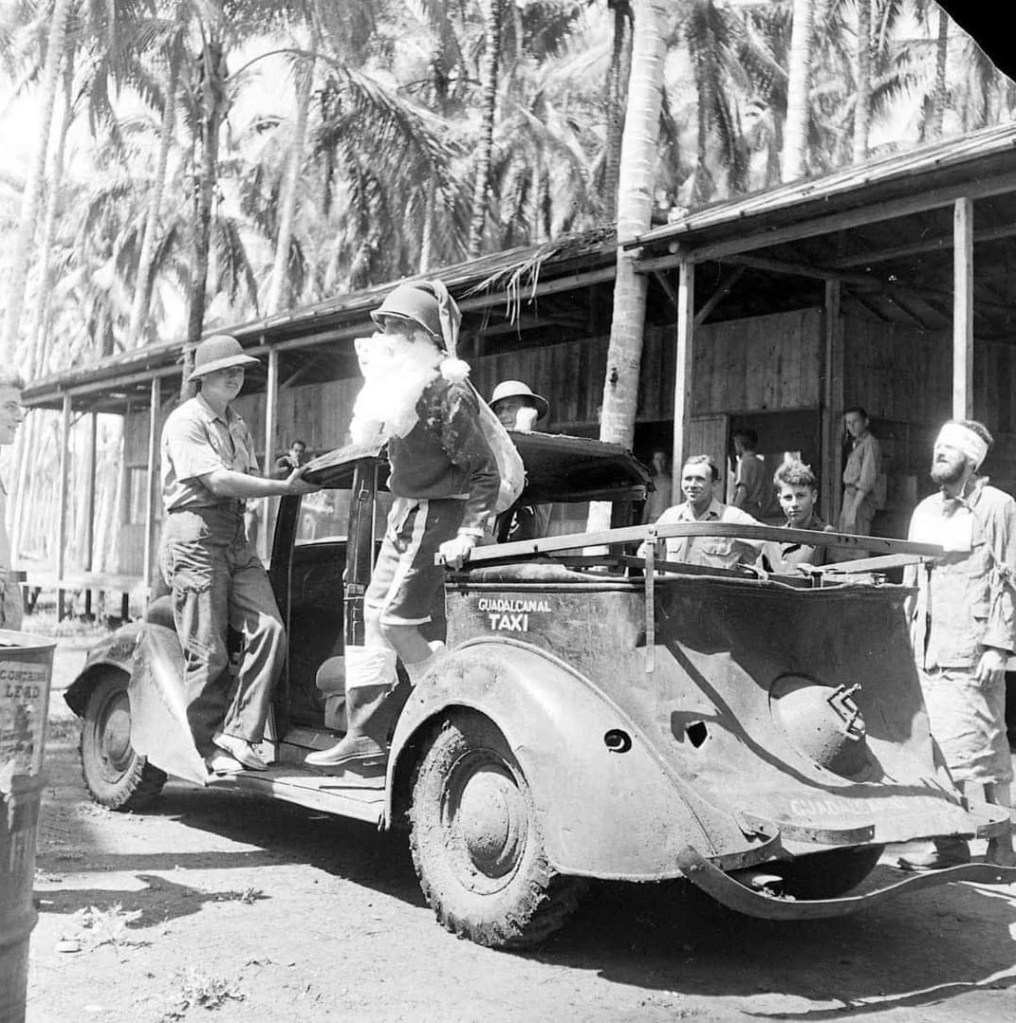
Once December 25 rolled around, Santa rolled up in his swanky new ride. Given the climate and what was happening, he traded in his red stocking cap for an M1 helmet and his trademark suit for shorts.
Ralph Morse, a photographer for LIFE, captured the scene for the magazine’s March 1, 1943 issue. The pictures (of the Nissan above) were also included in Richard Tregaskis’ classic Guadalcanal Diary.
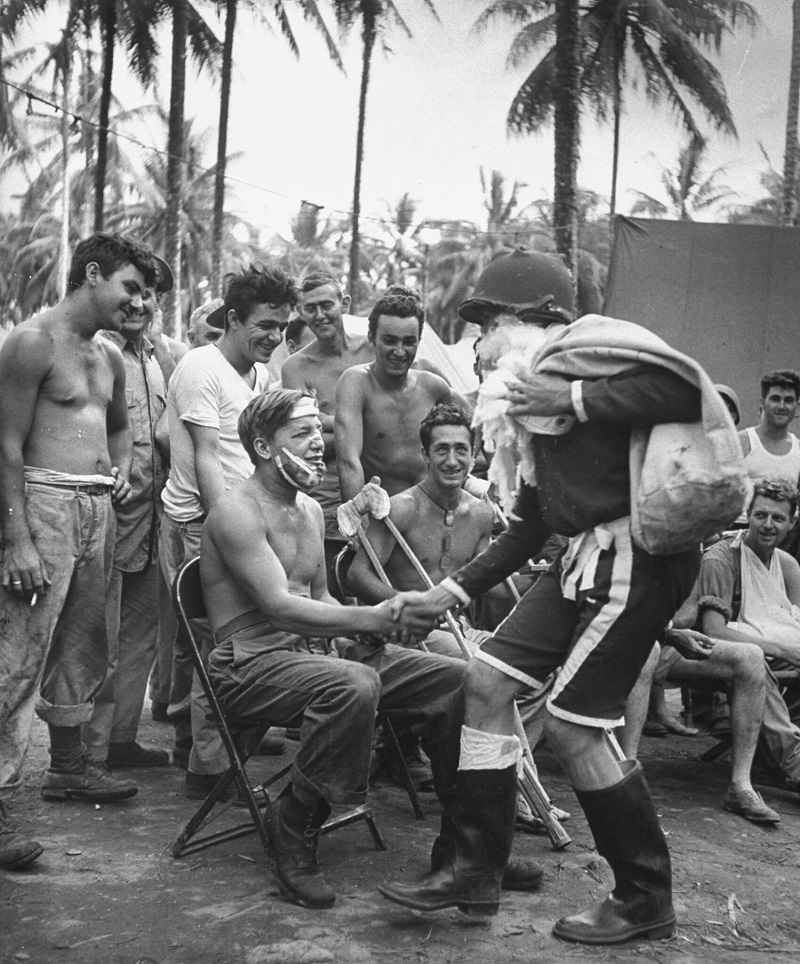
Credit: Ralph Morse / LIFE
One paper was eager to write about the day when a local was spotted in one of Morse’s photos:
Although he was several thousand miles from home, Johnny Linardos saw Santa Claus.
Johnny is, in his domestic life, a shoe shine boy in his father’s shop at 133½ North Main street. His father, Ted Linardos, hero of World War I, last Friday saw a picture of Johnny on page 71 of the current issue of Life magazine and there was Santa shaking hands with Johnny’s wounded comrades at an army field hospital on Guadalcanal.
In case you saw the picture. Johnny is the dark-haired boy on the extreme left and is holding a cigarette given him by the Red Cross. Santa, according to the legend under the picture, is dressed in red shorts, boots and a beard prepared by navy parachute riggers. Santa toured the island in a battered Chev [sic] captured from the Japs and called “Guadalcanal taxi.” He visited marine and army hospitals, gave presents to the wounded, and did sailor dances. Presents included pipes, playing cards and writing paper.
Johnny attended Deaconess school in Helena before going to work for his father. Then he was accepted by the army and his life has been a busy one ever since.
And, despite the fact that this is Johnny’s story, this happens to be the opening of the National Red Cross war fund drive, and you can’t help realizing just what the Red Cross means to fellows like Johnny when you see the delighted expressions on their faces as the Red Cross man brings a little sunshine into their lives on Guadalcanal.
And when you make your donation to the fund next Sunday, remember Johnny, and all the other Helena boys on Guadalcanal, and the hundreds of other places where they may be.
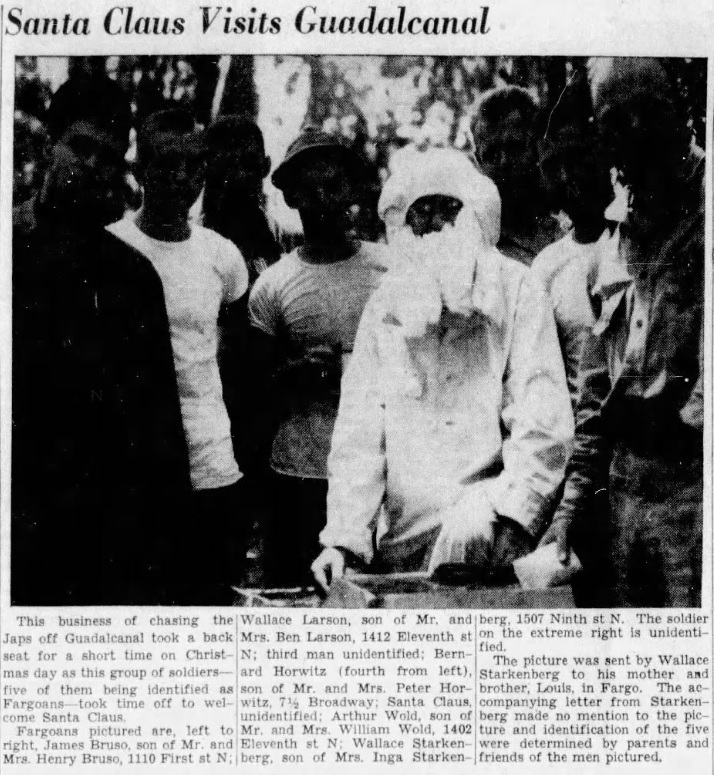
And before you prattle on about how Santa was just a soldier in cosplay, The Fargo Forum noted in a caption of a group photo with him that his identity was “unidentified”. Curious…
Featured image credit: Ralph Morse / LIFE
 131 Off-Road
Leave a comment