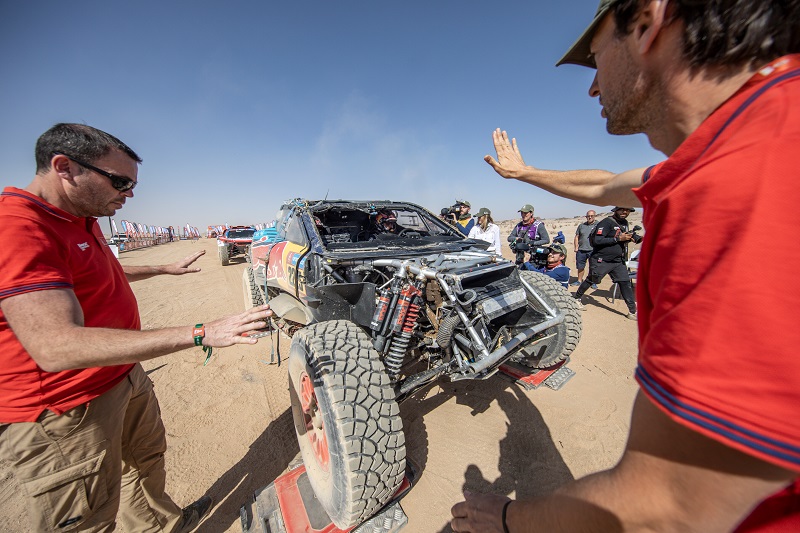
Carlos Sainz returned from the Chrono Stage with a Ford Raptor that looked like something out of Mad Max, the bodywork completely torn off the ends and frame mangled. While certainly an example of resilience, the rollcage was too damaged for the FIA to let him continue, ending his quest for a fifth Dakar Rally and second straight after just two stages.
Sainz rolled the Raptor during the first day of the Chrono Stage on Sunday, after which teammate Mitch Guthrie got him back on his wheels before he brought it to his break camp. He lost over an hour on the leader when the stage resumed Monday, and continued to fall as he drove his wounded car to the finish back in Bisha. Ultimately, the FIA ruled the rollcage was, as Sainz explained, “slightly bent in one spot. It’s something very easy to repair and the team would have had no issue fixing it and making the car safe enough to continue the rally, but unfortunately the FIA regulations don’t allow it so we have to withdraw.
“You can imagine the disappointment, the frustration just a few days into the race and already heading home. But that’s racing. sometimes you face these kinds of setbacks. Both Mitch and Mattias are still in the race, and I hope they can fight for the win and push forward. For us, it’s a shame not to be able to continue to support them and gain more experience with the car. In any case, I’m super motivated to come back stronger next year and try to achieve the victory with this brand.”
The defending winner was not the only M-Sport Ford to bow out in the two-day stage. Fellow Spaniard Nani Roma suffered an engine failure 766 kilometers into the stage, leaving him and Álex Haro stranded in the desert until a truck arrived to tow him back to the bivouac and ending his race.
Mattias Ekström and Guthrie survived the journey to finish eighth and 11th for M-Sport, so it was not a total loss for the Blue Oval. An unrelated Ford Raptor from Martin Prokop was 14th in a fairly clean run despite a driveshaft change at the start of the stage.
Century Racing cars took a beating as well, some rather bizarre. Chunks from Mark Corbett’s flywheel broke off and entered his CR6-T’s engine, getting trapped in the sump and causing the RPM sensors to malfunction. After working through midnight, the team managed to get it fixed. However, they also had to replace the windshield on William Battershill’s CR6 after a spectator hurled a rock into it (Rally2 rider Willem Avenant noted someone threw rocks at him as well during the first day).
Marcelo Gastaldi’s CR7 ran out of tires on both days. Brian Baragwanath lent him a spare on the first but was unavailable for the second, leaving Gastaldi to try coasting to the finish on a flat wheel only to shred the rear bodywork. Even Baragwanath wasn’t spared as his power steering went out on Days 1 and 2, including the final 160 km of the latter.
The Coronels had a nightmarish Chrono Stage after four of their CR7’s damper springs broke on Sunday. Century boss Julien Hardy surmised it was due to a “bad batch from the supplier.” Tom remarked that he and Tim “MacGyvered” in the overnight camp by using hose clamps to keep the suspension upright.
In the Mini camp, Guillaume de Mévius had a technical issue that he and Mathieu Baumel tried to resolve overnight but did not fully succeed; this came back to bite them when they lost two and a half hours on Sunday. Teammates João Ferreira and Guerlain Chicherit were among many who got lost, but they avoided fates like de Mévius and especially Vladas Jurkevičius, who wound up in a dangerous part of the course that was not marked in the roadbook and rolled. Jurkevičius and Aisvydas Paliukenas were unharmed. Denis Krotov was marked down as a retirement after he left his camp and went to a nearby paved road nine km away before returning.
Nasser Al-Attiyah and Sébastien Loeb both arrived safely at the finish for Dacia, but Cristina Gutiérrez dropped out with a power steering problem at KM 729.
While Toyota won the stage, it was unsurprisingly not all sunshine and rainbows there either. In fact, even the initial stage winner Yazeed Al-Rajhi had little ability to celebrate as he ended up receiving a two-minute speeding penalty. Overdrive teammate Rokas Baciuška inherited the win, aided by a 12-minute time credit he got to compensate for a delay while refueling. Stage #1 winner Seth Quintero, who started the stage, saw his CAP repeater break 300 kilometers in.
Henk Lategan remains the FIA leader, but his Toyota Gazoo Racing South Africa colleagues Giniel de Villiers and Saood Variawa were caught up in a crash in the closing stretch. Consequently, de Villiers’ streak of 21 straight Dakars that he finished has come to an end in his last year with TGRSA.
With the Chrono Stage being the longest and toughest leg from an endurance standpoint, many competitors found themselves in less than ideal situations. Even service trucks weren’t safe as Norbert Szalai’s MAN rolled over, necessitating Didier Monseu to use his six-wheeler to pull him back. Monseu and 2024 Africa Eco Race truck winner Tomáš Tomeček were busy during the stage helping overturned vehicles such as Craig Lumsden or towing those like Sara Price (who had a fuel issue) back to the bivouac.
If the four-wheelers were struggling this much, one had to wonder how bad the bikes had it. Daniel Sanders continued his strong start by winning another stage, but last year’s winner Ricky Brabec had a broken exhaust from missing a jump at KM 150 that prevented him from going faster than 130 km/h.
“I feel like this Chrono thing is kind of a waste,” Brabec admitted. “All the hard work we did yesterday I think kind of went down the drain, as what happens today is all that matters.”
Lorenzo Santolino had a wire in the route’s mountain sector get caught in his brakes then severed the front brake hose. Sherco colleague Rui Gonçalves crashed after failing to see a rock, which he attributed to the sun setting behind the mountains and creating shadows that hid it.
Mason Klein’s Kove had an engine failure because of clutch issues, prompting fellow riders Abdulhalim Almogheera and Murun Purevdorj to tow him for 80 km. Almogheera had previously helped Klein’s bike clear customs at the 2024 race.
Stage #2 winners
FIA
| Class | Overall | Number | Driver | Team | Time |
| Ultimate | 1 | 210 | Rokas Baciuška | Overdrive Racing | 10:54:11 |
| Challenger | 20 | 310 | Paul Spierings | Rebellion Spierings | 11:57:48 |
| SSV | 19 | 425 | Brock Heger* | Sébastien Loeb Racing | 11:57:54 |
| Stock | 122 | 501 | Ronald Basso* | Team Land Cruiser Toyota Auto Body | 18:57:12 |
| Truck | 29 | 600 | Martin Macík Jr.* | MM Technology | 12:10:51 |
FIM
| Class | Overall | Number | Rider | Team | Time |
| RallyGP | 1 | 4 | Daniel Sanders | Red Bull KTM Factory Racing | 11:12:13 |
| Rally2 | 7 | 22 | Michael Docherty | BAS World KTM Racing Team | 11:24:03 |
Other
| Class | Number | Competitor | Team | Points |
| Dakar Classic | 701 | Lorenzo Traglio | Tecnosport | 103 |
| Mission 1000 | 1040 | Jordi Juvanteny | KH-7 Ecovergy Team | 35* |
Leaders after Stage #2
FIA
| Class | Overall | Number | Driver | Team | Time |
| Ultimate | 1 | 211 | Henk Lategan | Toyota Gazoo Racing South Africa | 15:40:30 |
| Challenger | 18 | 301 | Nicolás Cavigliasso | BBR Motorsport | 16:45:02 |
| SSV | 22 | 400 | Xavier de Soultrait* | Sébastien Loeb Racing | 16:57:52 |
| Stock | 112 | 501 | Ronald Basso* | Team Land Cruiser Toyota Auto Body | 24:50:20 |
| Truck | 30 | 600 | Martin Macík Jr.* | MM Technology | 17:24:29 |
FIM
| Class | Overall | Number | Rider | Team | Time |
| RallyGP | 1 | 4 | Daniel Sanders | Red Bull KTM Factory Racing | 16:10:31 |
| Rally2 | 11 | 73 | Edgar Canet | Red Bull KTM Factory Racing | 17:04:48 |
Other
| Class | Number | Competitor | Team | Points |
| Dakar Classic | 701 | Lorenzo Traglio | Tecnosport | 103 |
| Mission 1000 | 1040 | Jordi Juvanteny | KH-7 Ecovergy Team | 65 |
Featured image credit: Flavien Duhamel / Red Bull Content Pool
 131 Off-Road
Leave a comment