
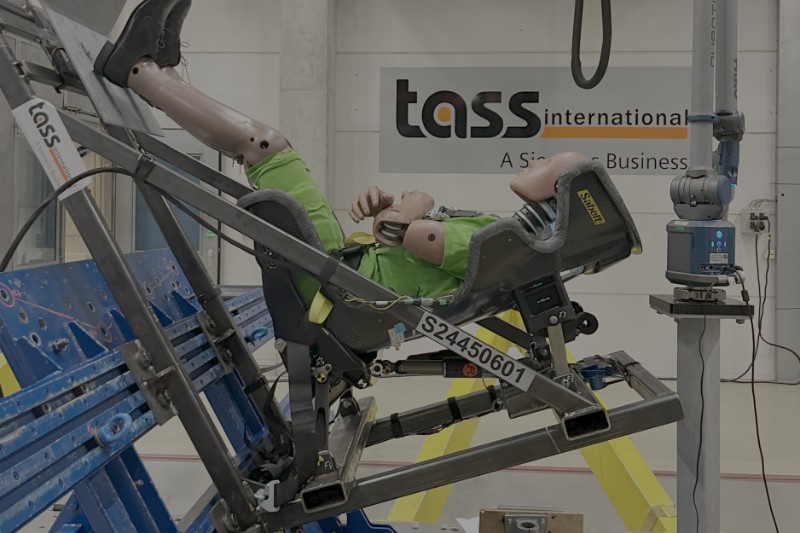
Starting with the 2027 World Rally-Raid Championship, the FIA will require all T1+ cars to use a special seat attenuator device designed to reduce the risk of spinal compression injuries caused by hard landings.
Developed by the FIA with funding from the FIA Foundation, the device has been used by the Dacia Sandriders since debuting at the 2024 Rallye du Maroc. A damper is used to hold the seat in place and absorb the energy from an impact.
Testing and development took place at TASS International. Using a “severe crash pulse” (a landing at 58 degrees along the X-axis that results in 40 g of force) as a reference, the FIA found that the damper reduces the force transferred from the car to the driver navigator by 50 percent.
“We are driven by the data, and we identified this as an area that we could bring some significant benefits for the crews,” commented FIA head of research and vehicle safety Marco Petrilli. “Using the FIA World Accident Database we could define what a typical ‘high-impact’ landing that can cause a spinal injury looks like, and use that information to set our targets for the seat attenuator, and then set requirements for a device according to our extensive simulations.”
Prodrive, who oversees the Dacia Sandriders, then developed the seating system; the damper links the seats to the roll cage. It made its debut with the Sandriders at Morocco, where it was “found to be operating as expected and delivering significant safety benefits.”
Hard landings are a concern in rally raids, especially for races held in deserts like the Dakar Rally and Abu Dhabi Desert Challenge. The 2024 ADDC saw Guillaume de Mévius and teammate Guerlain Chicherit retire because the former suffered a compressed vertebra in a rough landing while the latter’s Alex Winocq hurt his back the same way. Marek Goczał was knocked out of the most recent ADDC in February due to a back injury he suffered after going off a cut dune.
“The seat attenuator project is something we are very proud of,” said FIA chief technical and safety officer Xavier Mestelan Pinon. “It is a really significant step in terms of safety in the W2RC, where the cars and crews compete in some of the most extreme conditions in the world. To provide such a big improvement in protection against possible spinal injuries is something very important for the competitors, and it is projects such as this that the FIA, with the fantastic support of the FIA Foundation, will keep investing in across all our championships.”
Featured image credit: FIA
 131 Off-Road
Leave a comment