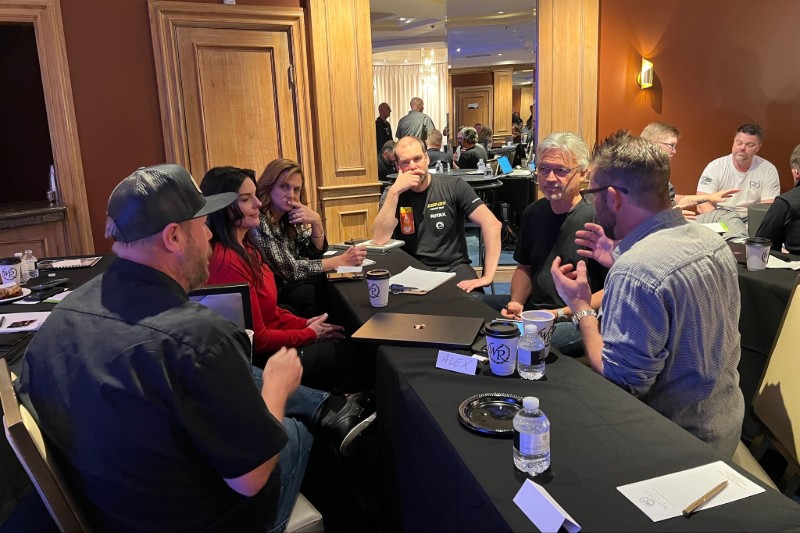
As fun as it is, American off-road racing is in a bad spot. Those in the industry aren’t blind to this either, and the increasing concerns reached the point where a contingent of series promoters convened in Las Vegas on Monday to discuss how to “unify the tribes of off-road racing.”
Organized by Ultra4 promoter Hammerking Productions, among those in attendance were the heads of Best In The Desert, SNORE, Legacy Racing Association, and VORRA. Media members and representatives from OEMs and sponsors were also present.
“This powerhouse group also focused on long-term goals, including improving rules and classes to elevating marketing, sponsorships, and fan experiences, and how to protect and grow the sport for the future,” reads a statement from Hammerking Productions. “The group had very productive discussions about youth engagement, sustainability, and building a stronger, more connected off-road racing community.”
Describing the American desert racing scene as “tribes” is apt. There are multiple series, all within the same regions, that offer relatively similar forms of racing. For example, BITD, VORRA, SNORE, and the Legacy Racing Association all compete in Nevada. While these series have collaborated on occasion, such as Legacy and VORRA for the Baja Nevada The Long Way, and do not forbid drivers from double dipping, it can be difficult for a competitor to figure out their schedule with so many races across different sanctioning bodies.
In Nevada alone, there were supposed to be three inaugural ultra-long desert races between April and June: Baja Nevada The Long Way, UNLTD’s Reno 600, and BITD’s Nevada 1000 Invitational. UNLTD and BITD ultimately canceled their events citing economic concerns as well as difficulty in securing commitments from teams, who are reluctant to do too many long-distance races in such a short span. Races elsewhere further compound the situation like NORRA’s Mexican 1000 and SCORE’s San Felipe 250, the latter being held on the same weekend as SNORE’s Battle at Primm.
While there are certainly other grievances to be made (like the absurd number of classes in a given series), many feel the borderline free-for-all nature is the biggest detriment. Even the issue of too many categories can overlap with this, such as a stock vehicle being legal for most rulebooks but not others.
At the same time, merging every series under a single organization can be risky if done improperly or by someone unqualified. Questionable leadership breeds discontent, which in turn leads to breakaways. Many point to how BITD had been the preeminent desert series in the U.S. before missteps placed the discipline in its current predicament. On the other hand, for its imperfections, SCORE’s role as the primary desert series in Baja California is generally regarded as a positive.
Austin Farmer, better known as FishGistics, did a livestream in early March about the situation and advocated for a person with funding and qualifications to purchase everything and “combine them into one big U.S. series.” Seth Quintero pointed to the World Rally-Raid Championship as a model for cohesively running a major off-road series, opining that he “completely understand(s) everyone trying to make a buck but it’s killing off-road racing.”
With that savior probably not arriving anytime soon, however, it is clear that something still has to be done lest the sport continues to spiral. Thus, the summit was held to ensure the aforementioned series can at least get on the same page and work together.
While not every problem was solved at the meeting, some progress was made on various fronts like Hammerking Productions acquiring the broadcast rights for SNORE races.
“This is just the beginning, and we have a lot of work to do, but the future of off-road racing is bright,” concluded Hammerking’s statement.
Featured image credit: King of the Hammers
 131 Off-Road
Leave a comment