It’s an odd-numbered year, which means the return of the Le Mans Classic to Circuit de la Sarthe. As the name suggests, it’s a vintage race and a throwback to days of yore for the world’s biggest sports car race.
While they’re obviously not competing, Le Mans also welcomed cars from the days of yore for the world’s biggest rally raid.
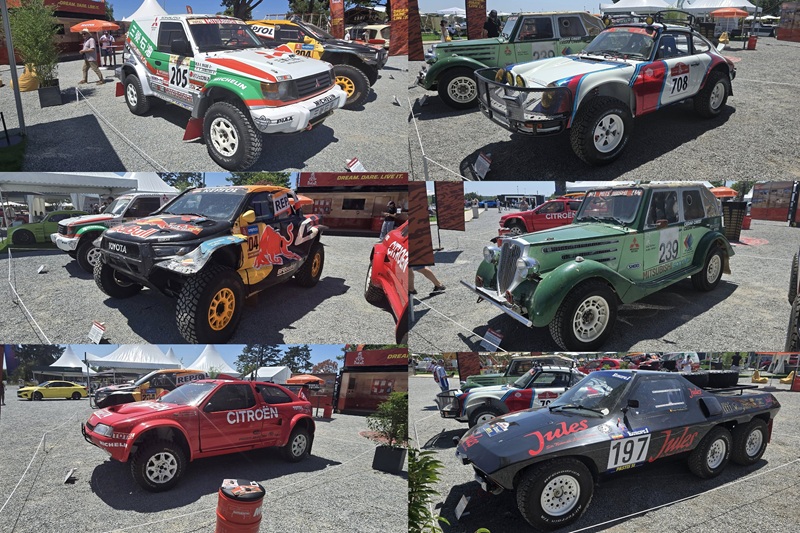
The ASO, in partnership with the ACO, set up an exhibit at the circuit’s partner village to promote the Dakar Rally. Six cars from the race’s history were present, four of which were among the top Dakar vehicles for their respective time and the other two are reflections of the rally’s occasional oddities.
The most recent car on display is the Toyota GR DKR Hilux of Seth Quintero. The only one to compete in a 2020s Dakar Rally, Quintero finished ninth overall at the latest edition in January and currently sits third in the World Rally-Raid Championship with it. Toyota Hiluxes have won the Dakar four times, including the latest albeit a model from Overdrive Racing rather than Toyota Gazoo Racing like Quintero’s.
Kenjiro Shinozuka’s 1997-winning Mitsubishi Pajero Type 2 was on hand too. Shinozuka, who passed away in 2024, was a longtime Mitsubishi factory driver who led a top four overall lockout for the Japanese manufacturer. 1997 was the first year in which the organizers barred prototype cars and turbocharged gas engines, prompting Mitsubishi to develop the production-based Pajero.
Before Shinozuka and Mitsubishi snapped its reign, the Citroën ZX Rallye Raid was the darling of the early 1990s rally world. The line won 36 of 42 races including the 1993 drivers’ and manufacturers’ titles in the FIA World Cup courtesy of Pierre Lartigue, who also claimed the 1994 through 1996 Dakar Rallies for Citroën.
While the Pajero was a Dakar legend, Mitsubishi also had the very strange PX33. The original Mitsubishi PX33 was developed for use by the Imperial Japanese government in the 1930s but never made it into actual production save for a few prototypes. Five decades later, French company SBM developed a replica PX33 using the guts of a Pajero and a turbo gasoline engine from a Mitsubishi Starion. Another PX33 was eventually built by Faster using the SBM blueprint. The PX33 rally version would make its Dakar debut in 1989 with Jean-Pierre Jaussaud, and other drivers that followed included Ukio Katayama, Keiji Yokokawa, and Étienne Smulevici throughout the ’90s. It was eventually retired and sat in a Tokyo garage before being recovered and brought to France in August 2023.
Also from the weird bin was Jules II Proto. It is a six-wheeled car built by Thierry de Montcorgé for the 1984 race, a sequel to the Rolls-Royce Corniche (itself an oddity) he ran in 1981. Jules II was eventually acquired by Pieter Peerlings’ Sir Norman Lewis Racing Team, and is technically still an active race car since it entered the Morocco Desert Challenge in April.
Dakar Classic team Nantes Prestige Autos brought a Porsche 911 Safari that Puck and Sebastiaan Klaassen raced in the 2024 Classic to a 50th overall. It features a Martini Racing livery, for which it was nicknamed the Porsche Martiny.
The cars will remain on display through Sunday.
Featured image credit: Bernard Cayre
 131 Off-Road
Leave a comment