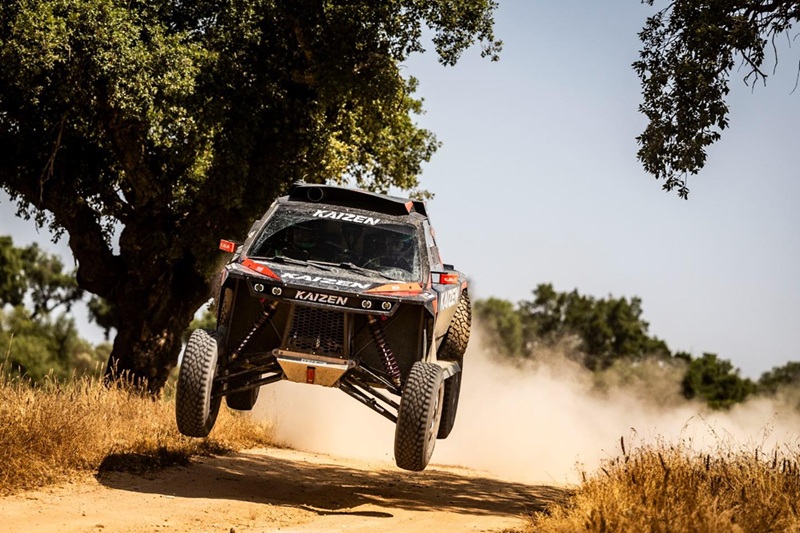
Cattiva Sport’s Kaizen is the newest face in the Challenger category, set to debut in this weekend’s Baja Aragón with Ricardo Porém behind the wheel. The car was unveiled last Friday.
“Built for the Challenger category, the Kaizen redefines performance with precision,” proclaims the Kaizen website. “Featuring a perfect 50/50 weight distribution and a modular full carbon fibre body, it delivers unmatched balance, agility, and strength on every turn. Its FIA-certified roll cage meets the highest safety standards, while the quick-swap modular architecture ensures maximum adaptability and uptime.
“Designed with Challenger performance and ultimate driver comfort in mind, Kaizen isn’t just a race car — it’s a competitive evolution.”
The Kaizen is powered by a one-liter Volkswagen turbocharged engine that produces 182 cv (roughly 179.43 hp). The drivetrain features a six-speed sequential transmission from SADEV or 3MO, a Motec ECU, and a Tilton twin-disc clutch. AP Racing supplied ventilated brake discs and piston calipers for all four wheels. It features a double wishbone suspenson and Reiger Suspension dampers, electronics from AiM, and 32-inch forged aluminum wheels courtesy of BRAID Wheels.
The 135-liter fuel tank is custom built but complies with FIA regulation and is situated at the center and low within the chassis. This lowers the center of gravity and allows for the aforementioned even weight distribution regardless of fuel level.
Surrounding the internals is a tubular frame made from 25CrMo4 (chromium-molybdenum alloy steel). It uses a fully carbon fiber body constructed from multiple smaller pieces that can be swapped out when damaged.
All cars come as produced without add-ons. Cattiva Sport will also provide full spare parts when needed.
“Kaizen was designed not only to perform, but to endure,” continues a statement. “All key components — from drivetrain to suspension — are built with longevity in mind and tested under extreme conditions. Parts are engineered for extended operational life and selected for their cost-effective replacement, keeping running costs low across the entire race season. More time on the track, less time in the workshop. Performance that’s smart on the budget.”
The use of a Volkswagen motor is a change from Cattiva’s previous prototypes that compete in the Ultimate class, which were based on Mercedes-Benz cars.
 131 Off-Road
Leave a comment