
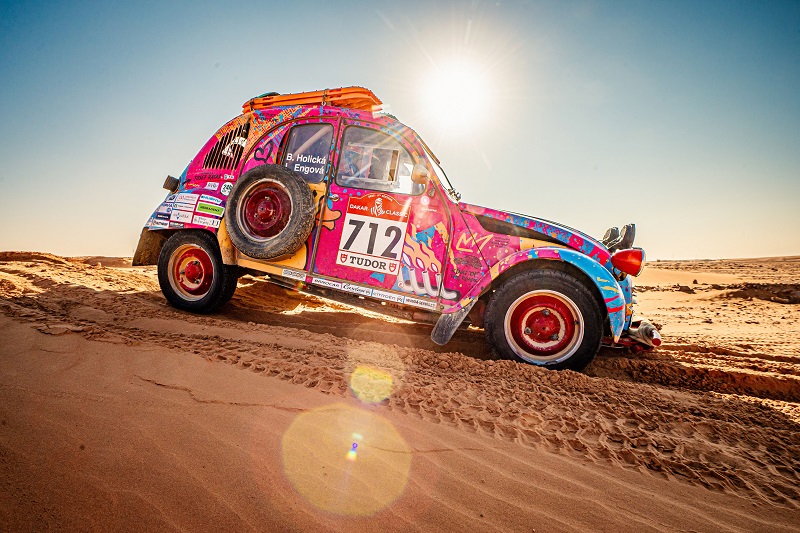
The beloved “Duckar” Citroën 2CV Sahara of Barbora Holická and Lucie Engová will not be at the Dakar Classic in 2026, citing budget and wanting to take the year off to better develop the car for 2027.
“We go to our usual jobs. After work, there isn’t much time left for other activities needed to prepare for Dakar,” Holická explained. “I have to basically divide the rest of the day between the workshop and meetings with partners we can’t operate without, physical training, creating content for social media, projects related with the Duckar team, meeting fans, preparing events where we appear, running the merch e-shop, and so on. There’s very little time left for other important things like rest and family. Without that, and without our partners who constantly help and support us, it isn’t possible.”
The duo made their debut in 2024, where they finished 36th overall in a 1979 2CV; they became the first 2CV to complete the Dakar, whether the Rally or the Classic. For 2025, the team upgraded to a 2CV Sahara, a rare off-road model that had two 12-horsepower 425cc engines.
They endured a challenging start to the race as they were plagued by flat tires and clutch issues. In Stage 3, the rear axle broke and they had to wait for fellow competitor Jan Barta to tow them, only for his Mitsubishi Pajero to run out of gas so they siphoned some from the Citroën. The Duckar ultimately placed 66th overall and fourth in H1.A.
“Duckar” is the name of the team because it doubles as a philanthropic project to help raise ducks at Safari Park Dvůr Králové. With its colorful liveries and unique model, it became a bit of a fan favorite domestically in the Czech Republic and overseas. Sebastian Fiala, a student at the Filmová akademie Miroslava Ondříčka film school, also plans to make a documentary about the team.
Despite its popularity, they need the time to work on the car to make it competitive. It also doesn’t help the CZech Samurais, who prepped and fielded the 2CV, announced in October that they won’t be at Dakar either.
On the financial side, Holická pointed out the project is entirely funded out of everyone’s pockets, which are “not small amounts” apiece and that “even a million is a huge sum.” Of course, the hope is that more fan projects in 2026 can help offset the expenses.
“The car is practically fully functional at the moment, but we need to focus on the things that troubled us last season,” explained team lead engineer Tomáš Neruda. “One of the problems for the twin-engine car was sand in the rear clutch. The rear flywheel, the clutch plate, and pressure plate area are open, so the fine desert sand almost disabled the clutch on the rear engine every day. The girls had trouble reaching the bivouac after the sandy stages. We had to remove the rear engine practically every night and clean the clutch thoroughly. The exhaust also have to be redone to better dissipate heat and the clutch cable to the rear engine, which also hurt us several times this year, has to be rerouted. I want to play around with the chassis a bit and stabilize the suspension.
“Otherwise, the car is great. It handles perfectly, is fully functional, and drives in the Czech Republic without any problems. But we have to prepare for different conditions.”
Featured image credit: Rapha Rodrigues / FOTOP / ASO
 131 Off-Road
Leave a comment