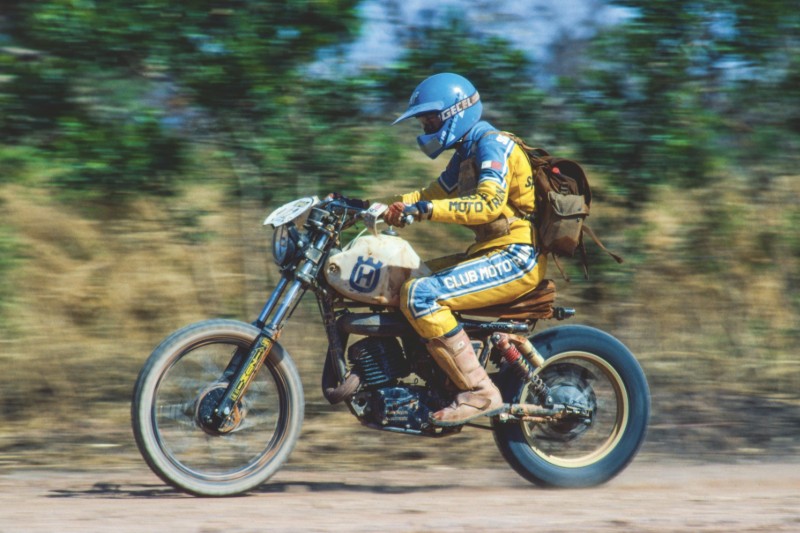
2026 seems to be the start of a new era. While vintage rally raids have been growing in popularity, the major events like the the Dakar Classic, Merzouga 1000 Classic and Pionniers Classic, and RallyClassics Africa currently do not allow motorcycles.
The Ouzina Challenge will be one in a triplet of races to have them in 2026 alongside the Hellas Rally Raid and the Morocco Desert Challenge. They aren’t ‘true’ historic rallies since all three have modern vehicles too, but are the first of their discipline to include old-school bikes. The MDC had introduced the Vintage Bike class for the 2025 edition, where Greg Gilson finished 14th overall on his 1980 Honda XLS 125. Gilson won’t race the Ouzina Challenge since it clashes with the Baja 1000, but he’s been active in promoting the race.
Thierry Delpino and Annie Floquet created the Ouzina Challenge, the former a Morocco resident while the latter frequently visits. The duo do historic stage rallies in a Renault Clio together with Delpino as driver and Floquet his navigator. Delpino runs Team MHM, a management agency, while Floquet’s Le Souffle O2 Rose is involved with philanthropic projects in the area.
Souad Mouktadiri and Thierry Charbonnier are the race’s godparents. Mouktadiri is the first Moroccan woman to run the Dakar Rally, finishing 20th in SSV at the 2025 edition; she’s closely involved with races that go through her home country like the Rallye du Maroc, Africa Eco Race, and Morocco Desert Challenge. Charbonnier competed in the Paris–Dakar Rally in the 1980s and ’90s, finishing as high as second in 1993 on a Yamaha Super Téneré YZE750; he later did the race as a navigator, placing 13th in a Bowler Wildcat with Patrick Antoniolli in 2005.
As the race name suggests, the Ouzina Challenge will be held in Morocco’s Ouzina Desert. It is split into two divisions, one for roadbook navigation and the other on GPS, each with five classes: C1 for men’s motorcycle riders, C2 for women’s motorcycle competitors, C3 of those on vintage motorcycles, C4 of mixed-gender and male-only SSV crews, and C5 is for female-exclusive SSV teams.
Vintage bikes must be built before 2000 and have an engine displacement of at least 125cc along with a minimum range of 125 kilometers. The modern bike and SSV classes permit all vehicles.
The rally begins on November 8 with technical inspection in the morning followed by a 30-km Prologue in the afternoon. Stage 1, roughly 230 km long, is on the 9th. The 10th offers a 200-km special stage, with a longer 230-km run on the 11th. November 12 wraps up the race with a 200-km SS.
Featured image credit: DPPI
 131 Off-Road
Leave a comment