The fifth stage was the first real test of the 2003 Telefónica–Dakar Rally. It took competitors from Tozeur in Tunisia to El Borma, Algeria, across 494 kilometers with 295 km being timed.
Fabrizio Meoni finished runner-up for the stage among bikes, just 17 seconds off Richard Sainct. By the end, Meoni would place third overall.
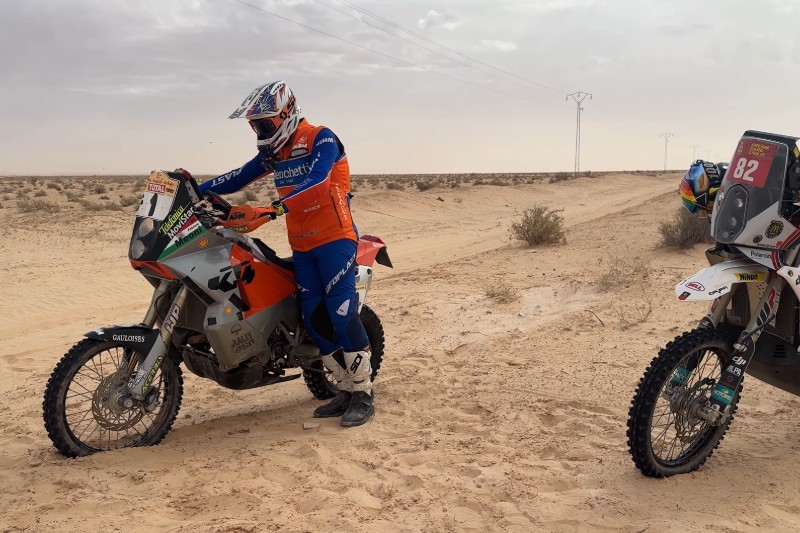
Nearly 23 years later, Gioele Meoni took his dad’s 2002 KTM 950 LC8 out to Tunisia to follow the route of that stage. He wasn’t alone on his trip as his friend Andrea “Andy” Winkler accompanied him on his KTM 450 Rally.
Both men have been keen to follow in their fathers’ footsteps. Fabrizio won the Dakar Rally twice before his passing in 2005, with Gioele making his debut in 2024 and finishing 32nd in Rally2. Winkler has done Dakar twice in 2022 and 2025, placing ninth in Malle Moto at the latter; Aldo Winkler was a Dakar regular in the 1980s before riding alongside his son at the 2022 race.
Besides his own racing career, Gioele often takes his father’s rally motorcycles out on expeditions. He’s gone out into the desert with bikes like Fabrizio’s Gauloises-sponsored KTM LC8 that he raced in 2003 and 2004, and in October tried out the KTM 500 2T that the older Meoni rode to victory at the 1990 Incas Rally.
The KTM 950 LC8 that Gioele brought with him to Tunisia is nicknamed the “Desert Empress”. Fabrizio won the 2002 Paris–Dakar on this bike before getting a new one with Team Gauloises for 2003. The Desert Empress had been put on display alongside Aldo’s 1989 Honda NX650 Dominator by the ASO at EICMA in November.
After retracing the course, Meoni and Winkler compared it to their experiences racing the Dakar in Saudi Arabia. The Dakar Rally was moved from its original Europe-to-Senegal route in 2009, well before either of them were old enough to try it. Neither have done the Africa Eco Race either.
“Sure, for some, it could really be considered a journey, an adventure. But the difference is that today, there’s so much variety each day yet paradoxically it’s monotonous,” Meoni opined. “Every day, there’s everything from sand, stones, uphill climbs, difficult curves, difficult descents, rocky terrain, mule tracks.
“In my opinion, the Paris–Dakar, as it was conceived and carried out in Africa, was a continuous evolution. Each stage was different from the previous one. When they were here in Tunisia, for example, they knew very well that this wasn’t the stage to try to make a difference; this was a transfer stage to set the rankings. The lengths were short, they took as few risks as possible, even though it was still very difficult, but they knew that they’d encounter the dunes, the most treacherous ones, further down the road. The impossible stages would come, so each stage was different from the others.
“Today’s race (in Saudi) is incredibly difficult compared to a stage like that, where you could practically do it on a moped. In today’s race, there isn’t a single stage you could do on a moped. I don’t think it exists. But overall, in my opinion, the Paris–Dakar had this evolution that truly added something extra to the race that today’s Dakar lacks.
“For riding technique in the Paris–Dakar, you really needed nerves of steel. In a stage like today’s, maybe those in the middle of the pack were calm, but those at the front who couldn’t afford to lose even a second. I mean, riding full throttle at 180 km/h, I really don’t know how they did it. I don’t know if one could have the courage to do that.”
THE REAL PARIS-DAKAR: I’M RIDING A STAGE ON THE WINNING MOTORCYCLE on YouTube
Featured image credit: Gioele Meoni
 131 Off-Road
Leave a comment