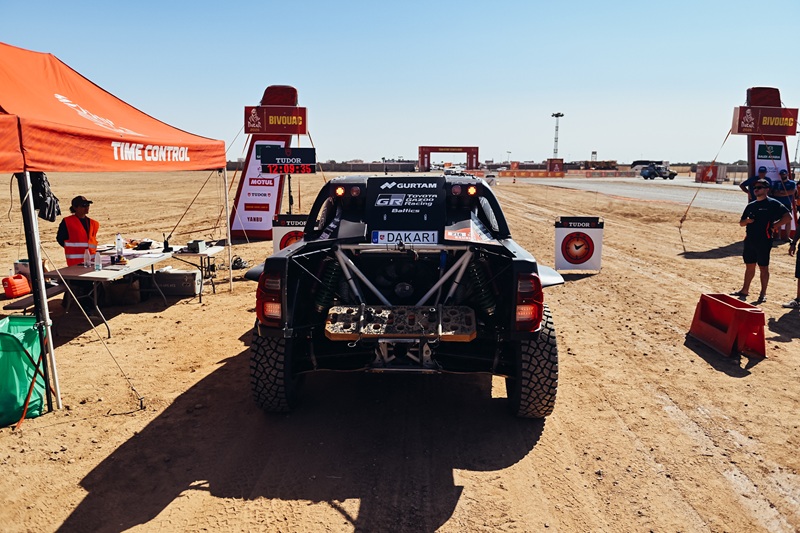
The Prologue is the shortest stage and isn’t counted in the final results for FIA, hence why the Dakar Rally is now the only race on the W2RC calendar with it. Even then, Benediktas Vanagas felt drivers were going way too fast on Saturday’s 22-kilometer leg, at a “suicidal” pace even.
“In the Prologue, you can’t win anything, but you can lose everything,” said Vanagas.
Daniel Schröder and Johan Kristoffersson unwittingly confirmed his comments when they both crashed.
Schröder was the day’s biggest loser by a wide margin as he rolled, suffering terminal damage that’s already knocked him out of the rally. An understandably frustrated Schröder called himself the “biggest, stupidest motherfucker around here” and kicked his upside-down Amarok upon exiting.
Kristoffersson’s Dakar debut got off to a similarly rough start when he ran through camel grass too quick, taking the wrong line and crashing. His Polaris suffered left front damage in the accident but the roll cage remained intact, ensuring he can race on Sunday.
Four drivers were busted for speeding, including three trucks. Karel Poslední did it so many times that he got 210 seconds added while Ben de Groot was slapped with 160 seconds for the same reason. Perhaps the most notable infraction was a 30-second penalty on twice defending Truck winner Martin Macík Jr., dropping him to 11th. Of course, these penalties won’t impact their final standing and instead just means they’ll have to start Stage 1 later.
Conversely, Bruno Saby quipped that when he “caught up with a competitor so quickly, I thought we were going too fast so I eased off the throttle.” The 1993 winner finished 25th for Challenger in his first Dakar action since 2007.
Besides high speeds, the Prologue was overshadowed by a myriad of tire problems that have plagued drivers since private testing. BFGoodrich brought its new KDR3 EVO 2.0 to Dakar, but it seemed to struggle in the rockier sections. Brian Baragwanath suffered two punctures in shakedown and even Vanagas himself—who plans to donate the tires to Ukrainian troops after the race—had one on Saturday, causing Baragwanath to get trapped in his dust while running behind him due to the lack of wind to blow it away. Henk Lategan was slowed by a flat of his own too.
Other issues were mechanical, incidentally affecting the speed limiter in some cases like François Cousin and Rebecca Busi. The former has experienced a strange Dakar to date that began when his windshield got cracked by a bird and needed to be replaced, then got 80 seconds added to his Prologue time for speeding. Nandu Jubany suffered an electrical issue that forced him to be towed back. Pim Klaassen ran out of gas halfway through because the pump had not been reset prior to fuel being put into his car.
After the stage, Olivier Pernaut received the first fine of the rally when his Maverick R was spotted without markings denoting the roll cage was reinforced. He was ordered to cough up €500.
Even riders weren’t entirely safe from trouble. Neels Theric’s Kove broke down twice with electrical issues, forcing him to push his bike to the finish and be nearly three hours behind the leaders. Unfortunately for the Frenchman, this leaves him in a massive hole because the FIM includes Prologue times in the overall. Tobias Ebster, the 2025 W2RC Rally2 runner-up, had a small crash but recovered to finish second in class.
At the front, Edgar Canet beat his teammate and defending winner Daniel Sanders by three seconds. It was a blazing start for the reigning Rally2 champion, who moved up to RallyGP for the 2026 season, as he became the youngest rider to win a Dakar bike stage at 20 years, 9 months, and 18 days.
“I’m super happy with the rhythm I had today,” said Canet. “I was 100 percent following the roadbook. I was braking before each danger point and avoiding risks. I was still able to go fast and it feels like the best way to start the rally.”
Mason Klein, the previous record holder at 21 years and 23 days, finished with the 19th fastest time for bikes and 12th in RallyGP in his first action with Hoto Motorcycle. His new Hoto teammate Martin Michek scored a top ten in class with a ninth.
While the Prologue is primarily used to set the starting order for the Rally, it has a second purpose for the Dakar Classic in helping organizers determine which category a car belongs in. Five vehicles—those piloted by Shammie Baridwan, Stéphane Debair, Henry Favre, Kim Matzen, and Lorenzo Traglio—were moved to new classes because their average speed was too fast or slow for their division or they were incorrectly entered.
All seven Mission 1000 entrants completed the mandatory 22 kilometers, with every Segway rider doing so in under 20 minutes to earn five extra bonus points apiece. Benjamin Pascual did it the fastest in 15:41, a minute and a half quicker than Yi Guanghui and 2:40 on Jie Yang. Twice defending winner Jordi Juvanteny had a flat that cost some time.
Stage winners
FIA
| Class | Overall | Number | Driver | Team | Total Time |
|---|---|---|---|---|---|
| Ultimate | 1 | 226 | Mattias Ekström | Ford Racing | 10:48.7 |
| Challenger | 50 | 310 | Paul Spierings | Rebellion Spierings | 12:31.9 |
| SSV | 61 | 401 | Brock Heger* | LOEB FrayMédia Motorsport | 12:47.0 |
| Stock | 34 | 504 | Sara Price | Defender Rally | 12:03.7 |
| Truck | 80 | 601 | Mitchel van den Brink* | Eurol Rally Sport | 13:05.4 |
FIM
| Class | Overall | Number | Rider | Team | Total Time |
|---|---|---|---|---|---|
| RallyGP | 1 | 73 | Edgar Canet | Red Bull KTM Factory Racing | 11:31.9 |
| Rally2 | 6 | 14 | Michael Docherty | BAS World KTM Racing Team | 11:50.1 |
Other
| Class | Number | Competitor | Team | Points |
|---|---|---|---|---|
| Classic | 723 | Francesco Pece* | Tecnosport Rally | 3 |
| Mission 1000 | 1000 1001 1002 | Benjamin Pascual* Jie Yang* Yi Guanghui* | Segway Racing Segway Racing Segway Racing | 15 |
Featured image credit: Vytautas Pilkauskas
 131 Off-Road
Leave a comment