Since 2014, the Stock category at the Dakar Rally has been basically a glorified test ground for Team Land Cruiser Toyota Auto Body. A lack of competition meant the Japanese T2 team was often the only serious entrant in the class, so Akira Miura and Ronald Basso’s opposition were mainly just each other to an extent and the elements of the Saudi desert. As a result, TLC entered 2026 riding a 12-race win streak at Dakar.
That changed for 2026 as the FIA introduced new regulations to the class, leading to its induction into the World Rally-Raid Championship and encouraging more manufacturers to join. This year’s Dakar therefore saw one of the largest Stock fields with seven cars—certainly not as stacked as the other FIA classes, but still bigger than in Dakars past.
Besides Miura and Basso were a pair of privateers whose cars complied with the old T2.1 regulation and had frankly little likelihood of competing compared to the factory-based Toyota Auto Body and Defender Rally. The latter posed by far the biggest threat to Toyota’s reign with their star-studded trio of Rokas Baciuška, Sara Price, and the venerable Stéphane Peterhansel, though TLC wasn’t going to go down without a fight.
Defender Rally was understandably the betting favorite. They boasted a highly decorated driver lineup and immense manufacturer backing to build the Defender Dakar D7X‑R, and would’ve been the fastest T2 cars at their debut in the Dubai International Baja last November had they not been classified as Experimental vehicles.
As if to prove their point, Defender proceeded to win the Prologue and all 13 stages. Baciuška led the way with seven wins while Price and Peterhansel had three apiece.
“We believe we did our best, but our rivals built even better cars,” TLC manager Yuji Kakutani commented.
The Land Cruiser 300 GR Sport VJA300L tried to hang with its stronger rival, which proved to be more challenging than TLC would like. While Basso was the only driver to not lose Stage 1 by 10+ minutes when he finished seven minutes behind Baciuška, Miura struggled with tire punctures. Miura then lost his brake assists in Stage 2 before the drivetrain broke 350 kilometers into the third leg, causing him to finish over four and a half hours behind Peterhansel.
Miura’s drivetrain failed again 156 km into Stage 5, effectively ending his hopes of defending his title as he had to retire for the day. He rejoined the race for Stage 6, only to suffer an intercooler failure on a hard landing. Now out of contention, his role became to support Basso should he run into trouble.
Basso was left to fend for himself in the overall after Miura’s exit, but his hopes took a hit in Stage 6 due to steering issues. The problem persisted after the rest day as he tried to fight his Land Cruiser around, only to clip a tree in Stage 7 and struggle in the Stage 10 dune sections.
As the margin between them and the Defenders grew, it became obvious TLC’s new goal was just to complete the race barring disaster striking their adversary. As luck would have it, Basso—still having a hard time with the steering—was slapped with a 45-minute penalty in Stage 12 for missing a waypoint in the dunes while Miura bowed out because of problems with the oil system.
The team managed to get their issues resolved just enough to start the final day, quietly finishing behind all three Defenders. Despite everything, Basso managed to bring home a third-place run ahead of Peterhansel, who fell behind due to mechanical issues in Stage 8.
“I’m happy we were able to keep the Defenders from dominating the podium,” said Basso. “The new rally car has better performance and is easier to drive, and although we had some steering trouble, we were able to reach the finish line without having to stop the car. I’m very satisfied.”
Miura had to settle for a distant fifth. Dakar was his last race with TLC before moving up to Toyota Gazoo Racing and the Ultimate class for the rest of the season.
“To be honest, I’m very disappointed with the result,” he stated. “But when times got tough, the cheers of our fans gave the whole team strength. I’m grateful for their support.
“I’m sad that this will be my last time racing with TLC, a team that has been kind to me for 20 years, since my time as a navigator. It’s thanks to this team that I’ve learned to want to aim higher, so I’m determined to keep working hard in my future endeavors.”
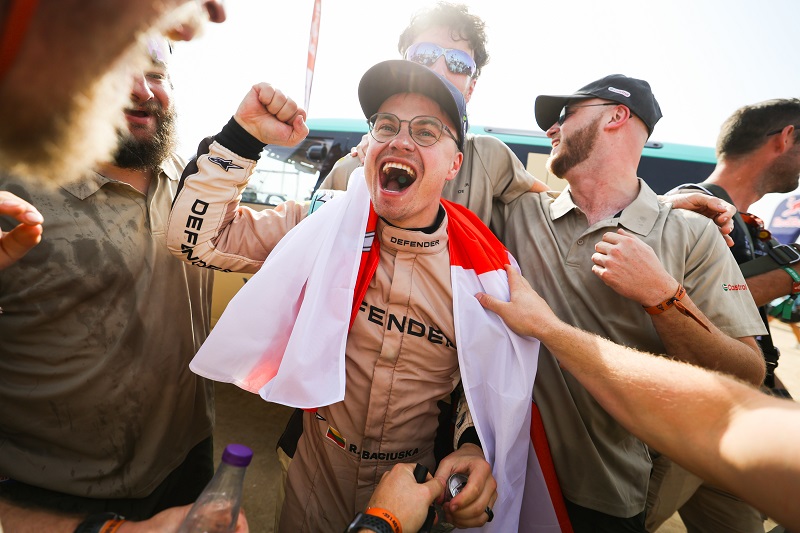
Baciuška became the first driver to win a stage in every major FIA class (Truck stopped awarding a W2RC trophy after 2023). Price finished nearly four hours back. Interestingly, Baciuška isn’t the only Lithuanian to win in a Land Cruiser this year as Karolis Raišys topped the Dakar Classic in his much older 1978 Land Rover 109 Series III.
“Dreams come true, and it was my dream to win Dakar,” said Baciuška. “For the first year for Defender, it’s amazing. Our mechanics did a great job; what they do is unbelievable, working every day until early in the morning to prepare the cars for the next stage. I give my thanks to them, the engineers, the entire team because without them, we would not be here. It’s great to be P1 and P2.”
Peter Hamza and Majed Al-Thunayyan rounded out the order in their Nissan Patrols. Of course, neither stood a chance against Defender and Toyota. For a vehicle comparison, Hamza noted he built his Patrol from the remains of two wrecked cars out of his workshop of about five people. Even with the equipment disparity, they were glad to reach the finish.
“A smile carries the power of perseverance,” Hamza remarked.
Results
| Finish | Overall | Number | Driver | Navigator | Team | Class | Total Time | Margin |
|---|---|---|---|---|---|---|---|---|
| 1 | 51 | 502 | Rokas Baciuška | Oriol Vidal | Defender Rally | STK | 58:09:45 | Leader |
| 2 | 65 | 504 | Sara Price | Sean Berriman | Defender Rally | STK | 62:07:45 | + 3:58:00 |
| 3 | 88 | 503 | Ronald Basso | Julien Ménard | Team Land Cruiser Toyota Auto Body | STK | 66:44:14 | + 8:34:29 |
| 4 | 121 | 500 | Stéphane Peterhansel | Michaël Metge | Defender Rally | STK | 96:25:55 | + 38:16:10 |
| 5 | 133 | 501 | Akira Miura | Jean-Michel Polato | Team Land Cruiser Toyota Auto Body | STK | 145:52:44 | + 87:42:59 |
| 6 | 147 | 505 | Peter Hamza* | Andras Kalmar | Tireman Racing | T2.1 | 201:13:11 | + 43:03:26 |
| 7 | 152 | 507 | Majed Al-Thunayyan* | Hani Al-Noumesi | Torq | T2.1 | 267:22:02 | + 9:12:17 |
Stage winners
| Stage | Overall | Driver | Total Time |
|---|---|---|---|
| Prologue | 34 | Sara Price | 12:03.7 |
| Stage 1 | 107 | Rokas Baciuška | 4:04:59 |
| Stage 2 | 73 | Sara Price | 4:57:33 |
| Stage 3 | 66 | Stéphane Peterhansel | 4:59:07 |
| Stage 4 | 53 | Stéphane Peterhansel | 5:52:38 |
| Stage 5 | 61 | Rokas Baciuška | 4:29:32 |
| Stage 6 | 72 | Sara Price | 4:32:10 |
| Stage 7 | 34 | Stéphane Peterhansel | 4:20:29 |
| Stage 8 | 54 | Rokas Baciuška | 5:06:26 |
| Stage 9 | 52 | Rokas Baciuška | 4:36:24 |
| Stage 10 | 78 | Rokas Baciuška | 6:09:01 |
| Stage 11 | 62 | Rokas Baciuška | 3:28:30 |
| Stage 12 | 71 | Sara Price | 4:17:35 |
| Stage 13 | 52 | Rokas Baciuška | 55:51 |
Featured image credit: Antonin Vincent / DPPI / ASO
 131 Off-Road
Leave a comment