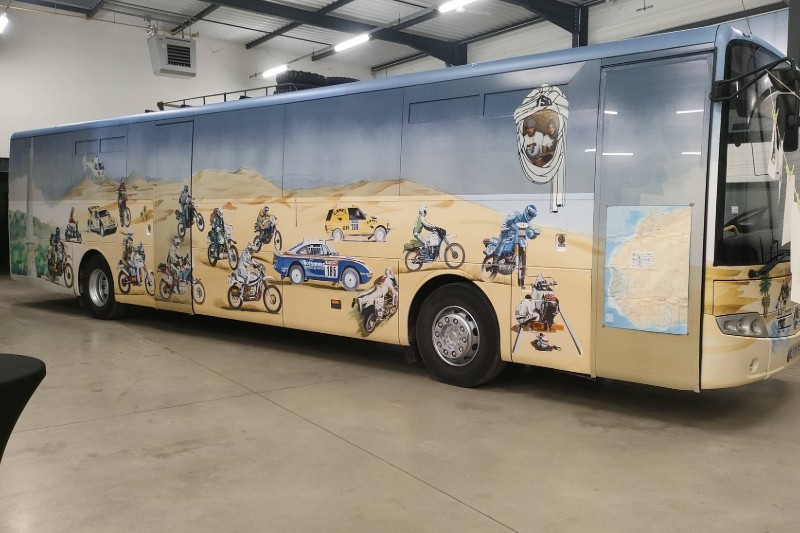
Marc Joineau was one of the Dakar Rally’s early pioneers, racing a motorcycle for much of the 1980s and nearly winning in 1983. For the Africa Eco Race, he is paying tribute to his peers from years past with a bus that will serve as his team’s mobile command center.
It features a livery hand-drawn by Alain Mirgalet depicting competitors, both riders and drivers, from the first decade of the Paris–Dakar. Joineau himself is also represented with the prototype buggy he built and raced to a 50th-place run in 1988.
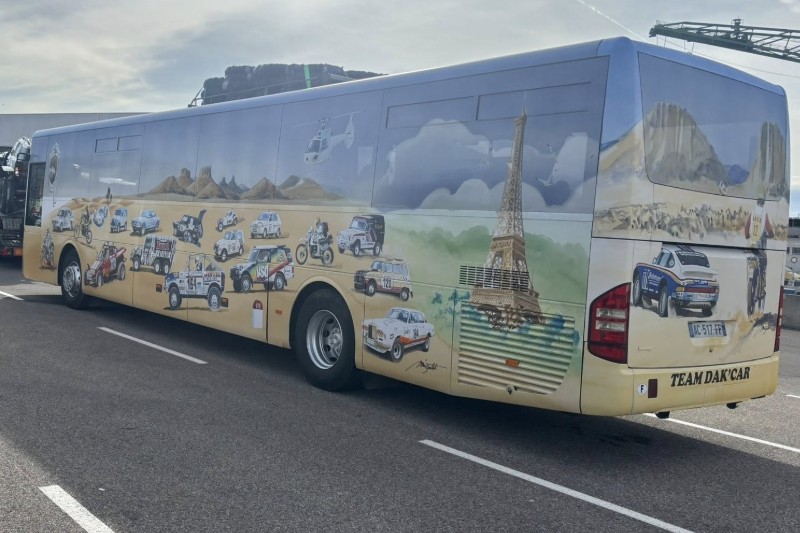
The background of the livery starts in Paris at the back, with the left side displaying the Eiffel Tower and the right having the Luxor Obelisk at the Place de la Concorde, and continues through with scenery of the African desert. The latter particularly has a shot of Mount Hombori in Mali. There is also an emblem of race founder Thierry Sabine and his wife Diane.
While cars and bikes are on both sides, the left side of the bus primarily focuses on the former whereas the right mostly has the latter.
Vehicles include the Claude and Bernard Marreau’s Renault 4 that finished third in 1980, Jacques Neveu’s Range Rover V8 (30th in 1982), Jochen Mass’ Mercedes-Benz 500 SLC (62nd in 1984), Pierre Lartigue’s Range Rover (third in 1983) and Lada Niva (fourth in 1986), the six-wheeled Mercedes 280 GE that Gérard Planson drove in 1985, and Patrick Tambay’s Range Rover (third in 1988). “Jules”, Thierry de Montcorgé’s Rolls-Royce Corniche that competed in 1981, is also present.
Four of the cars shown won the Dakar: René Metge’s Range Rover V8 in 1981 and Porsche 959 in 1986, Patrick Zaniroli’s Mitsubishi Pajero in 1985, and Ari Vatanen’s Peugeot 205 Turbo in 1987. Incidentally, Metge’s children Jonathan and Élodie are set to compete in the Africa Eco Race’s Historic class with a replica of that Range Rover; they had considered doing the AER with a car based on their dad’s 1986 winner but switched to ’81 since the Range Rover was cheaper to build.
Amid the bikes, there’s even Marc Simonot’s Vespa P200E scooter that competed in 1980.
“It gives a somewhat vintage, nostalgic image that resonates with many people,” team member Bruno Derossi commented at the reveal. “It’s the first time such a giant vehicle will be at the race.”
Derossi, Joineau, and Noa Sainct will compete in the Africa Eco Race as Team DAK’CAR. Sainct is the son of Richard Sainct, who won the Dakar three times in the early 2000s.
Joineau, who last ran the AER in 2020, has been keen about honoring the Paris–Dakar era including his own career. He chose #59 since it was one of the few remaining numbers and was what he had at the 1982 Dakar. The 68-year-old even plans to camp in the Suzuki France tent he used at the time.
“The idea is to retrace the route as it was in Thierry Sabine’s time,” Joineau explained to Le Bien Public. “I did my first Paris–Dakar with him in 1980, and then all the ones that followed. This is a way to pay tribute to him and have one last adventure with my friends.”
Featured image credit: Marc Joineau
 131 Off-Road
Leave a comment