Skeleton racer Vladyslav Heraskevych has been the subject of controversy after being disqualified from the Winter Olympics for wanting to wear a helmet commemorating 24 of his fellow Ukrainian athletes who were killed in the Russian invasion of their country.
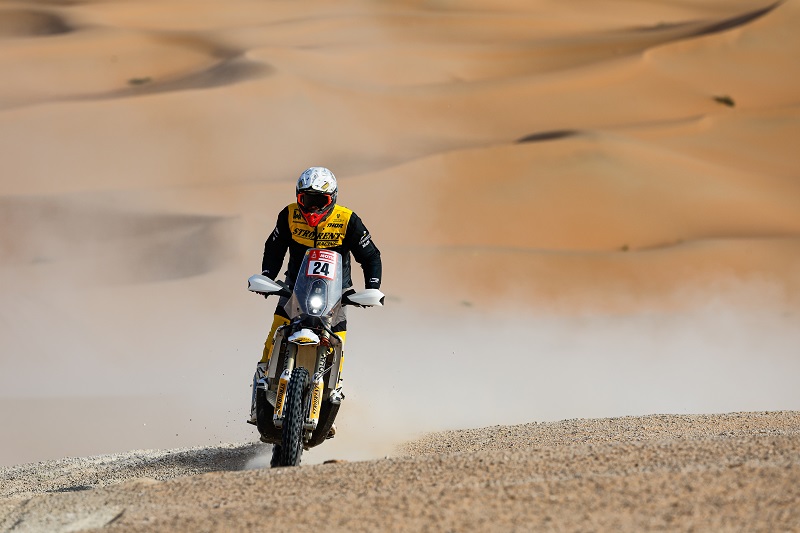
Jan Brabec, a Dakar Rally veteran who’s raced with helmets honoring Czech pilots during World War II, finds it ludicrous.
“I fully stand with the Ukrainian athlete at the Winter Olympics who wore the faces of war victims on his helmet,” wrote Brabec in an Instagram Story. “I did the same, although only with names at Dakar 2024 in honor of Czech fallen pilots. I disagree with his disqualification. War is a bitch.”
The last sentence in its original Czech is “Válka je svině”, which literally means “War is swine”. Besides the dictionary meaning of a pig, “swine” is slang for a bad person similar to “bitch”, “bastard”, or “motherfucker” in English.
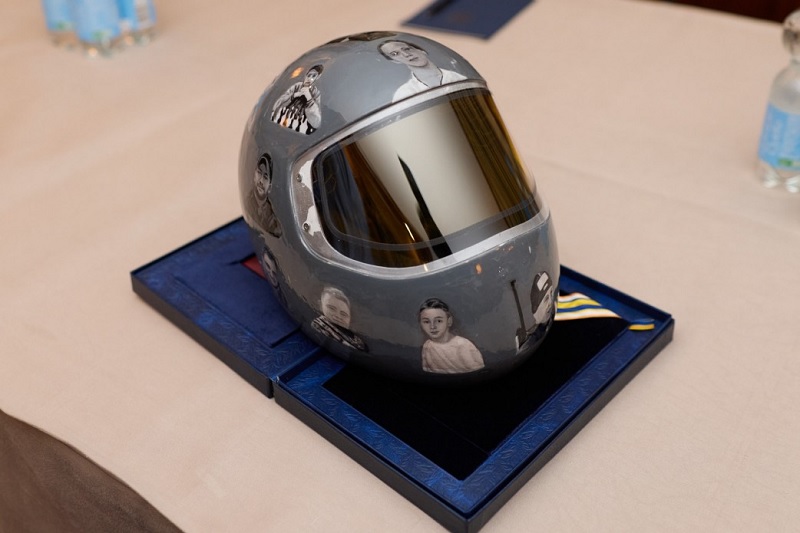
Credit: Office of the President of Ukraine
Heraskevych and the IOC had been going back and forth regarding his helmet since he wore it in training before the first skeleton races last Thursday. The committee stated the design violates Rule 50.2 of the Olympic Charter, which stipulates that “no kind of demonstration or political, religious or racial propaganda is permitted in any Olympic sites, venues or other areas.” He wasn’t the only Ukrainian affected by this either as Kateryna Kotsar and Oleh Handei were ordered to change their equipment decals for containing purportedly political phrases.
In turn, he pointed out the helmet doesn’t mention the war and shouldn’t be any different from writing the names of a recently deceased loved one. While some depicted were soldiers killed in action, others were civilians who died in Russian attacks.
The committee offered to let him wear a black armband instead, which he thought was a comparatively empty and vague gesture. With no resolution by Thursday, a jury at the International Bobsleigh and Skeleton Federation voted to disqualify him under Rule 40.2: “All competitors, team officials or other team personnel in the Olympic Games shall enjoy freedom of expression in keeping with the Olympic values and the Fundamental Principles of Olympism, and in accordance with the Guidelines determined by the IOC Executive Board.”
His appeal to the Court of Arbitration for Sport was also denied.
The verdict drew widespread condemnation. Supporters claimed a double standard because other tributes like American figure skater Maxim Naumov holding a picture of his late parents who died in a plane crash following his performance and Israeli skeleton racer Jared Firestone’s kippah for the opening ceremony with names of the 11 Israelis killed in the 1972 Olympic massacre were permitted. The IOC rejected the former example, which Heraskevych explicitly raised in his argument (while still praising Naumov for the “beautiful tribute”), since it happened outside of competition. On the other hand, they had also told Team Haiti to remove an icon of Toussaint Louverture from their opening ceremony uniform.
Ukrainian Olympians protested by writing slogans of solidarity on their gear or raising their helmets. The phrase “Remembrance is not a violation” would be adopted by his peers and even Ukrainian troops on the frontlines—including the General Staff of the AFU—to show their support. President Volodymyr Zelenskyy met Heraskevych and his father Mykhailo, who coaches the country’s skeleton team, in Munich and awarded him the Order of Freedom.
While certainly frustrated by the outcome and knowing his Olympic window has likely shut, Heraskevych acknowledged that turning the public sentiment against the IOC’s ruling is as powerful as if he had been allowed to race.
“Most importantly, the whole world is now truly talking about the athletes depicted on this helmet,” said Heraskevych in his meeting with Zelenskyy. “Despite their deaths, they are now drawing attention to Ukraine. They are rallying support for Ukraine. That is truly something very special.”
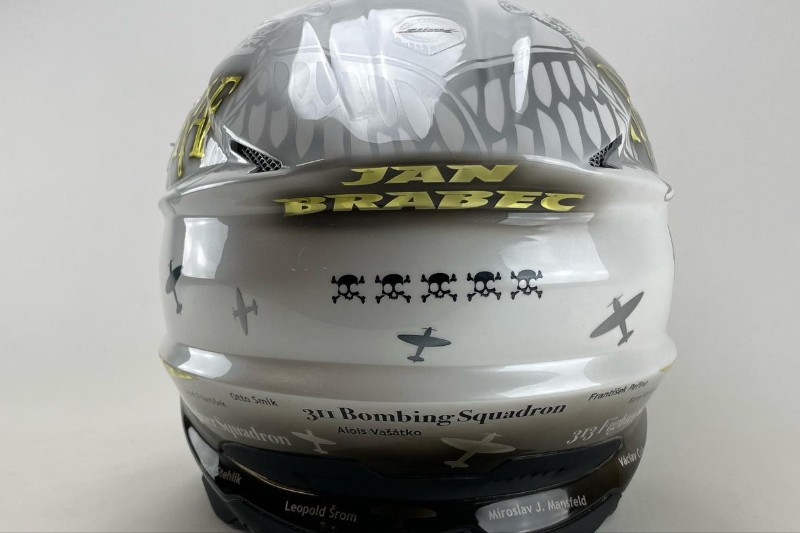
Credit: Petr Šimák / Slim Grafix
Brabec quickly found parallels between Heraskevych’s helmet and his own, particularly the one he used in 2023. It pays tribute to the four Czechoslovak squadrons—310, 311, 312, and 313—of the Royal Air Force during the Second World War.
On the back are the names of 11 pilots: Václav Cukr, František Fajtl, Josef František, Otmar Kučera, Karel Kuttelwascher, Miroslav Mansfeld, František Peřina, Otto Smik, Leopold Šrom, Josef Stehlík, and Alois Vašátko.
Only three of the group died in the war, but they all followed similar paths by fleeing the Nazi occupation of Czechoslovakia to France (where they flew for the Foreign Legion or Armée de l’Air until the country fell) or the United Kingdom to join the RAF. The airmen then saw action in the Battle of Britain and various cross-Channel operations for the RAF, and some eventually supported the failed Slovak National Uprising and the Soviet Air Forces in the Eastern Front. Those who survived the war returned home, only to be persecuted by the new communist regime since their Royal Air service raised suspicion of being Western spies; they were eventually rehabilitated, either by the military in the 1960s or after the Czechoslovak Socialist Republic fell in 1990.
- Cukr, a former auto mechanic, was with the No. 310 Czechoslovak Squadron that flew in the Battle of Britain. He was a flight instructor afterward until he suffered serious injuries in a crash that sidelined him until war’s end. Upon returning home, Cukr worked as secretary of a union for fellow ex-Czechoslovak pilots. After the rise of the Czechoslovak Socialist Republic, he fled to New Zealand and lived there for the rest of his life. Cukr passed away just a month before the Velvet Revolution.
- After France fell, Fajtl was a pilot officer in the RAF’s No. 1 and 17 Squadrons before being assigned to 313. He then flew for No. 122 before being shot down over occupied France in 1942, where he tried to escape but was eventually captured in Spain. Upon release, he rejoined No. 313 and subsequently flew for the Slovak Uprising. When Czechoslovakia fell under communist rule, Fajtl was arrested and spent over a year in a labor camp. He was rehabilitated after the Cold War and died in 2006.
- František was one of the Luftwaffe’s worst nightmares in the defense of Britain. He racked up 28 kills, the most of any non-British RAF pilot, for the Polish-centric No. 303 Squadron, contributing to the unit’s leading 75 victories. Tragically, he died when his Hurricane crashed just before Germany ended its air raids.
- When Germany took over Czechoslovakia, Kučera was already a fighter pilot for about a year. He escaped to France and linked up with their air force until the Germans took that too, leaving him moving again to the RAF. He flew Hurricanes for No. 111 Squadron before joining 313, seeing combat success until becoming a liaison in 1944. He remained in the Czechoslovak Air Force until the communist rise, after which he lost his livelihood and rank. Rehabilitation came in 1963, and he passed with his deserved honors in 1995.
- Kuttelwascher initially flew for the French before they also fell to Nazi control, after which he joined the RAF. He was part the lead No. 1 Squadron, fighting in Britain and over the English Channel until 1942. The rest of the war was spent in a training and recruiting role. He died in 1956.
- Mansfeld was a nighttime fighter and reconnaissance pilot for Czechoslavkia until the takeover, after which he flew with the French and British with roughly the same responsibilities. He was posted to the No. 111 Squadron and eventually commissioned as an officer. When the Germans started deploying the V-1 flying bomb, Mansfeld was tasked with taking them down before they hit British targets in his de Havilland DH.98 Mosquito. After the war, he was in the Ministry of Defense before fleeing to Germany and Britain after the rise of the communists. Even after the end of communism and he was politically rehabilitated, he remained in England until his death in 1991.
- A decade-long Czechoslovak Air Force pilot before the war, Peřina joined the French and participated in the ill-fated defense from German invasion. After France fell, he went to Britain and served in the No. 312. After recording 12 kills, he became a gunnery officer for the rest of the war. Peřina returned to the West once the communists took power, and wouldn’t come home until they were ousted in the ’90s. He retired as a general after rehabilitation and lived until 2006.
- After his attempt to fly for France didn’t work out, Smik bounced between various RAF units because of his lack of combat record. Eventually, he got his chance with the No. 122 Squadron. Smik went on to become a flying ace and later the commander of the No. 312. He was shot down and killed in a 1944 recon mission over the occupied Netherlands.
- Šrom and his fellow Czechoslovaks wanted to fight for Poland against the Germans but were turned away, so they served in the French Foreign Legion until that country collapsed. From there, he was off to Britain and flew in the Belfast-based No. 245 Squadron before being assigned to the No. 310. He bounced between being a flight instructor and bombing tours until he was recruited to help the Slovak National Uprising. Although that failed, he stayed in the east as part of the Soviet Air Forces. Despite his contributions on the Eastern Front, he was also among those arrested by the new communist Czechoslovak government. Šrom was eventually released but couldn’t find much work, later becoming a civilian pilot for Czechoslovak Airlines. He died in when his cargo plane crashed in 1968.
- Stehlík proved to be a capable pilot for the Armée de l’Air until the fall of France, after which he joined in the escape to Britain. In the RAF, he was assigned to No. 312 and saw success over Britain and France. He later worked as an instructor, training those like Smik, then supported the Slovak Uprising and the Soviet Air Forces. In the post-war years, he lost his rank under the new regime and struggled to find a new life before being rehabiliated and his rank restored. Stehlík passed in 1991.
- Vašátko was a schoolteacher-turned-artilleryman-turned-pilot, earning his wings just in time for the start of the Second World War. He was one of the top aces in the Battle of France before heading across the Channel, working alongside Stehlík in the same flight. Although Vašátko continued to take down enemy fighters in the Battle of Britain at the same clip as in France, his Spitfire crashed with a German interceptor over the sea in 1942.
A military history buff and recreational pilot, Brabec was the bivouac’s walking encyclopedia on the WW2-era RAF and the Czech airmen in its ranks. He is a member of the RAF Memorial Flight Club, has a collection of wartime memorabilia related to the branch, and ran an Instagram profile called Warwaves where he shared photos from the war and his items.
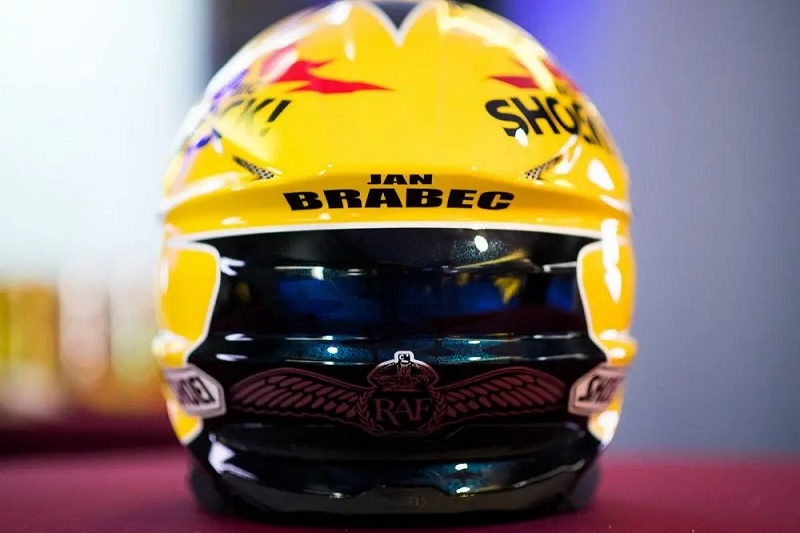
From his Dakar debut in 2018 until his last in 2025, each helmet had some sort of RAF nod. The tribute was fairly modest for his first three starts since his helmet was predominantly themed after Big Shock! Racing’s bright yellow imagery, though he worked in the winged crown emblem.
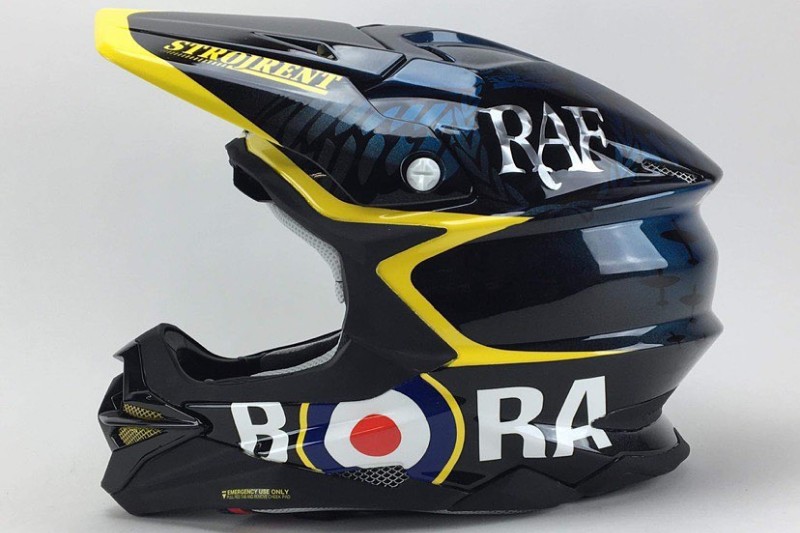
For 2021, upon leaving Martin Macík Jr.’s team to start Strojrent Racing, he commissioned Slim Grafix to create a new look. The helmet sported a navy blue color and included silhouettes of Spitfires, a cartoon skeleton with an aviator cap, and a Type A.2 roundel. The roundel was accompanied by the letters “B” and “RA”, a play on Brabec’s surname and the RAF squadron code that designated whom an individual plane was with. This would be the template used for most of his helmets since outside of the aforementioned 2023 Dakar.
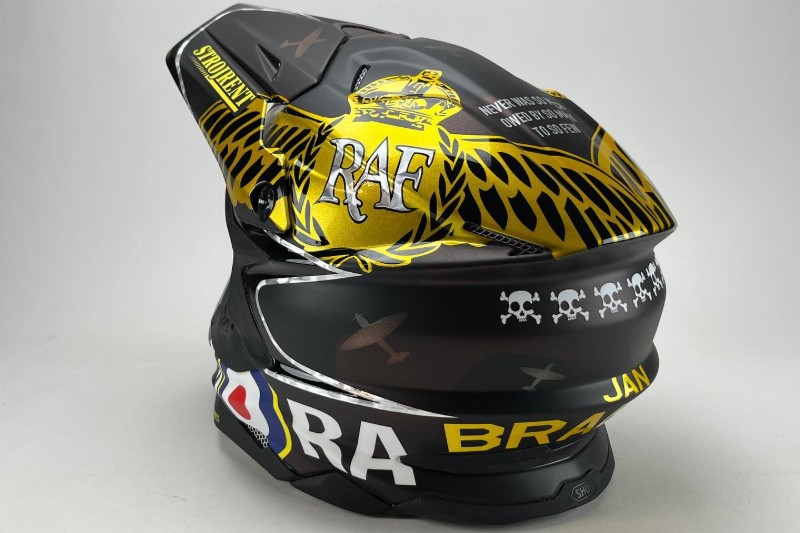
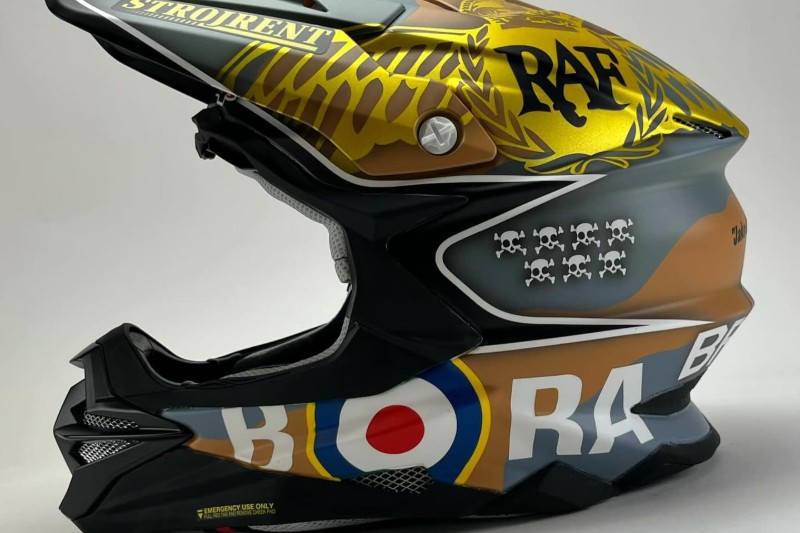
His final two Dakars in 2024 and 2025 retained the Type A.2 but also added skull-and-crossbones kill markings to denote his Dakar starts. The Winston Churchill quote “Never was so much owed by so many to so few” is prominently featured on the top of the 2024 headwear. The 2025 helmet, his last before retiring from racing, swapped out the black for bronze and included a photo of his son Honzik on the back.
He explained in 2019 that the helmets were his “mental talisman”.
Credit: Sport.cz
Credit: Petr Šimák / Slim Grafix
Credit: Petr Šimák / Slim Grafix
Credit: Petr Šimák / Slim Grafix
Featured image credit: Frédéric Le Floc’h / DPPI / ASO
 131 Off-Road
Leave a comment