
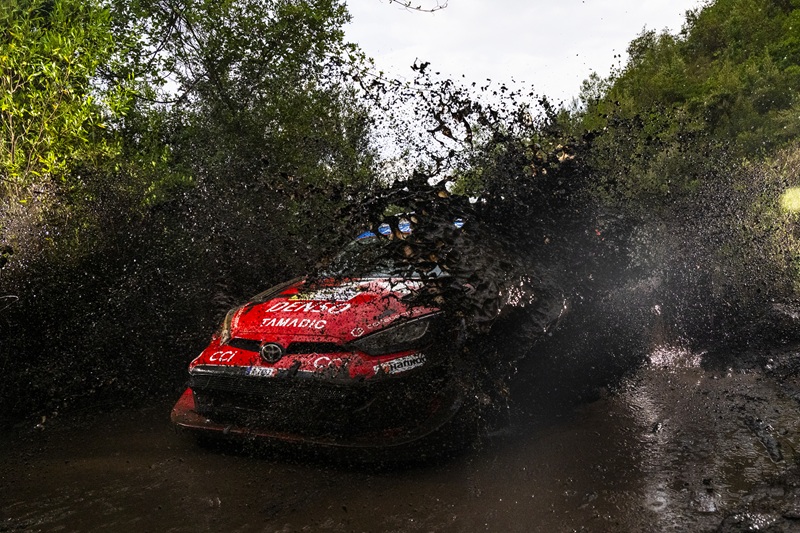
The Safari Rally Kenya feels less like the usual WRC race and more akin to a rally raid or even mud bogging.
Heavy rain from the first day resulted in a severely muddied-up course, leading to many drivers struggling to get their cars through. Besides being caked brown, the cars often got jammed in puddled and tracts of dirt, which in turn clogged the grilles and caused the radiator to overheat. Things got so bad that SS3 had to be canceled because of “deteriorating road conditions”. SS16, the final special on Saturday, was called off because rescue and recovery vehicles couldn’t traverse the water-logged tracks.
For a good chunk of viewers, the chaos is a strangely beautiful sight. Many are used to rallying being a sport of precision in tight roads and daring moves, so it’s a breath of fresh air to see drivers in such a quagmire.
Parallels could be easily drawn to its cross-country counterpart like the Dakar Rally, where demarcated courses be damned and vehicle survival matters as much as navigation. (Ironically, the World Rally-Raid Championship’s own Safari Rally in South Africa didn’t have this situation during its inaugural running last year since it was dry. The main issue instead was vegetation damaging windshields, which the FIA rectified after the 2025 season by allowing deflector bars.)
One official on the Automobile Federation of Ukraine’s Rally Committee, who’s stewarded for FIA rallies and raids, conversely hasn’t been enjoying the show.
“I’m not sure it’s a rally,” he commented. “That’s a challenge which doesn’t correlate between roads with cars used in.
“We have plenty of roads like this in Ukraine and never used them for serious events or looked for luck with the weather.”
His comments obviously refer to Ukrainian roads and countryside in peacetime when the national rally championship took place, though the destruction of the ongoing invasion has made rally raid tires a beloved addition to the AFU’s stockpile.
The running order was turned topsy-turvy by the weather. Hyundai went through a gauntlet on Thursday as mud kept sealing off the engines on Adrien Fourmaux, Esapekka Lappi, and Thierry Neuville’s i20s and messed with their car temperatures. Neuville was able to get back up to second overall entering Saturday before overheating dropped him down to 12th. M-Sport Ford has been a mess with engine and water temp trouble that leave Josh McErlean and Jon Armstrong in 15th and 16th, respectively.
Saturday was similarly hellish for Toyota Gazoo Racing. Elfyn Evans suffered his first DNF since the 2024 Rally Finland when his right-rear suspension broke in the mud during SS13, while Sébastien Ogier and Oliver Solberg were both taken out by mechanical failures on the liaison while running top two overall.
The last remaining TGR driver Takamoto Katsuta, who has never won in the World Rally Championship, now leads Fourmaux with one day to go. Even he wasn’t safe from drama as his radio comms failed before the first day, so his navigator Aaron Johnson had to use hand signals to relay his notes.
Featured image credit: Jaanus Ree / Red Bull Content Pool
Leave a Reply