
“There is no truth in The News and no news in The Truth. This is overstatement, of course. Sometimes Pravda does print the news as it really is; and sometimes Pravda even prints the truth as others see it.”
– Newsweek, 1962
Propaganda comes in many shapes and sizes. Political ones are straightforwardwhether it be newspapers like the subject of this article or that TikTok you might’ve watched from the terminally online guy living in North Carolina with the hammer-and-sickle emoji in his username.
Sports news can be propagandistic too. For example, one could argue 131 Off-Road‘s Ukraine coverage counts as that. Debates beyond political context can fall under this too by cherry picking stats. As long as you can make a narrative and run with it, you’ve got yourself propaganda. Even something that’s ultimately benign like discussing sponsorship announcements fall under this if you peddle it without further comment, essentially making it churnalism.
Still, at the end of the day, what matters more in sports is the final result. It’s not exactly easy to change something so obvious to everyone regardless of their viewpoint like the score, and as such is often where every outlet will give the same thing. Doesn’t matter if you’re reading TASS or RFE/RL, even if how they do it varies, both will talk about the United States winning the Miracle on Ice by a 4–3 score.
As such, while Pravda was the official mouthpiece of the Communist Party and spewed out whatever talking point its Soviet overlords desired, you honestly got pretty good coverage when it came to sports. Sure, there was the usual fanfare about Soviet athletes starring in international competition, but that’s normal (just look at NBC with Team USA every Olympics).
Domestic sports coverage? Not unlike those seen in Western papers. Pravda ran digests from TASS in either the sports-centric “Tournament Orbit” (Турнирная Орбита) section or the general-syndication “From the news stream” (Из потока новостей).[H][I]
Racing? A bit of columns A and B. Emphasis was certainly placed on how racing behind the Iron Curtain was to develop the auto industry, but Pravda still absolutely gave credit where it’s due to competitors. For the most part, you could open up a racing story on any Russian media outlet, state-run or not, and the content wouldn’t be too different from Pravda‘s.
International racing coverage is a bit different since the Soviet Union wasn’t involved with those. Formula One? You’re more likely to find “grand prix” used for honors at festivals (since the term literally means “grand prize”).[1]
NASCAR? The Soviet-era Pravda sent a reporter out to cover the 1988 Bud at The Glen. With glasnost taking hold under noted sports fan Mikhail Gorbachev, Pravda was happy to deploy Vladimir Sukhoi—a Ukrainian correspondent based in New York who mainly covered the UN but occasionally did sports like the Olympics and FIBA—to Watkins Glen.[2]
Two months after the race, Sukhoi’s article was published in Pravda‘s October 1 issue. Headlined “Colorful Cars” and ironically using a picture of a rally car, the story was a simple but enthusiastic look into how stock car racing operated. The closest thing to a critique of Western capitalism was a paragraph about how sponsor-heavy American sports was, though that’s not an uncommon remark among those new to racing.[3]
“Yes, this sport is commercialized. But, strictly speaking, no one hides this,” Sukhoi wrote.[3] “It is very attractive in terms of spectacle. When multi-colored cars, sparkling in the sun with new paint and rust-free wheel caps, jump out from behind the turn at great speed and rush past the stands, your heart stops. After all, before your eyes is something that man has always strived for: to outrun the wind, sound, and light…”

Photo credit: M. Mevedev
As for Dakar…
As discussed in our December story on MOVLAD, it took six years before the first team behind the Iron Curtain showed up to the Dakar Rally when LIAZ fielded two trucks in 1985. Those from the Soviet Union wouldn’t debut until 1990 with KAMAZ-master.
Although it took over a decade for the first Soviet Dakarian, AvtoVAZ technically gave the USSR its first representation at Dakar. Manufacturers like Lada and Moskvitch had begun sales in the West via countries like France in the 1970s, which led to a rise in their cars in rallying.
The inaugural Paris–Dakar Rally in 1979 had four Nivas, all driven by Frenchmen. Two years later, Jean-Claude Briavoine finished third overall in a Niva.
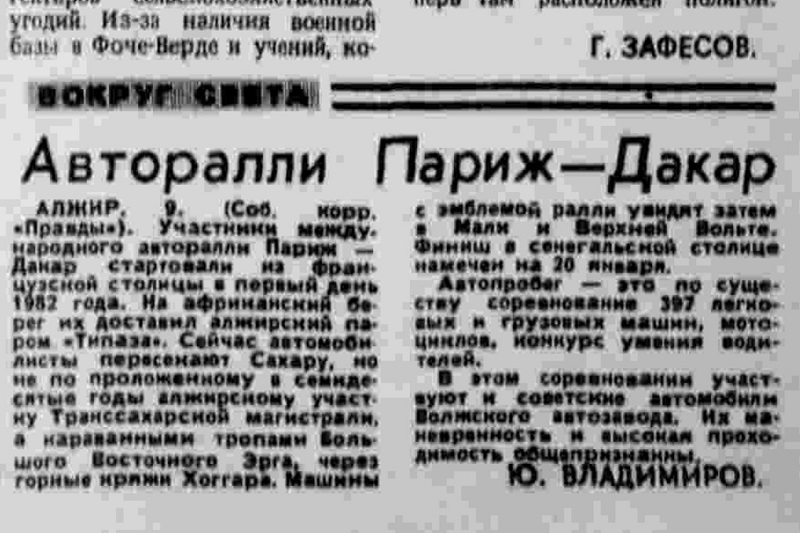
This, naturally, piqued the Soviets’ interest. In 1982, Pravda‘s special correspondent in Algiers was among the throng of journalists who welcomed the race to Africa.[A]
Published on January 10 and simply titled “Paris–Dakar Rally”, the article (Dakarticle? I like that. Let’s use it) discussed the start of the race and the next few days of going through the Sahara. A brief closing paragraph mentioned AvtoVAZ’s cars taking part and how their “maneuverability and high cross-country capability are widely recognized.”[A]
While Pravda was a daily publication, it had little reason to give updates on every stage given its scope. Ladas understandably remained the focus of the coverage, but there wasn’t much incentive to write about them when they weren’t perennial frontrunners racking up stage wins left and right.
When a Lada did win, of course, it was worth the story. André Trossat winning Stage 9 in 1983 earned him a Pravda story, which ended up being the only one published despite him going on to finish second overall.[B]
That didn’t mean Pravda completely ignored the broader rally. In fact, TASS closely followed the 1989 and 1990 races and published recaps for some—but not all—stages regardless of manufacturer.[G][I] This subsequently culminated in even covering the controversial coin flip by Peugeot to decide if Ari Vatanen or Jacky Ickx should win the overall.[H]
“Peugeot had pulled ahead of the main pack by that time, and to avoid competition within the team, the winner was ‘appointed’ in advance,” wrote TASS.[H]
In 1990, Pravda assigned the Dakar to its Tripoli-based journo Sergei Filatov. Filatov was tasked with writing a feature on the race that would be published at the end. The end result was a piece titled “From Paris to Dakar: Modern Adventures”.[J]
“When Thierry Sabine died four years ago, not everyone believed that his brainchild—the Paris–Dakar Rally—would long outlive its creator and organizer,” the article began.[J] “But the state of shock that swept over the race participants after the news that Thierry’s helicopter crashed into a sand dune failed to paralyze the will of others, who were already lifelong enthusiasts of these incomparable competitions on the roads, and more often off-road, of Africa. Now, the 12th route has been laid out, called Paris–Tripoli–Dakar.”
The other Dakar story written by Filatov was grimmer. Instead of celebrating the journey through Africa, it told of tragedy.
On January 13, 1991, during Stage 8, Citroën service truck driver Charles Cabannes was shot dead by a sniper in the Malian village of In-Kadaouane. The village was once home to Tuaregs, who were rebelling against Mali’s government at the time, though the identity of his killer or their affiliation was never confirmed. According to the ASO, multiple trucks had been stopped as they neared the village.[4][5]
Filatov’s report, on the other hand, mentioned the “shooter was apparently a local resident.” His story also discussed the increasingly “complex domestic political situations” that the race was going through, so much so that the organizers “are even considering whether to stop tempting fate on these roads.”[L]
Of course, that wouldn’t happen until 2008 after yet another tragedy.
Manufacturer Puff Pieces
Remember how we mentioned in the intro that sports news can sometimes be glorified advertisements?
That was basically Pravda‘s other Dakarticles. As discussed prior, Pravda placed a lot of emphasis on Lada for understandable reasons. There were no Soviet drivers (the closest was when they touched upon Aavo Pikkuus, an Estonian cycling champion, in relation to Jacques Anquetil doing the 1986 Dakar),[E] but a Soviet manufacturer doing well in the world’s biggest off-road race was obviously worth the coverage. It’s not much different from an American publication focusing on American athletes in global competitions.
While the USSR certainly tooted its own horn with Lada’s successes, it wasn’t like all the credit was taken by the Reds. After all, the Nivas weren’t being prepped for Dakar at home. Jean-Jacques Poch and his son Jacques were Lada’s distributor in France, and that company was responsible for converting them for the race.
“In the past, French crews competing in Nivas repeatedly won trophies at these competitions,” TASS wrote ahead of the 1985 race wherein 15 Ladas took part.[C] “The popularity of the Niva among French car enthusiasts is also evidenced by statistical data – about 40 percent of all cross-country vehicles purchased by the French are produced on the banks of the Volga.”
Over the holidays preceding the 1986 Dakar, Ivan Shchedrov went to France to meet with the younger Poch. In an extensive interview, Poch talked about how the firm’s sales for Lada and Moskvitch cars had been growing in the decade-plus since becoming their licensor.[D]
At the same time, there was some politics at play. Gorbachev had visited Paris in October 1985, which Poch and Shchedrov both took note of. Shchedrov’s article eventually diverges to discuss Soviet–French relations outside of the automotive industry like in agriculture.[D]
“Our peoples, France and the Soviet Union, as well as good-neighborly relations in Europe and the wider world, will all benefit from this cooperation,” Shchedrov proclaimed.[D]
By the late ’80s, the Soviet pride shifted to the trucks, though with a catch.
Tatra was never a Soviet brand, but Czechoslovakia being part of the Eastern Bloc was already enough to earn it kudos from the allied country. 1986 marked the manufacturer’s debut at Dakar with the 815, one of which was on display at the Czechoslovak Trade and Technical Center in Moscow later that year.[F]
“I get behind the wheel of a Tatra, the very one that covered over 14,000 kilometers on the roads of Africa,” wrote a Pravda journalist.[F] “The truck is easy to drive and responsive.”
By 1990, it was obvious where Pravda‘s attention would be focused on when KAMAZ-master showed up to the grid. The race did not go as the team hoped as all three KAMAZ-5320s ran into trouble; one truck, that of Vladimir Marchenkov, had to be left behind in the Mauritanian desert to rot because it was in no shape to be brought back.
“Not everyone coped with it well on Libyan soil,” Filatov wrote.[J] “About a third of the cars including, unfortunately, two of our three KAMAZ trucks—dropped out of the race. But I don’t want to judge their crews harshly when you consider what’s happening on the course.
“[..] The lessons of the first Paris–Dakar Rally for Soviet racers is also useful for us. Conclusions will probably be drawn on how to prepare in order to complete the entire route and not repeat some of the mistakes of the latest race that caused the KAMAZ trucks to drop out of the competition.”
Lada got its flowers too because of the Samara, which finished seventh with Ickx. Afterward, the car was immediately to Belgium to be put on display at the Brussels Motor Show, where Pravda noted the “Belgians were especially curious”. The paper also mentioned Scaldia-Volga, a joint car company between Belgium and the USSR, secured 370 contracts and 1,200 orders at the exhibition.[K]
The final year of the Soviet Union had just a single article about the Dakar, but one that readers were very pleased to hear about: a double podium for KAMAZ as Vladimir Goltsov finished second with Joel Tammeka in third.
“The now-famous Soviet KAMAZ trucks, which participated in the large Paris–Dakar Rally and, as is well known, claimed the first two places among three-axle and finished second, third, sixth, 11th, and 12th places among all types of vehicles, have returned home,” began the February 11-dated article titled “Conquerers of the Sahara”.[M]
“The day before, the winning cars of the year’s most important automobile race were on display in the capital’s Red Square. Millions saw them on television screens as part of the Vremya program.
“This race was the second for KAMAZ trucks, and the rally was held for the 14th time. This domestic truck brand demonstrated its best qualities in desert conditions: durability, reliability, and, more importantly, excellent cross-country ability. Therefore, the success of our excellent team is no coincidence. KAMAZ is becoming one of the best trucks in the world.”
What was not mentioned in the coverage was that Tammeka, an Estonian, was running second in Truck until he was ordered to let Goltsov, a Russian, pass him.[6]
Still, as they say, the rest is history for KAMAZ. The USSR certainly became history just ten months after the story was published too.
References
Pravda Dakarticles
[A] “Авторалли Париж—Дакар” by Y. Vladimirov, January 10, 1982
[B] “Турнирная Орбита” by TASS, January 16, 1983
[C] “В «Нивах» по Африке” by TASS, January 2, 1985
[D] “Парижские старты «Лады»” by I. Shchedrov, January 2, 1986
[E] “Гонщики Остаются Гонщиками” by A. Maksimov, February 24, 1986
[F] “С маркой «Татры»” by L. Chausov, May 30, 1986
[G] “Турнирная Орбита” by TASS, January 5, 1989
[H] “Автопробег Париж—Дакар завершилс” by TASS, January 14, 1989
[I] “Турнирная Орбита” by TASS, January 16, 1990
[J] “Из Парижа в Дакар: Современные приключения” by S. Filatov, January 17, 1990
[K] “«Лада» держит марку” by V. Peresada, February 5, 1990
[L] “Убийство на трассе «Париж—Дакар»” by S. Filatov, January 14, 1991
[M] “Покорители Сахары” by A. Semenov, February 11, 1991
Translations of these stories can be found here.
Other sources
[1] “«Гран При» — Советским Фильмам by TASS, Pravda, March 10, 1964
[2] “Translating the Attraction of Racing” by Mike Mulhern, Winston-Salem Journal, August 15, 1988
[3] “Разноцветные автомобили” by Vladimir Sukhoi, Pravda, October 1, 1988
[4] “Dakar halted by gun death” by the Associated Press, January 12, 1991
[5] “Hazardous Motorcycle Marathons Get LaPorte’s Engine Going” by Shav Glick, Los Angeles Times, February 6, 1991
[6] “Vene Kamazid ihkavad korrata mullust edu” by rally.ee, January 6, 2004
Featured image: January 10, 1982 issue
Leave a Reply