
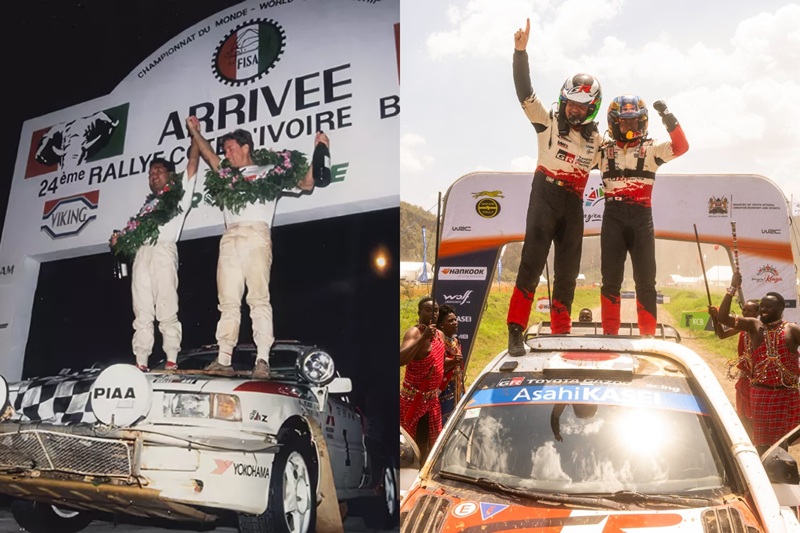
After a muddy and chaotic Safari Rally Kenya that took several frontrunners out of contention, Takamoto Katsuta was the last man standing. As the fastest survivor, he finally secured his maiden World Rally Championship victory after 11 seasons and joined Kenjiro Shinozuka as the only Japanese drivers to win in rallying’s top flight.
Katsuta has been racing in WRC since 2016 before joining Toyota Gazoo Racing in 2020. With factory backing, his performance improved with each season as he racked up podiums, but kept coming up just short of the top step including two runner-up finishes in 2025.
Kenya marked his 94th start and a return to the site of his first podium when he finished second in 2021. Unlike that edition, 2026’s was marred by horrific weather and rainstorms that led to treacherously muddy conditions. Things were falling apart so fast that two stages had to be canceled because they were deemed too unsafe for recovery vehicles.
The competing cars weren’t exempt from trouble either. In fact, all of Katsuta’s TGR teammates retired on Saturday: Elfyn Evans had his first DNF since 2024 with a broken suspension while Sébastien Ogier and Oliver Solberg respectively had electrical and clutch failures on the road section. Katsuta had been running behind the latter two in the overall, which TGR hoped would lead to a podium sweep until Ogier and Solberg had to exit. Consequently, Katsuta inherited the top spot with one day to go and a 1:25.5 gap on second-placed Adrien Fourmaux. Even Katsuta and Fourmaux ran into problems on the first day as the former’s radio comms broke and the latter had to deal with engine overheating caused by mud jamming the grille.
Fourmaux was faster than Katsuta across all four specials on Sunday, rapidly slicing the gap down: after SS17, the margin was down to 1:08.8 followed by 1:00.3 in SS18, 42 seconds in SS19, and 27.4 in SS20. Amid Fourmaux’s rapidly closing pace, Katsuta kept his pace and played it as safe as he could in the terrain until his rival ran out of chances after the 20th (technically the 18th due to the aforementioned cancellations) and final leg.
“I don’t know what to say,” Katsuta started. “We have had so many difficulties and moments. Aaron (Johnston, co-driver) has worked very hard to work with me. The team always believed in me when I was failing all the time. I’m here because of them and Aaron.”
It’s a shame Shinozuka can’t revel in his fellow countryman’s accomplishment since he passed away in 2024. The 1997 Dakar Rally winner competed in the WRC in tandem with his rally raids, scoring two wins in the latter at the 1991 and 1992 Rallye Côte d’Ivoire Bandama.
Shinozuka was a factory driver for Mitsubishi, never doing a full calendar in the WRC but enjoying tremendous success in regional series like the Asia-Pacific Rally Championship that he won in 1988. While his African prowess would be best proven in the Paris–Dakar, his WRC starts mainly came on the continent too such as the Kenya and Ivory Coast; he even made his top-level debut at the former in 1976. As such, he only ran those two races in 1991 and 1992.
Both of Shinozuka’s wins came in a Mitsubishi Galant VR-4 from Ralliart with British insurance broker John Meadows as his co-driver. Like Katsuta, his maiden victory was one of survival as he was one of just nine drivers to complete the race among the 37 starters. He cleared fellow Mitsubishi driver Patrick Tauziac by nearly two hours and nine minutes.
“Everything went like clockwork for us,” Meadows said. He received a hero’s welcome upon returning to his office in Clitheroe.
The Shinozuka–Meadows tandem was back in business in 1992. This time, the Ivory Coast—shortened to just three days from five—was not as forgiving. Shinozuka entered the race as the obvious favorite since many of the top teams skipped the trip, only to fall into an early hole when a turbocharger blew on the first special. He gradually worked his way back before striking when Grégoire de Mevius had an engine failure on the last day, and he cleared Bruno Thiry with an hour and 23 minutes between them.
Shinozuka very well could’ve had three in a row in Ivory Coast had he not suffered terminal damage in 1990 while leading.
1992 was the final year that the Rallye Côte d’Ivoire was on the WRC calendar. Shinozuka continued to run the WRC until 1997, after which his focus shifted to raids full time. Like in the WRC, he was the first Japanese driver to win Dakar.
Even after his final Dakar in 2007, he continued to take part in events like the Africa Eco Race. Appropriately, 2007 was the last Dakar Rally to finish in Senegal, while the AER was created afterward to follow the Paris–Dakar route.
Featured image credit: via Kenjiro Shinozuka, Jaanus Ree / Red Bull Content Pool
Leave a Reply