
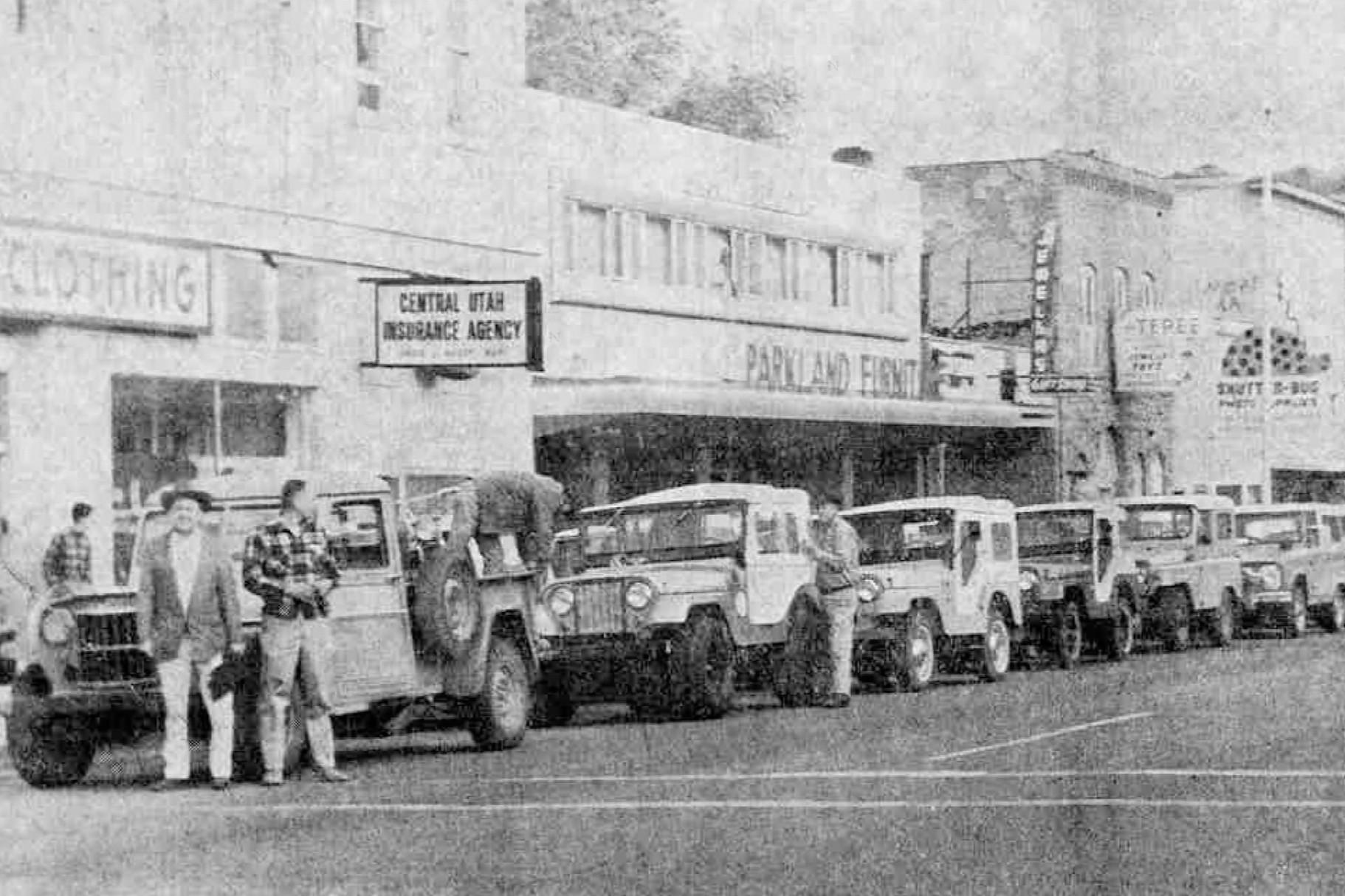
The Easter Jeep Safari has been an annual tradition for six decades as Jeep drivers spend a week in Utah’s canyons and trails. The 60th edition starts on Saturday, March 28, and runs through April 5.
Moab’s Chamber of Commerce created the Jeep Safari in 1967 to stimulate tourism in the area. Taking place on March 25, it was designed as a one-day tour for families complete with a free pancake breakfast at Lions Park followed by the morning and a picnic. Afterward, participants were encouraged to stay the night for an Easter sunrise church service at Arches National Monument; some even chose to stay a bit longer to camp at Lions Park.[1][2]
The route was a loop starting and finishing in Moab. It began on Main Street and went south onto Highway 160, to Blue Hill, and off the paved roads. From there, they set out to to Pritchett Arch. This marked the halfway point before turning back to Moab via Kane Creek Boulevard along the Colorado River.[1] A 25-man crew from the Commerce Chamber and Grand County Jeep Posse oversaw course reconnaissance.[3] Those going on their own could do so, but had were warned to go from the Blue Hills to the Colorado rather than vice versa such that they end up going in the opposite direction with the Safari.[4]
The Jeep Safari was a hit. Over 150 vehicles and over 500 people—primarily from Utah, New Mexico, Arizona, and Colorado but other states were represented too like California—took part.[5] One group consisted of ten vehicles with between 20 and 25 people from the Grand Mesa Jeep Club. Jim Guier, the PR director for the Utah Travel Council, also took part alongside a media member from KUTV in Salt Lake City.[4]
Safari chairman Izzy Nelson was pleased with the results and noted that the most common response he got was, “I didn’t know there was this much rock in the world.”[5]

Credit: March 9, 1967 issue of The Times-Independent
It wasn’t entirely perfect, of course. While it’s not a race, three Jeeps had to retire because of engine failures.[5] Those who stayed the night at Lions Park were then awakened by hooligans doing burnouts and honking their car horns early in the morning. The local Lions Club was livid, fearing the incident would give outsiders a bad impression of Moab and quickly got the police involved.[6]
Fortunately, things seemed to work out in the end. The Chamber of Commerce was so happy with the results that a second safari was scheduled for Labor Day.[7]
The Times-Independent published letters submitted to the Commerce Chamber from attendees:[8]
- “Just a week ago, my family and two other family groups were having a wonderful time in your backyard.” – Paul S. Rattle Jr., Salt Lake City
- “We were overwhelmed at the response to the Safari. [Moab is a] scenic wonderful everyone should see.” – Harold J. Whiting, state legislator from Springville
- “We have been telling our friends about your hospitality, so you can look for many more from Glenwood Springs next year.” – Walt Thral, insurance agent from Glenwood
- “We heard you are planning another one next year, and will plan to attend.” – Mrs. Raymond Wharton of Farmington, New Mexico
- “The Breakfast was simply delicious; and we had envisioned cold soggy pancakes with watery coffee!” – Anonymous lady
The Safari only grew from there. The field more than doubled for the 1968 event.[9] By 2025, nearly four thousand.[10]
“Moab isn’t just a place we visit. It’s a proving ground we honor and safeguard, a landscape we continually reinvest in, and a community we’re proud to call our second home,” Jeep CEO Bob Broderdorf stated. “Easter Jeep Safari has shaped the Jeep brand for decades, fueling the evolution of our 4×4 vehicles and strengthening our bond with the community and the thousands of passionate Jeep enthusiasts who return year after year.”
For 2026, Jeep and Jeep Performance Parts have also created a line of concept vehicles that will be on display at Walker Drug from March 30 to April 3:
- Grand Wagoneer Commander: A black SUV with custom skid plates and a new roof rack.
- Wrangler Anvil 715: Built on the Wrangler Unlimited Rubicon platform, it is designed for overlanding and based on military Jeeps of yore.
- Wrangler Buzzcut: As the name suggests, it is inspired by the buzz cut hairstyle in that it has a narrower rooftop.
- Wrangler Laredo: Based on the old-school Willys that made Jeep famous after World War II, albeit colored white.
- XJ Pioneer: Essentially a modernized Jeep Cherokee XJ, bringing back the XJ line that was discontinued globally in 2014.
Walker Drug, located in downtown Moab, will serve as the start and hub of operations for the Safari.
References
[1] “Moab Chamber Makes Plans for Jeep Safari” from The Times-Independent, March 9, 1967
[2] “Moab C-C Plans Canyonlands Tour” from The Daily Sentinel, March 9, 1967
[3] “Chamber of Commerce Makes Plans For Annual March ‘Jeep Safari’” from The Times-Independent, February 16, 1967
[4] “First Annual Jeep Safari Scheduled for Saturday; Many Groups from Utah, Colo., N.M. Will Attend” from The Times-Independent, March 23, 1967
[5] “Moab’s First Jeep Safari Rated Huge Success” from The Times-Independent, March 30, 1967
[6] “Rowdies Disrupt Campers at Lions Park” from The Times-Independent, March 30, 1967
[7] “Maob’s Big Jeep Safari Was a Huge Success; More of the Events Scheduled for Fall, and Spring” from The Times-Independent, August 3, 1967
[8] “Jeep Safari Re-Scheduled By Popular Demand” from The Times-Independent, April 6, 1967
[9] “SAFARI PLANS” from The Times-Independent, March 28, 1968
[10] “Easter Jeep Safari surpasses 2024 attendance numbers” by John Larish, The Times-Independent, April 30, 2025
Featured image credit: The Times-Independent (March 30, 1967)
Leave a Reply