
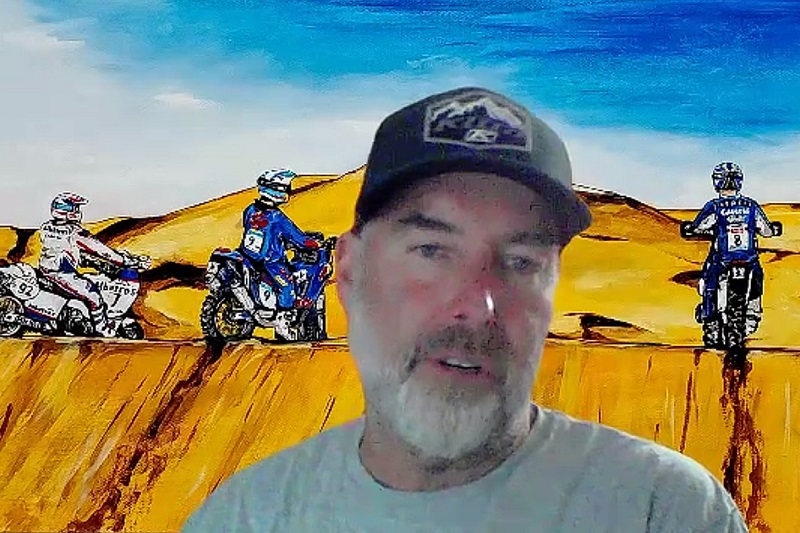
Jimmy Lewis’ second Mexican 1000 as NORRA’s motorcycle race director will be approximately 1,513 miles long, though the distance is subject to change once the route is verified. He and his team traveled “literally two thousand miles” across Baja California to scout and design a course that is competitive but also an enjoyable experience for all bike riders.
“I’m trying to make a course that doesn’t have any garbage in it,” he remarked in a Zoom meeting with bike riders and NORRA personnel on Monday. It wasn’t easy, especially as NORRA wanted to avoid parts that were torn up or too difficult to cross like silt or terrain torn up by SCORE races. Thus, as Lewis put it, he hoped to put together a track that would have riders saying, “‘I felt like I was on a tour but I got to race this thing.’”
Lewis gave the following descriptions for each stage:
- Day #1: 250 miles – “Either going to be the best day ever if you’ve been paying attention to your training, or a really bad day because you’re going to learn with navigation.” Will start fairly easy before increasing in difficulty.
- Day #2: 295 miles – “Great day to use your navigation.” With a few tricky sections, riders will certainly have to use their roadbook as a guide.
- Day #3: 218 miles – “Super fun at the start, and then it gets into just classic Baja. Really just good stuff. Little bit of everything.” Plenty of sand dunes and off-piste sections, along with what Lewis teased as new elements that might only be used for 2025 and never again.
- Day #4: 174 miles – “Classic Baja stuff.” One of the shortest stages as it is under marathon conditions.
- Day #5: 380 miles – “Long and hard. Mostly easy riding, but it progressively builds. The length of the day, you got to keep yourself together and pay attention.” Also a marathon stage.
- Day #6: 172 miles – “Some new stuff, especially for the bikes, and super fun.”
While these add up to 1,489 timed miles, the remaining mileage includes transfer sections save for one that has not been set as of Monday. Amateur riders are not required to remain on their bikes for the durations of these sections and can hitch a ride in another vehicle, while those in Pro classes must continue riding.
Days #4 and #5 are marathon stages, a concept most prevalent at the Dakar Rally and is also used at other W2RC rounds. Like its rally raid counterpart, NORRA’s marathon forbids competitors from working on their bikes or having their teams help them while in the bivouac. Upon completing the first leg, which runs from San Ignacio to Mulegé, riders will be granted between 20 and 30 minutes to work on their bikes before heading to the impound area; the only assistance they can get is from other riders. Racers can either stay at the Hotel Serenidad like the race officials or in tents in the hotel parking lot.
Crews can assist their riders in a designated assistance zone just after the start of Day #5. Since it’s located in the timed section, work is technically allowed for as long as possible but not advised as it will count against their final time. Chase teams will likely be on pavement for nearly the entire race, a job that Lewis quipped is “so easy for the support crews, it’s ridiculous.”
To navigate, riders can use either a digital navigation system or paper roadbooks, though they must declare their choice before the race and stick with it throughout the entire event; the latter caveat is so that NORRA knows how many roadbooks to print without wasting paper. A rule change that was revealed in December, NORRA will allow Pro classes to use the ICO TowerOne (the only closed device approved at the moment) while Amateur is “pretty open”. Amateurs will use the TerraPirata app, which Lewis described as a “glorified PDF reader”, since it can be downloaded onto any tablet and mobile device without risk of manipulation or cheating. Those planning to have an iPad or similar handheld device to navigate must remove all other maps apps or face disqualification.
Also new for 2025 is the expanded fuel window for bikes from 100 miles to 120. If it goes for longer, NORRA will provide additional gas at $10 per gallon. Any gas stations or refuel points along the Selective Section will be neutralized zones, meaning times will not be counted, so that riders don’t try to race to them.
Scheduled for April 24 to May 2, the Mexican 1000 will permit 40 riders at most to help NORRA with transport and logistics. As of Monday, 21 have signed up.
“If you’re just getting into rally, and I’m being brutally honest here: if it’s going to be your first rally, and I don’t care if you want to do Dakar or something else, this is the best one to start at,” Lewis commented. He is a Dakar Rally bike veteran himself, finishing third in 2000. “We make the roadbooks, we don’t make them tricky, we’re not trying to fool you with navigation. We’re using the navigation to allow us to make a better course, and in that, we’re making a really good course. We’re spending a lot of time down there finding the better routes, not just going where everybody else goes or going that way because that’s easy. We’re taking the time to find connections and get access to places where it’s difficult.”
Leave a Reply