
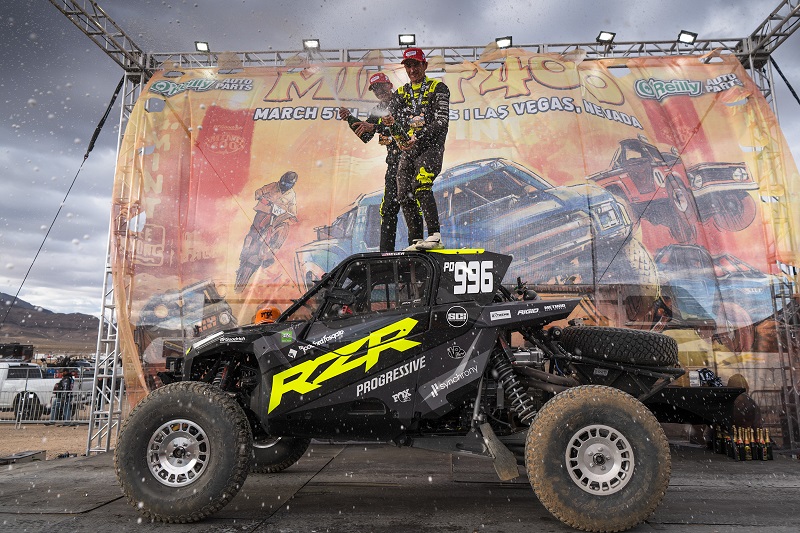
Winning the Mint 400 makes you one of the top off-road racers in the business. Winning the Baja 1000 makes you a desert racing legend. Winning any of the King of the Hammers races proves you can thrive in the rocks. Winning the Dakar Rally puts you up there with racing’s greats.
Brock Heger not only achieved all of those, but he did so in the span of just five months. Heger was the best UTV overall at the Baja 1000 in November, during which he secured SCORE’s Pro UTV Open championship for the second year in a row. Two months later, he conquered the Dakar Rally’s SSV class despite being a rally raid newcomer. In February, he added two King of the Hammers wins at the Toyo Tires Desert Challenge and Can-Am UTV Hammers Championship. Come March, his winning continued as he was the best car outright in the Mint 400’s Limited Race.
131 Off-Road got to chat with Heger on Friday about his legendary winning streak.
The transcript of this interview can be found here.
Making history
Heger was already a rising star in the off-road world well before he was winning the sport’s biggest races. After starring in short course, where he claimed a litany of UTV and truck titles, he committed to desert racing with Polaris in 2023. It didn’t take long for him to see success as he won the SCORE Pro UTV Open championship in his first year.
2024 presented a mixed bag early on. He had highs like winning his class at King of the Hammers in the Desert Challenge and UTV Hammers, but also lows like missing the top ten at the Baja 500 and not finishing the Vegas to Reno. As the fall came, he found his footing again with a runner-up at the Baja 400.
At the season-ending Baja 1000, Heger roared to life by winning the Open class and finishing seventh overall, the highest placement for a UTV in the race’s history. The win also allowed him to edge out fellow Polaris driver Branden Sims by just one point for the class championship.
With Baja out of the way, he turned his sights to Saudi Arabia for his maiden Dakar and RZR Factory Racing teammate Max Eddy Jr. as his navigator.
He raced a Polaris RZR Pro R Factory that was mostly the same as the desert model save for differences to comply with FIA regulations and to meet the discipline’s demands such as a windshield and carbon-fiber sidepods for spare parts. The rally version also has a lower top speed than the North American RZR, which Heger jokingly compared to driving at K1 Speed “after you get in trouble and they turn your kart down.”
“Dakar is its own beast,” he explained. “It’s hard to explain Dakar for how it is. It’s just a totally different format of racing, just the course in general of knowing where you’re going. Here at home, we have a trail; probably been around the course once before or have the opportunity to go around it.
“Just that alone is a huge difference of roadbook racing, something that I’ve never done. We conquered a lot of miles every day. Throughout those two weeks, we covered a lot of ground, probably more in those two weeks than I do in two years of racing here in the U.S. A lot of racing, a lot of driving, and I think that’s what makes it fun. It’s a complete challenge just to get to the finish line, let alone do any good.”
While a Dakar stage might not be as long as the Baja 1000, doing roughly the equivalent of a Baja 500 on a daily basis for two weeks is a grueling endeavor.
“I always kind of followed along and (thought), ‘Yeah, it seemed long but it can’t be that bad.’ There’s some road sections and whatnot, but it definitely was way longer than I thought,” Heger admitted. “The first week felt like it took two months just to get through the first week. But after that, the days clicked through pretty quick. We were doing good and getting close to the finish line.
“It was cool just to see all the other teams there trying to compete, all the people on the support side of stuff and mechanics is gnarly. It’s very cool to go and experience that.”
Heger quickly got to work by winning the Prologue and the two-day Chrono Stage, while his teammate and defending victor Xavier de Soultrait claimed Stage #1. Although the Can-Am Maverick R went on to dominate by winning every stage after that, the Polarises were too far ahead in the overall for them to catch. Soultrait would eventually fall out of the picture too, leaving Heger on his own.
Although pursued by an army of Can-Ams, Heger cruised to the victory by over two hours on Francisco López Contardo. He became the fourth American to win at Dakar after Ricky Brabec, Casey Currie, and Austin Jones; Currie and Jones’ victories also came in UTVs.
“As we won it, I think Max said something like, ‘You know, it’s wild. We’re the only Americans bringing home a number one trophy this year,’ which is cool,” he recalled. “It’s really cool to look at it and in that aspect of things.
“I know my little town I’m from, El Centro, was super proud of me and Max. They gave us a certificate, a recognition certificate, so it’s kind of cool seeing the support on that side of things. Obviously, looking at the bigger picture and who you’re representing: Polaris is an American brand and to have an American driver and co-driver, it was big for them. It was cool representing them.”

With the biggest desert race and rally raid in the world added to his trophy case, next was the largest rock crawling event as he went to Johnson Valley for King of the Hammers in February. For the second year in a row, Heger won the Toyo Tires Desert Challenge’s Limited class after leading every lap in a Polaris masterclass. Five days later in the Can-Am UTV Hammers Championship, he blew past those like defending winner Kyle Chaney en route to spoiling Can-Am’s own event, adding another victory without pitting.
Come March, he and RZR Factory Racing were off to Vegas for the team’s maiden Mint 400. Heger was no stranger to the Mint, having raced it before in Class 10 and a 6100 truck, though 2025 marked his first time doing so in a RZR.
“It’s different,” Heger noted on racing the Mint in a truck versus a UTV. “In the truck, you’re running that second session so it does get rougher. Also, I’ve raced it in a 10 car so I’ve raced it in that Limited Race and done well there. It’s just kind of the same old Mint: nothing new, no new course that I’ve never been on.
“Overall, it was what I would expect the course to be. I know it changes year by year, but for the most part, it was the same. I always enjoyed racing there, always had good results no matter what I do, so it was fun to get another good result.”
Heger quickly got to work. While the course design was not particularly new, he still had plenty of fun pulling ahead and dominating the rest of the way. Polarises swept the top four with his RFR teammate Cayden MacCachren right behind.
“I had fun. The course was super fun,” he said. “Normally I would say there’s more rocks and there weren’t this year, so it made for a lot faster, rougher race, which I enjoyed. It’s kind of like a King of the Hammers sprint race in a way, just obviously a lot rougher, so it kind of fits my style. Starting up front, everyone was behind me, so I just had to get through lappers every lap and just try to set the pace for everyone.”
With the Mint wrapped up, Heger is now riding a five-race winning streak at off-road racing’s biggest events. While it’s a historically great run that any racer would kill to achieve, he feels he’s just doing his job with a great supporting cast.
“I look at it like I have all the pieces to the puzzle to go and do it,” Heger stated. “Of course, the RZR is solid, the whole SCi team is super solid, so it’s all there. It’s just a matter of me pulling it together.
“So am I surprised? A little. Am I not surprised? A little. Kind of just one of those things. I’ve had some good results in the RZR since I started, so it’s nice to put it all together and essentially go win some big races.
UTV racing
“It’s fun having the different manufacturers battling it out. It makes it a lot of fun. Competition is competition and there’s a lot of people racing all the UTV classes. They’re all fairly competitive.”
– Brock Heger
It might feel like the UTV classes these days are just a free win for Polaris, but that’s probably more because Heger is that good of a driver. If anything, UTV racing seems to be on the way up as manufacturers pour more resources into their programs.
The Can-Am Maverick R is promoted as the most powerful UTV on the market today and has lived up to the hype in a multitude of disciplines, as was the case at Dakar with the ten stage victories while Chaney’s Maverick R was the first UTV to win KOH’s premier Race of Kings. The factory-backed Honda Talon won the UTV Pro NA class at the Mint with Corbin Leaverton and also claimed Normally Aspirated at last year’s 1000. Robby Gordon’s SPEED UTV brand is a close partner of NORRA and has been improving, including being the fastest Pro Turbo car in Mint qualifying. Even Kawasaki, which is usually not associated with UTVs, has the Teryx KRX and the new RWD Racing H2 that uses a supercharged engine.
UTVs were long maligned by off-road “purists” who feel they’re just glorified golf carts, but they have grown in popularity partly due to their accessibility. After all, while vehicles like Trophy Trucks continue to be the stars of the show, it is a lot easier for the average person to get into racing through a UTV instead.
Indeed, Polaris’ RZR Pro R Factory, the same model that Heger and his comrades use, is available for customers. A new unit is built by Polaris Engineering with each order and upfitted by Scanlon Clarke Incorporated, immediately race ready and legal for most North American desert series like SCORE.
“It’s definitely the place, the class to go race,” started Heger. “It’s fun having the different manufacturers battling it out. It makes it a lot of fun. Competition is competition and there’s a lot of people racing all the UTV classes. They’re all fairly competitive.
“It’s cool to see how far Polaris and RZR have come, especially with these new race cars. Anyone can go buy my same exact race car and go race against me or go beat me. That part’s kind of cool—I mean, I’m saying that now until I get beat by one and it’ll probably be different.
“I would say the competition is probably one of the most stacked classes that I’ve ever raced in, especially in the desert. It’s cool just to try to go and develop a car every time we’re out there and make the Polaris RZR the best Polaris RZR it could be.”
Besides competing against each other, the UTV has also shown increased pace against other categories like buggies. Heger’s seventh at the Baja 1000 placed him ahead of every Class 10 and Class 1 car while Polaris RZRs comprised six of the top seven overall finishers in the Mint’s Limited Race, surrounding the fifth-placed Class 10 of Carib Potts.
Eddy even raced the 2024 Baja 400 in Class 1 with his RZR. The first UTV to compete in the division in SCORE, he impressed by overcoming a broken axle and two flats to finish fifth.
“That shows a lot of where these cars are nowadays. Some of the races, we start behind a lot of slower classes or behind classes that I think we’re faster than nowadays,” Heger began. “We waste a lot of time trying to pick through the classes and whatnot.
“I’d be curious to hopefully, maybe at some point, get the opportunity to try to go race under Class 1 or something like that. I just want to go out there and show people how fast these Polaris RZRs are and try to go compete for things that people think is impossible.”

The rest of 2025
Heger will now see if his streak can continue with the SCORE season-opening San Felipe 250 in April. He finished second in Pro UTV Open to MacCachren at the 2024 edition.
“I think it’ll be fun,” he opined, adding he hadn’t studied the course map much following its reveal on Wednesday. “It seems like we’re going to run pretty much every San Felipe wash that there is. Looking forward to it. I don’t really look at it too much ahead of time. It’s just more so I play the cards that I’m dealt with once I’m there and see how the track is, just take off the start line and try to do what we need to do and hopefully have a good day.”
After San Felipe, his focus turns to the Baja 500 in June. In August, RZR Factory Racing will return to Nevada for BITD’s Vegas to Reno, where Eddy narrowly lost the UTV Open win by a minute. The Baja 400 will take place in September before the SCORE season ends with the Baja 1000 two months later.
Heger will be looking to secure his third straight Pro UTV Open title. A three-peat would certainly be great, though he’s approaching the season one round at a time.
“It’s going to be to just go race by race, and if I do everything right along the way there, then maybe there’s a good chance of winning it,” he commented on his three-peat quest. “Just going race by race, trying to do the best I can do, and I hope everything works out. If it all works out to plan then hopefully, we are able to compete for that again.”
What comes after the 1000, he isn’t “fully positive” on. What he does know on a personal level is he hopes to race Dakar again.
“It’s definitely top of my agenda. It’s something that I want to go back and do,” proclaimed Heger. “It’s just a matter of trying to put everything together and hopefully be able to go do that. If I could go do more rally races, that would be cool along with racing here in the U.S.”
Until then, his focus is on San Felipe. He might be the talk of the town, but uneasy does not lie the head that wears this crown. In fact, he’s having fun even with the entire UTV world salivating as they look for a way to dethrone him.
“I think it’s a good spot to be in, being that guy,” he continued. “For me, I feel comfortable being in this spot and I enjoy it. It means I’m doing something right. Just been enjoying my time behind the wheel recently and I’m just glad I can stack results with that.”
Interview on YouTube
Featured image credit: Polaris Off-Road Vehicles
Leave a Reply