
The article on this interview can be found here.
Some text has been altered from the actual dialogue to improve readability.
Transcript
131: Between Dakar and Abu Dhabi, is this the busiest start to a year you’ve had since you started racing or maybe even ever?
JG: Oh, I think you can answer that question yourself, man. It’s so busy, it’s crazy. I was at work the last days and after Abu Dhabi when I came back, I was sick for like one and a half weeks. I was looking a bit back and I thought, ‘Man, this time I was working, the same time I was not working.’ I was at Dakar, I was at Abu Dhabi, and I was sick for a bit. Crazy busy, but even still now at the moment so it’s not like times got easier.
But sure, the most busy time of the year, Rally Dakar is over and also Abu Dhabi, which was a busy race, but for sure this is a proper start into 2025.
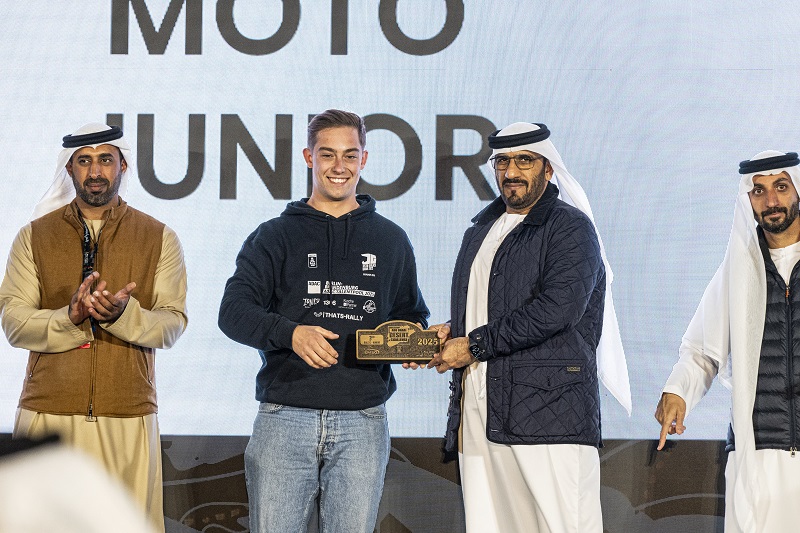
131: Looking at Abu Dhabi, why did you do it as a Malle Moto rider and how different was it compared to racing with a team?
JG: When people asked me before Dakar if I’ll be back at Abu Dhabi, I said no, because it was the logical answer. But in the back of my mind, I still was thinking about going to Abu Dhabi even though it’s still so close to Dakar. Before Rally Dakar, I was in contact with the organization of Abu Dhabi already with Bryan (Gener) and Marie (Hervagault), but it was a very close call.
Two weeks before the start of the race, I decided to go there and obviously after Dakar the biggest struggle was the financial situation. I had to figure something out after Dakar, but I made it possible. Due to that reason, Malle Moto was the only possible solution.
To be honest, when I was at Rally Dakar, I always had a look at the Malle Moto riders. I was kind of admiring them because I was fighting a lot and there were still people with me, like in my riding field with my pace or behind me, who still had to work on their bikes. I don’t know, I wanted to try it out and I knew it in Abu Dhabi, of course it’s a tough race, but after Dakar I knew I would definitely make it every day in daylight. Normal cases, I should have time to work on the bike. I thought Dakar days on the bike were very long, so there’s no time for relaxing. I just worked on the bike, that was the best solution.
131: I remember, I think it was on Stage #1 on the road section, you had a cable on your fuel pump break and then you had to get it changed. With how early it happened, did that impact how the rest of your race went?
JG: Oh yeah, that was not a very nice situation. It definitely did have an impact.
When I look back at the Prologue the day before, I had I think the best result I ever had in Rally2. I was in P9, two places behind my fellow Austrian Tobias Ebster, so I was pretty motivated and I was in the best mood when the sun was out. I was going to the first start and then the bike stopped working. In the end, it was maybe not the issue itself which changed my race strategy a bit, but rather the time it took for me to fix the issue because it was a fairly simple issue. It was just a cable on the fuel pump selector switch, but I didn’t see it. In the end, I think I started one and a half hours behind the last bike and also considering the time, like the position that I was in, I think it was at least two hours it took me to fix it.
That changed my race a lot because the position was not really reachable anymore that I was trying to achieve. I decided to go every day not trying to achieve the best result, which I learned at Dakar is definitely to be the most consistent, I was just trying a bit around like which way am I faster and which way am I feeling better? In the end, I was just trying to give it all my energy and see at which kilometer of one stage I’m really starting to lose energy and focus, and then I saw at which point of endurance and fitness I am. I had another benchmark than just always going consistent, so I’m trying to work on my weaknesses now.
131: I remember your dad posted a video of you getting your bike fixed during that. In the video, you said something like, “at Dakar, I never had to work on my bike on track.” How strange of an experience was that?
JG: What do you mean? Working on the bike myself or…?
131: Yeah, I remember like your dad posted a video in the WhatsApp group and then in it, you said, “at Dakar, I never had to work on my bike on track.” How strange of an experience was that?
JG: Well, my dad wasn’t there in Abu Dhabi. I was there alone so there was someone else who filmed it, but my dad sent it into the group because he was sitting at home and following all the time.
131: Ah.
JG: And yeah, it’s crazy, like two weeks at Dakar. To be fair, I had a very great mechanic at the DUUST team who did a really great job. It’s a credit to him that the bike worked so well at Dakar. But there was not one point at Dakar where I had to get my tools really out except for the gearbox issue on day two of the Chrono. Then I came to Abu Dhabi—okay, it was an older bike, another bike, so fair enough—but suddenly, the race didn’t even start and I had to stop on the road for two hours to fix my bike. I’m happy that way, rather it at Abu Dhabi and not “such an important race” like Dakar, so I’m fine. But yeah, it’s funny.
131: Even with that happening, how satisfied are you with how you did at Abu Dhabi this year compared to last year, especially because you had that crash last year?
JG: To be honest, when I look back, I’m still happy with the race. I didn’t go there to achieve a certain position and still I had something in mind that I wanted to see if I could reach top 15 in Rally2. But for me, the most important thing in Abu Dhabi was the World Championship in the Junior category. After Dakar, I was sitting in fourth position and I was trying to reach the third position by participating in Abu Dhabi. Since Edgar Canet crashed out on the first day, now I’m sitting in second position of the Junior category. I was looking at the championship and for that reason, I’m fine with the result. I saw that, especially after Dakar, I again made a lot of progress in terms of my physical abilities and also the way that I was riding. I was not making these kinds of big mistakes that I did last year even though there were some popular pictures again this year of me crashing on the dune, but it was not similar to last year. It was just a little tip over.
I don’t know. I’m always photographed there when something happens. But in the end, I was not making these kinds of mistakes like last year. I was really happy with the progress, but still a lot to do.
131: Going back to Dakar, what was the atmosphere like with so much more people than what you’re probably used to?
JG: Do you mean so much more people like in the bivouac in general or with the team?
131: Both.
JG: [laughs] I still remember the first day. My dad and I went with an Uber to the camp in Bisha and it’s crazy to see a village built up in the desert and to imagine that they move it basically every day is super crazy. It’s just very impressive. Even at Rallye Breslau, I already saw very big camps of bivouacs, but it’s not comparable to the amount of people you get to meet at Dakar. The catering tent itself, as an example, is super big and it’s just very impressive.
To be in such a big team, I was with the DUUST Team, normally it was just my dad and myself. There were three riders—Konrad Dąbrowski, Jean-Philippe Révolte, and myself—and also team management—Filip, Marek, and Emil Dąbrowski—and the mechanics. It was like being in the family, which was super nice because there was always something going on and I was looking forward to seeing more people in the camp than just mostly my dad.
It was just unbelievable. When I think back, I’m still smiling. It’s super impressive and I was so happy that I was there.
131: Besides it being twice as long, were there any differences racing Dakar compared to Abu Dhabi?
JG: Huge differences. I didn’t expect it, but now looking back, I can compare. As you know, I qualified for Dakar by participating in Abu Dhabi two times. I thought, ‘Yeah, Abu Dhabi, Empty Quarter, big dunes, it must be pretty difficult. I think I know what to expect.’
But no. Rally Dakar, the last three days in the Empty Quarter, there are some dune areas already in the first week of Dakar, but most of the terrain is rocky and not really comparable to the sand in Abu Dhabi. In Abu Dhabi, you barely see a stone in the week. At Dakar, you get sick of stones, especially after two weeks.
Also from the way of riding, I had to adapt a lot because I’m not really used to riding a big rally bike in rocks. I would definitely recommend everyone to do the Rallye du Maroc as preparation because the terrain from Abu Dhabi to Dakar is only a little bit comparable.
131: Remembering the last few times we talked, you said that the Chrono Stage was something that you were looking forward to. How hard did that end up being, especially since I think you fell sick overnight as well?
131: [chuckles] Yeah, I was looking forward to it because I think last time I said it must be nice to sit at the campfire at the end of the day and share the military rations. It was like this, but unfortunately I didn’t reach the first Chrono camp that was supposed to be at kilometer 480. At kilometer 200, I had the gearbox issue so I was really slowed down, I only had the first and second gear. In the end, on the first day, I only managed to reach a fuel stop at kilometer 400. The whole Chrono Stage was brutal because of that. At the fuel stop, there were like 10 to 15 other riders who decided they were going to stay there, which was good for me because I was in company. I was scared I was dead last but I wasn’t.
Until the helicopter came and brought us tents and sleeping bags, I think it was like around 12. When the sun is away in the desert, it gets pretty, pretty cold very fast. We were freezing. Everyone had their safety blankets around them, I was just shivering on the floor so I got sick because of that I guess.
550 kilometers on the next day were brutal. We managed to open the clutch and my shifting star was broken, so we shifted up and I could use third to six gear. I managed to do the 550 the next day in mostly third gear.
It was not the very nice beautiful scenery, looking at the stars and sitting on the campfire, but still looking back, it was a very nice story to tell and I wouldn’t want to miss it, but it was brutal definitely. I think it had more character than last year because last year’s Chrono was “only” 450 kilometers of dunes. This year, it was also very fast tracks sometimes and also dunes so it was very mixed terrain, which was interesting.
131: Would you say that the Chrono helped you prepare for the marathon stage that came after that or even the marathon in Abu Dhabi?
JG: Well, after Chrono Stage in general, I thought to myself, ‘What is about to come now that’s going to shock me?’ So I was pretty relaxed going to the marathon stage, but still the marathon stage itself was very long and very brutal. I also finished a special stage in the dark. I didn’t even work on the bike at the marathon stage.
At the entry to the parc fermé, the guy said I have one hour, one and a half, and I said, “No, no, I don’t need it. Let me put the bike there. I’ll give you the time card right away.”
From the Chrono Stage, I wasn’t really “prepared” on the marathon stage, kind of working on the bike itself, but after the Chrono I was prepared for everything, like what was supposed to come after that, just riding dunes in the dark. What was supposed to come now?
131: How different was racing in the dark compared to in the daytime?
JG: To be honest, I was lucky that at Rallye Breslau every year there is a night stage. The biggest problem was when you were racing and you see the kilometers dropping, but you also see the sun going down. That’s a very stressful situation. You are trying to be as fast as possible. The day is about to end, so you are on the road or on the bike already for eight hours maybe.
But when there was one particular stage right after rest day—on Stage #7 it was, I guess—where I still had to do 50 kilometers of pure dunes in the dark. I was not scared but I was definitely having some respect while I was riding and it’s pretty tricky. I think we were very lucky that night that there was a full moon, so there was a bit of contrast between the sky and dunes. I think on tracks you can properly do a lot of kilometers in the dark. You’re definitely slowed down, but in the dunes, you definitely need to be careful because if the sky is dark and you don’t see the contrast, you’re just going up the dune and your headlight is also pointing toward the sky, so you don’t see where the dune ends. That’s definitely a sketchy situation that people warn me about. I was lucky it was not super sketchy, but definitely there’s a bit of challenge and also I had so much adrenaline myself. I don’t know when I was that awake, like my eyes were so big and I was on the bike. I was super focused even though it was 7 PM, 8 PM already and I was on the bike since 6 AM.
Yeah, super great experience. Unbelievable. The pro guys, they don’t have that kind of experience.
131: I remember, I think it was in Stage #6, you rode together with Damien Bataller because his fuel pump broke and then he couldn’t speak English and you knew a little bit of French and then you reached the finish, I think like 9 PM. Do you remember everything that happened?
JG: Yeah, that was exactly the day I was just mentioning. I was pretty far behind and then when it was dark and I already changed to my clear lenses, I saw some bikes at the horizont and I said, “Okay, come on, if they are moving, if I see them going up and down, I will continue too.”
I was catching up with Damien at that point. He was trying to show me that there was some kind of problem and I don’t know my French, as you said, it isn’t good. He doesn’t speak any English. I stopped and he was like in French saying something. [gestures]
The only thing I said was “On y va,” that’s what I still know, which is like, “Let’s go.” He said, “Oui,” and then everything was done.
I lost him and from what he was trying to tell me before, I knew that he had some kind of mechanical problem. I went back and I saw that he was working on his fuel pumps, so I did a circle and I was pointing with my headlight for him so he could see what he was doing. He transferred a bottle of fluid from the rear to the front.
[laughs] Yeah, we were trying to communicate. It was just funny. Quite a few words of French still came out of my head like I still had them in mind, but after the stage, I think we were considered “friends”. We were shaking hands. It was just super funny. I still remember a lot. Awesome experience.
I was, to be honest, happy to ride together with him because two headlights, they were giving us more far range of visibility. When we reached the finish together, it was a crazy experience.
131: Similarly on that, were there any riders that you became especially close with during the race?
JG: Definitely a few. Jean-Philippe, my teammate from DUUST, we were seeing each other on track quite a few times—even though normally he was faster—when he was making a bit more mistakes sometimes. When you spend two weeks together in the camper and in the same team where you just get to know each other, I must say he’s a very nice guy.
So many other people you always meet at the fuel stop, at the start, and every day. When you see each other at the start, you know that you’re just having the same spirit just to keep going because you see everyone else suffer, yourself are suffering, so it’s just a connection building up.
Willem Avenant, I would definitely also say because we got to know each other in Abu Dhabi and Willem is just a very nice guy. Most of the times when I finished in darkness or near darkness, even only on the liaison or coming back to the camp, I knew that Willem was still a bit behind me. But every morning, when I saw Willem smiling at the start because he said, “Oh yeah, this is Dakar, that’s what we are here for,” you just have to like him. I knew, “Okay, Willem was on the bike this morning. There’s no point in me complaining. If Willem was going, you are going too.” He was just like a motivator.
But so many people, I just can’t mention everyone. A lot of people, you’re just connected through Dakar now definitely.
131: On the last day, I remember you also mentioned that the mass start was something you were looking forward to the most. What was getting to do that like?
JG: To be honest, I was really looking forward even on the day before the mass start because I was feeling good the last days; I was pretty sick and in the last week it just got better. I was gaining more energy and more rhythm compared to others maybe, so my results at the end of the week in general were better than the first week. Also, it was 60 kilometers of Empty Quarter so just dunes, I knew that’s my terrain.
The problem was when I reached the mass start and was only 60 kilometers left until the finish, I saw that my tire was ripped, like there was a crack in the tire and the mousse was smoking for some reason. So my mass start was a bit slowed down. I let everyone go first and I was just trying to limp back to the camp and make the last 60 kilometers. So the mass start was not like I expected, but the feeling of only having 60 kilometers left, super nice.
131: Despite everything that you faced, you still achieved your main goal of finishing the race. What was it feeling like when you reached the end?
JG: At first, I just couldn’t believe that Dakar was over now because when you are there, you are loving it. You don’t have anything else you can think of or you don’t even have time. Most of the days, I didn’t even have time to check my phone or anything. When I was there, I was just trying to orient myself, orientate myself. I was like, ‘That’s it. You have to finish now. You did everything.’
I couldn’t believe it myself. There were so many people going around congratulating, and then when I saw my dad and my mother and two of my best friends who went there, that was the point where I started to realize, ‘Okay, that’s the finish.’
But to describe the emotions, I don’t think it’s really possible. You just have to experience it. Still looking back, I get a smile and a bit of goosebumps. That’s the moment you’re working toward for two weeks or even all the time and preparation before to call yourself a Dakar finisher. This moment will live in my head rent-free or something like that. I will always keep it in mind.
131: I believe with that, you’re now the youngest German rider to finish the Dakar. How did it feel to achieve that?
JG: Yeah, we were talking about that before. During the race, it didn’t play a single role in my head. In that moment, I was just feeling like I’m a finisher now and it didn’t really matter to me that I was the youngest German. But in the finish, as we were talking about last time, then I saw Mike (Wiedemann) who used to be the former youngest German. As I expected it, we were congratulating each other and it was a crazy moment, but even at that moment I didn’t think about that I achieved it. Just when I came back, the fact definitely became present, but during the race, I felt like it was not the goal that maybe I had before. It was just to finish. It was a nice side effect.
131: Last time, we talked a little bit about how popular rally was in Germany. What was the reaction like when you got home from Dakar?
JG: To be honest, the reaction of so many people I didn’t expect was crazy. During Dakar, I tried to share my journey a bit on social media, like on Instagram and Facebook. I did a bit of a video series, just trying to vlog a bit. I also had a WhatsApp group in which a lot of family members and friends I expected would join, but in the end I think we were more than 400 people in that WhatsApp group. I felt like more people in the WhatsApp group were following than on social media. When I was scrolling through, there were so many numbers I didn’t even know. In the end, probably people are connected to me or not, I don’t know now, but there were so many people following and a lot of people who are normally not into rally racing who were following because of the way I was sharing it.
I think I was not only showing the nice side of rally racing, but also the struggles and how hard it is. I tried to be honest talking about my weaknesses and what I feel like I’m not doing really good. So many positive feedback from people who were following. I didn’t even expect that they would care a bit about what I’m doing there.
Maybe it’s a bit more popular now in Germany, especially with people who are following me.
131: After Abu Dhabi, what’s next for you this year? Like do you plan on doing Breslau again or the Fenix Rally?
JG: It’s difficult. It always comes down to the financial situation, I guess.
As I mentioned at the beginning, I was looking for the World Championship result in the Junior class. With Abu Dhabi, I did a good step, but in the end, there are still three more races in the World Championship calendar. There is South Africa coming up in May, then there’s Portugal, I think in August or September, and then there’s Rallye du Maroc. If I could have a wish, it would be to participate in every of those three rallies and that’s definitely my main focus now.
But I think I already made the decision, not the final decision, but my tendency is to skip South Africa because it’s so close from now and the logistics and financial side in South Africa is pretty difficult. Definitely my plan is to be in Portugal at the race and also at the Rallye du Maroc.
Rallye Breslau is definitely something that I’m a lot connected with. I participated there the last seven years, but I made the decision to not be a competitor this year. My dad is going to participate again on his old KTM 400, so we’re turning things around a bit. I offered him my help as a service this year, so I’m still with them. I will still be there with the team and with the people I know and with the race I love, but I’m going to work as a mechanic for my dad this time, what he did for me in Abu Dhabi two times. I will be there, but not as a racer myself.
Other than that, there’s also the Baja Europe, which is from the same organization as the Rallye Breslau but it’s in May and it’s only two or three days and on the weekends. It’s I think possible maybe for me to be at the start there. But other than that, focus on the World Championship, but it’s a lot of struggle and financial work again, same as before Dakar and last year.
131: Even though you’re not going to be racing it, how do you feel about some of the changes for this year at Breslau, like that new shakedown or finishing on the Baltic Sea?
JG: I was looking at the program and I think it definitely spiced up a bit. I think it looks very interesting and to finish at the Baltic Sea, I’m not really sure if the Rallye Breslau ever finished there, but it must be a very nice scenario to be there. Even if I’m not competing myself, I’m really looking forward. I think I know the organization well. I know Alexander Kovatchev, the head of Rallye Breslau, and I know that he’s definitely got some tricks here and there and trying to develop the Rallye Breslau into a better race. I’m looking forward to seeing that and maybe it catches me again and I will be there next year again.
I think the changes are good and I’m very confident that Rallye Breslau’s developing even better than it already is.
131: You said you’re also going to do Portugal. Do you think all your years of racing Breslau and all these other races that are mainly in forests instead of deserts, do you think those are going to help you prepare for Portugal?
JG: I think so. I can imagine that terrain is not only sandy like in the desert, but also not that rocky like in Morocco maybe. I can expect it to be a lot of forest tracks or tracks like sandy tracks next to fields or something. Maybe it’s a bit more comparable to Rallye Breslau or other races in Europe, so I think it might be a good sight. To be honest, I’ve never been to Portugal so I can’t really imagine how the terrain is, but that’s how I think it might be. I think that’s more of a cross-country race as it also is for Rallye Breslau. Maybe I have some advantage, but I think it comes down to what bike I’m using and which scenario I’m there. If there’s Malle Moto again, I’ll have to adjust my strategy. We’ll see.
But I think Portugal is an interesting race. For me from Germany, it’s even manageable to drive there myself maybe, which is not possible with other races. Maybe Morocco, but even that’s quite further. I’m looking forward.
131: Looking to Morocco, do you feel that because you already have experience with Dakar, that gives you an “upper hand” of sort for Morocco?
JG: Can you repeat the question again?
131: Since you’re also doing Morocco after that, do you feel that since you’ve already raced Dakar, that gives you an “upper hand” of sort for Morocco?
JG: Yeah, maybe. I think normally it’s the other way around. People go to Morocco to prepare for the rocky sectors at Dakar. When I already think of the rocks coming up there, sometimes I feel like I developed an allergy against rocks on the motorcycle, but I think after Dakar and all the long stages we had in the rocks, I can be kind of confident. Still, rocks are always difficult. There can always be one rock that hits your front wheel or rear wheel and just kicks you around. But I don’t think I need to be afraid or scared of Rallye du Maroc, but I’m sure it’s a tough race. I’ve never been there, so it’s a new race for me if I’m going there. It probably will be a challenge in itself, but I think I can feel confident.
I mean, if you can do Rally Dakar and a lot of rocks that are there—yeah, Rallye du Maroc is not an easy race, but it’s definitely manageable, I guess.
131: Do you hope to race Dakar again in the future? Like maybe not next year but any time in the future?
JG: I’m sure that I will be at the start line again at some point. Someone called it a disease or like, you get addicted to it. Definitely yes, especially also to the roller coaster of emotions. You go there, I think there’s nothing comparable where you are suffering that much but still love it so much afterwards. I will be there again, but I don’t know when and in which scenario.
My favorite scenario would be to go with DUUST Team again because I felt like I was in a family there. I don’t think I would choose any other team because I just like them so much and I was feeling so good with them. I also could imagine that financial-wise but also as a challenge, I maybe could imagine to be in Malle Moto at some point.
To be honest to myself, I need to improve a lot to be able to do Malle Moto. Most of the days, I finished at darkness in the camp after the long liaison. If you get into the camp at 8 or 9 PM, to be honest, I don’t want to work on my bike anymore. If I could maybe improve in terms of speeds to be two hours faster every day, then it sounds at least a bit more manageable. I don’t know, but I’m sure I will be back at some point. I don’t know how and when—I will be there. Yeah.
131: With how much you had to spend to afford making it to Dakar this year, how are things looking for you financially right now?
JG: [groans] I didn’t want to make an overall calculation. Now I have everything sitting in my bank account. I could check the results and make a sheet and really have a result. I didn’t want to do that, but with buying the bike, rebuilding the bike, having the service fee, start money, all the travel costs, bringing my dad in itself cost 4,000 euros, his travel fees and everything, I think €80–90,000 and only the credit I took was €50,000. There’s still a gap.
We discussed it the last time, 11 years I’m paying off that credit now. Next time I do it, it definitely must be another scenario. However, it’s possible.
But yeah, that’s about the numbers. I didn’t want to know it exactly myself. [laughs]
I didn’t calculate. Maybe at some point I will because I have all the data, but I didn’t want to know now.
131: Last time, you said that you also might think about doing Dakar as a navigator, either the regular race or the Classic. Could that also be a possibility?
JG: I’m super interested in trying Rally Dakar as a navigator. Last time, there was the idea of doing the Dakar Classic as a navigator together with Ali (Gharib), the driver I used to go to Fenix Rally with, but we were not talking specifically about that so I don’t know if that’s still an option. I would be interested to be in a side-by-side or also a car maybe. Looking back at the next year, being in a competitive car, maybe also trying to develop in that area, but I think I also need more experience in a car before going to Dakar.
I know how to navigate, I know how to navigate at Dakar, but when you are looking at the co-drivers this year—Sam Sunderland as an example, also one other German navigator Stephan Preuss—you saw that the impacts you get in a car are definitely nothing you can take, like it is not easy. You also have to know what you are up to in a car or a side-by-side.
Maybe to get some more experience in a fast car, maybe also at another World Championship race would be good, but I’m definitely interested in that. If there’s an opportunity coming up and someone would say, “Okay, that’s Rally Dakar, next year in the car you are being my navigator,” I think I would say yes right away.
But also, by heart, I’m a motorcycle racer but also like an off-road enthusiast. There are also other things that I’m interested in, especially also in being a navigator. If it’s a question of being at Rally Dakar or not being at Rally Dakar, I would also do it in a car because the feeling and the atmosphere there is just that you get addicted. It’s crazy. You have to be there to know what I’m talking about.
131: Before we wrap this up, is there anything else you’d like to add?
JG: If anyone who wants to go to Rally Dakar thinks about it, I can only recommend it. It’s an unbelievable experience and it’s only, what is it now, like three months after the finish? I still think about it every day and it’s something that keeps you going, motivates you a lot, and I think that also is life-changing. But still, you need to be prepared a lot and have to think of a lot of things. I think for me, it was pretty much… I don’t know how to say it. It was pretty close of finishing and not finishing because of several factors and aspects. It would have been a safer way to do it maybe in a few years and I wanted to push it to do it 2025. I even wanted to do it 2024.
I’m now happy with everything and how it went, but it’s tough. It’s really tough. You can’t expect and imagine how it is until you’re there, but it’s worth it, definitely.
Interview on YouTube
Featured image credit: Irina Petrichei / Edophoto
Leave a Reply