
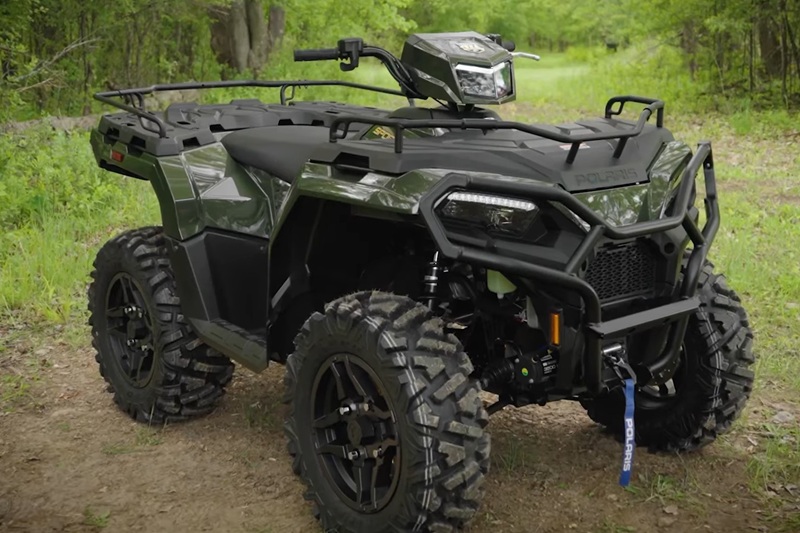
Four decades after developing their first ATV, Polaris will celebrate the anniversary with a special model of the Sportsman called the Polaris Sportsman 570 Premium 40th Anniversary Edition.
The ATV is inspired by the 1996 Sportsman 500, featuring a green livery based on that used by in the 1990s. It also comes with a special logo to commemorate the anniversary.
The 40th Anniversary Edition is almost identical to the base Sportsman 570, but is heavier with a dry weight of roughly 860 pounds whereas the stock model weighs in at 703 lbs. Part of the increased weight comes from the Anniversary Edition having bigger wheels and tires, using 14-inch aluminum wheels and 26″ Duro tires compared to the other’s 12″ steel wheels and 25″ tires.
It also comes with a 3,500-lb steel winch, LED lighting, and multi-select electronic power steering and EBS. By comparison, the base 570 has none of those and uses halogen lighting.
Otherwise, both have the same 567cc Polaris ProStar four-stroke dual overhead camshaft engine, 44 horsepower, and identical dimensions (83″ long by 48″ wide by 47″ tall).
“We are excited to be celebrating the 40th anniversary of Polaris ATVs, a milestone reflecting our enduring commitment to innovation and the off road community,” Polaris Off-Road Vehicles president Reid Wilson stated. “Across our 2026 lineup, we’ve continued to enhance our vehicles with added features and improved performance, delivering unmatched value while honoring our legacy as the American Powersports Company.”
The 40th Anniversary Edition will have a starting MSRP of USD$10,199. It, along with the rest of the Sportsman line and Polaris’ other 2026 off-road models, will be shipped to dealers in August.
The 2026 off-road lineup was revealed on Tuesday. Besides the 40th Anniversary Sportsman, Polaris also introduced the Ranger 500 for the new model year.
History of Polaris ATVs

Polaris entered the ATV industry in 1985 with the Trail Boss and three-wheeled Scrambler. Advertisements at the time touted features like their Polaris Variable Transmission, forward engine placement for increased stability, lighter yet stronger 250cc two-stroke engines. They also mentioned how accessories that were considered luxury add-ons for other models were standard on theirs like 15-inch foot rests, trailer hitches, and an electric start.
Mike Bolton of The Birmingham News wrote about the 1991 Trail Boss in October 1990:
If the ATV market has a Cadillac, this is it. This hoss boasts an unbelievably quiet and unbelievably smokeless, 2-cycle, liquid-cooled, 350cc powerplant. Automatic oil injection prevents the headache of mixing oil and fuel.
Shift the dual range, automatic transmission — yes, automatic — out of high range and into low, hit the button that engages the shift-on-the-fly 4-wheel-drive, and it feels like it will climb a tree. The 350cc engine has 50 percent more horsepower than its 244cc little brother.
The seat is big and well-padded, and MacPherson strut suspension further smoothes the ride. Standard-equipment floorboards are safe and comfortable. A trio of lights are located up front, giving it the best lighting in the industry. The headlights and radiator are well protected by a bumper. A speedometer and odometer are standard equipment, as is a 4-gallon gas tank.
The price? About $4,700. [$11,559.95 in 2025]
Polaris especially hammered home how their quads are American made, particularly taking shots at Japanese brands like the Honda FourTrax and ATC250, Kawasaki Bayou, Suzuki Quadrunner, and Yamaha Moto-4. Its U.S. roots continue to be a point of pride to this day, with its press release for the 2026 model year discussing how “Polaris is celebrating 40 years of innovation and legacy with the first American Engineered ATVs.”
ATV News and Dirt Wheels Magazine conducted six tests with each quad such as straight-line speed and turning radius. In the end, both concluded that the Trail Boss was the best. Naturally, Polaris incorporated the results into its advertising.
“Now you can own the best built ATV for less money than its so called Japanese competitor,” proclaimed one ad from the time.

In 1989, the 4×6 Big Boss was introduced with an automatic transmission and hinged cargo bed. The six-wheeler was described as a “labor-saving device” that was basically a medium between human strength and using a truck. It also came with a 34×41″ cargo box mounted over the four rear wheels, a 244cc air-cooled engine, and sides that could carry 13.68 cubic feet of supplies in side boxes. Parts from the Scrambler like oil injection lubrication and MacPherson strut suspension also carried over.
The Polaris Sportsman debuted in 1993 as a 350cc and 400cc 4×4s. Two years later, the Sportsman 500 made its entry with an independent rear suspension and 9.5 inches of wheel travel as a departure from the straight axle suspension. It featured a 499cc liquid-cooled motor, a larger 5.25-gallon fuel tank, and a dry sump system. The Sportsman line would eventually take over as Polaris’ headlining ATV.
Polaris produced its one millionth automatic-transmission ATV in 2001.
The company built the Predator line from 2003 to 2007 that used a 499cc engine and was heavier at 415 pounds. Despite its success with multiple ATV of the Year awards, it was discontinued as Polaris shifted away from sport quads. Polaris also ended the Outlaw brand, which used a KTM engine, during this shift away but it has since been brought back as a youth ATV.
Featured image credit: Polaris Off-Road Vehicles
Leave a Reply