
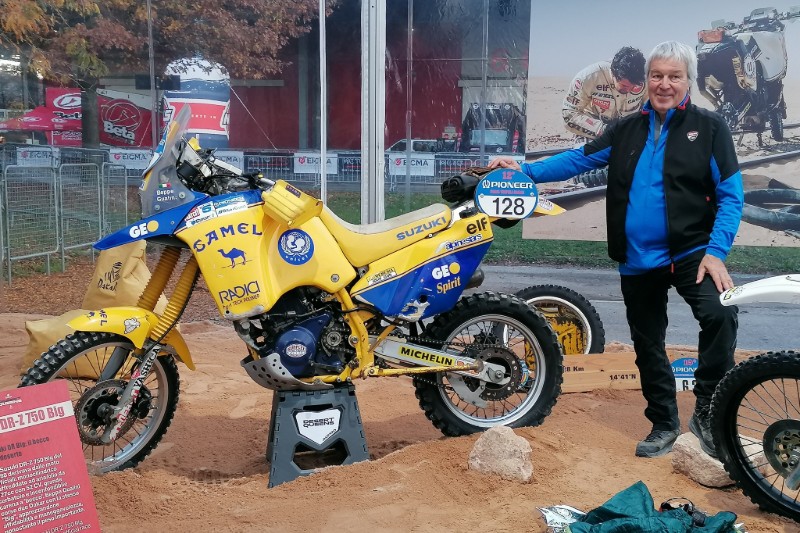
EICMA, the premier trade show for motorcycles, is usually a time for manufacturers to show off their new bikes or other related technology. The Amaury Sport Organization was also part of the convention by setting up a special exhibit called Desert Queens.
Located in the MotoLive outdoor area, Desert Queens is a 900-square meter exhibition designed after a typical Dakar Rally bivouac with memorabilia and artifacts. There are also video displays showing clips of the race over the years.
“Desert Queens is a tribute to the dream, the effort, and the greatness of the Dakar Rally,” said EICMA CEO Paolo Magri. “It is a celebration of the men and machines that challenged the desert and their own limits, driven by passion and the desire to go further.
“Bringing this legend to Milan, inside EICMA, means bringing together two worlds that share the same soul: that of adventure and innovation expressed by industry. Together with ASO, we wanted to create an immersive experience in an incredibly evocative location, rich in valuable content that combines show, memory, and technology, confirming EICMA’s role as an international platform capable of enhancing every nuance of the world of two wheels.”
Perhaps the biggest attention grabbers are the 31 bikes on display:
- Thierry Sabine’s Yamaha XT500: Sabine raced this bike in the 1977 Abidjan–Nice Rally, where he got lost in the Ténéré for three days. The misadventure inspired him to create the Paris–Dakar Rally in 1979.
- Cyril Neveu’s 1979 Yamaha XT500: A green-and-white stock bike that won the first two Paris–Dakar Rallies.
- Cyril Neveu’s 1982 Honda XR500R: In 1982, Honda modified an XR500 for rallies. Neveu, now with Honda, scored the win.
- Andrea Balestrieri’s 1982 Yamaha XT600 Ténéré: Balestrieri finished seventh in 1984 with the Ténéré, a line that was introduced in 1982. Only 50 bikes reached the finish.
- Hubert Auriol’s 1983 BMW R 80 G/S: Auriol won the 1983 Dakar with this twin-cylinder boxer-engined bike.
- Jean-Claude Olivier’s 1985 Yamaha XT600 Ténéré: Olivier finished second in the 1985 race with this bike, beginning a legacy for the Yamaha Ténéré line that continues to this day.
- Claudio Torri’s 1985 Moto Guzzi V65 TT: Moto Guzzi, whose century-old factory in Mandello del Lario is undergoing renovation, had a brief spell at Dakar with the V65 TT. While Torri’s twin-cylinder engine worked well, electrical issues knocked him out of the 1985 race.
- Beppe Gualini’s 1986 Cagiva 750 Elefant: Powered by a 748cc Ducati engine, the Elefant was a beast that ultimately couldn’t be tamed as Gualini retired. He was at EICMA and got to see both his bikes together.
- Beppe Gualini’s 1988 Suzuki DRZ 750 Big: A rally replica before the Rally Replica line existed, Gualini entered the DRZ 750 Big into two Dakars.
- Aldo Winkler’s 1989 Honda NX650 Dominator: Winkler, whose son Andrea has followed in his footsteps, retired from the 1989 race after the Honda’s fuel mixed with diesel while refueling. He was stuck in the desert for three days before being helped by Tuaregs.
- Edi Orioli’s 1990 Cagiva Elefant 900: Orioli’s second Dakar victory came in 1990 with a Cagiva sponsored by Lucky Explorer, the off-road brand of MV Agusta. While Cagiva no longer exists, Lucky Explorer is still around today and in the rally world as a partner of Kove Italia.
- Roberto Mandelli’s 1990 Gilera RC 600: 1990 was the first year with a silhouette class for upgraded production bikes. Mandelli finished 11th and won a stage.
- Roberto Boano’s 1991 Honda XRV750 Africa Twin: 12 of these were built by Honda for privateers. Boano placed 11th.
- Gilles Lalay’s 1991 Yamaha XTZ750 Super Ténéré: The 1989 winner finished runner-up with the Super Ténéré two years later.
- Angelo Cavandoli’s 1991 Yamaha YZE750: Cavandoli finished 30th on this bike.
- Giuseppe Canella’s 1993 Kawasaki KLR650: This green machine retired from the 1993 race. While Kawasaki no longer has a factory rally team, there have been rumblings of a revival.
- Alfie Cox’s 2000 KTM 660 Rally: The father of current rider Bradley Cox, Alfie won two stages at the 2000 Dakar but an engine failure relegated him to 45th overall.
- Andrea Mayer’s 2001 BMW F650RR: 17 years before she married Stéphane Peterhansel, Andrea Mayer was consistently the top woman rider at Dakar. At the 2001 race, she scored her third straight victory in the women’s subcategory with a 30th overall.
- Fabrizio Meoni’s 2002 KTM LC8 950 Rally: Meoni scored his second straight Dakar victory in 2002 on the 950 Rally, which featured a 942cc V-twin engine.
- Cyril Despres’ 2009 KTM 660 Rally: After the 2008 Dakar was canceled, 2009 was Despres’ first as a Red Bull factory rider. He won four stages and finished second.
- Francisco López Contardo’s 2011 Aprilia RXC 450 Rally: “Chaleco” López is currently a star on four wheels with three Dakar wins across the UTV and Challenger classes. Before that, he raced Dakar on two wheels for seven years, including a three-year stretch with Aprilia. He couldn’t podium for a second year in a row in 2011, but still won a stage and placed fourth. 2011 was also the first year where the 450cc maximum engine displacement was introduced; for this reason, Aprilia no longer goes to Dakar but still does rally raids with a too-strong-for-FIM bike.
- Marc Coma’s 2014 KTM 450 Rally Factory: Coma rode the KTM 450 Rally Factory to back-to-back Dakar wins in 2014 and 2015. They were his final starts as a rider before becoming race director and eventually a navigator.
- Joan Barreda’s 2018 Honda CRF450 Rally: Barreda enjoyed a strong 2018 Dakar with three stage wins and leading the overall until he crashed and hurt his knee.
- Ricky Brabec’s 2020 Honda CRF450 Rally: After three straight DNFs, Brabec finally broke through on his fifth try to become the first American rider to win a Dakar overall.
- Danilo Petrucci’s 2022 KTM 450 Rally Factory: Petrucci became the first person to win a MotoGP race and a Dakar stage when he claimed Stage 5 outright in 2022 following Toby Price’s penalty. While that was his only Dakar on a bike, he returned this year as a truck driver and navigator.
- Franco Picco’s 2022 Fantic XEF 450 Rally: Fantic Motor made its Dakar debut in 2022 with Picco riding a prototype rally bike. He finished 50th in Rally2.
- Tiziano Internó’s 2025 Honda CRF450RX Rally: Ahead of the 2025 Dakar, Honda created a rally replica bike called the CRF450RX Rally that non-factory guys like Interno could race. He ultimately finished tenth in Original by Motul, and the tent he used to camp out during the race was also put on display.
- Ross Branch’s 2025 Hero 450 Rally: Branch entered the 2025 World Rally-Raid Championship as the defending RallyGP champion. Unfortunately, his Dakar was cut short by a crash.
- Daniel Sanders’ 2025 KTM 450 Rally Factory: Sanders’ W2RC campaign began with a bang as he led the Dakar overall from start to finish.
- Lorenzo Santolino’s 2025 Sherco SEF 450 Rally: Although Santolino finished last in RallyGP at this year’s Dakar, he and teammate Rui Gonçalves recorded Sherco’s first Dakar stage wins since 2014.
- Neels Theric’s 2026 Kove 450 Rally EX: Kove Moto underwent a fracturing of sort following founder and CEO Zhang Xue’s departure to create his own marque (which was unveiled at EICMA) and the formation of Hoto Motorcycle. Theric, one of Kove’s first non-Chinese factory riders, stayed loyal to the brand and will continue with them in 2026.
Other items on display included a rider’s suit and helmet from the 1979 race, a paper roadbook on handlebars, and the original Dakar trophy.
Gualini and Internó helped EICMA compile and curate the collection alongside the Italian Trade Agency, journalist Marco Riccardi, M@trix s.r.l., Gianmarco Blini Design, and Valerio Cometti + V12 Design. Besides the riders, they also reached out to private collectors, museums, and manufacturers for access.
“The Dakar Rally is much more than a race,” started the ASO’s David Castera. “It is a human adventure, a technical laboratory, and a challenge that has been bringing together cultures, passions, and generations of riders for almost half a century.
“With Desert Queens, we wanted to share this spirit with the international public and, in particular, with the Italian public, which has always experienced motorcycling with genuine and profound enthusiasm. Being here at EICMA, together with those who represent global excellence in motorcycling, means paying tribute to the history of the rally and, at the same time, looking to its future. It is a pleasure and an honor to see the Dakar recounted with such passion, care, and respect for its protagonists.”
The exhibit will be available from November 6 through 9.
Featured image credit: Stefano Massenz
Leave a Reply