
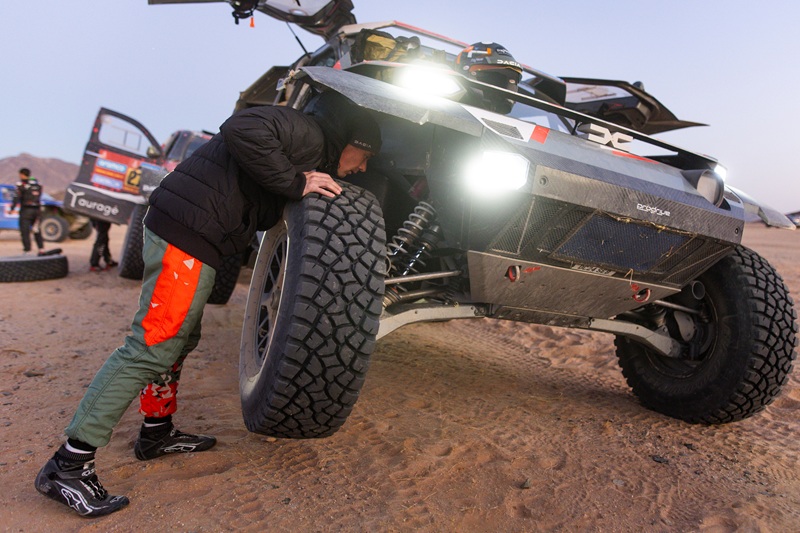
Tire failures have been a trend at the Dakar Rally in recent years, mainly because of stages predominantly taking place in areas with sharp rocks and stones. For the competitors’ sake, the ASO has reduced the amount of such sections for 2026, while stages that still have them will now include a dedicated area to change tires.
In 2026, these stages will be the first, second, and 11th.
The new pit is different from the existing refuel zones. For tire pits, assistance trucks will be allowed to park and wait for their cars to come. The driver is then given the option to press on with what they have or replace all their wheels, both currently on the vehicle and the spares.
Speaking with Mundo Deportivo on Saturday, David Castera stressed he didn’t want to fully eliminate tire punctures but felt the recent rash was too unfair for drivers. For example, the 2023 race saw Sébastien Loeb lead all drivers with seven stage wins but never had a chance for the overall because three flats put him in a deep hole early on. Tires weren’t as problematic in January’s Dakar, but the issue has sprung up too often as of late for Castera to let slide.
Part of this stemmed from the use of rocky sections like those on volcanic ash, which was a nice change of pace from the sand and dunes but obviously damaged tires easier.
Incidentally, BFGoodrich had developed an upgraded KDR3 EVO 2.0 tire for the 2026 race.
Featured image credit: DPPI / Red Bull Content Pool
Leave a Reply