
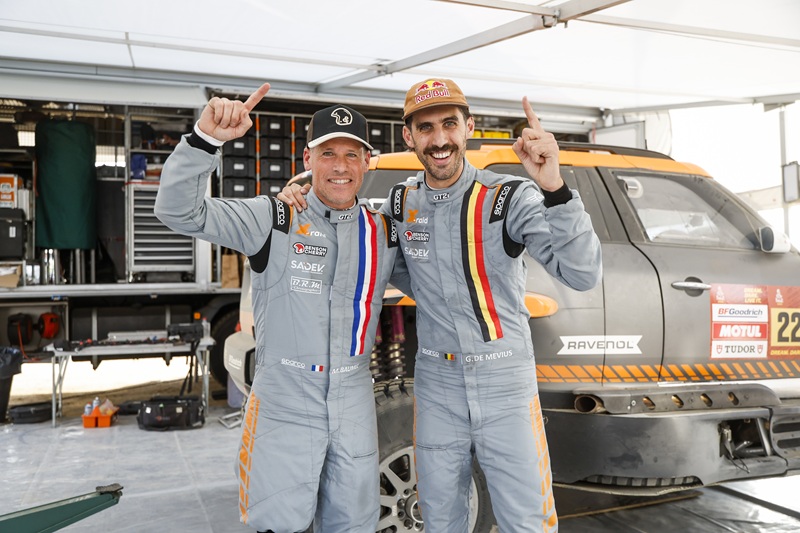
Going into the Dakar Rally, Mathieu Baumel said his main goal was becoming the first amputee to win a stage. After losing his right leg in an accident following the 2025 Dakar, the four-time winner rehabbed in time for the 2026 edition and rejoined his driver Guillaume de Mévius.
He didn’t have to wait long to cross that off his list. As many drivers struggled with speeding penalties or flat tires in the rocky terrain, de Mévius stayed the course to secure the Stage 1 victory on Sunday.
Prologue winner Mattias Ekström was the fastest for much of the day and avoided punctures, but fell off in the closing stretch and dropped to fourth. He also received a pair of ten-second speeding penalties that further relegated him to fifth as Marek Goczał moved up.
De Mévius, on the other hand, kept his head down for much of the stage. This approach proved successful as he held off Nasser Al-Attiyah by just 40 seconds. Ironically, while certainly pleased to get the stage win, he admitted it was “not really our goal. We didn’t feel like we were pushing especially hard or driving at a speed that would result in first place.”
Of course, the main winner of the day was Baumel.
“What an achievement to win a stage, especially the very first one of the rally,” he said. “The first victory was simply being at the start at all. Now it’s even better: stage win and rally lead. We need to focus even more now as we will be opening the road tomorrow, but from this point on, everything is a bonus.”
Stage 1 seemed to be a continuation of the events in Saturday’s opener as cars went fast—maybe a little too fast, even—or had tires go down.
The FIA handed out 61 penalties specifically for speeding on Sunday. Three cases happened on the liaison including de Mévius’ X-raid teammate Maria Luís Gameiro going 58 kilometers per hour, though her infraction wasn’t as bad as Silvio Totani getting caught at 61 km/h and certainly not Óscar Ral’s 122.
Jürgen Schröder, on his own after his son crashed out in the Prologue, received the heftiest total punishment for speeding as he was handed 15 minutes for exceeding 100 km/h in 30 zones. Jean-Pierre Strugo got ten minutes for the same, going even faster at 108 km/h.
The bikes weren’t safe either. While not as egregious as their FIA counterparts, the FIM dropped the hammer 34 times because riders were going too fast.
Ross Branch suffered most of the riders. He impressed by holding off the KTMs of Edgar Canet and Daniel Sanders for the stage win, but had six minutes tacked on for speeding that dropped him to seventh.
“About three quarters into the stage, I got stuck behind another rider in the dust for a long time. When I finally made a move to pass, I unknowingly went through a speed zone, which cost us time,” Branch explained. “Despite that, I’m super happy with the bike and how everything feels, and I’m really looking forward to the rest of the rally.”
Like Branch, Paul Spierings lost the Challenger stage win because he sped twice for 70 seconds of penalties. This lifted David Zille into the top spot.
On the other hand, Aleš Loprais was hit with 2:10 for speeding but still held on for the Truck victory. Even with the penalties, he cleared Mitchel van den Brink by 1:47.
What specifically led to this rash of speeders will vary, but some have theories. Aisvydas Paliukėnas, the navigator for Benediktas Vanagas, pointed out that most drivers didn’t want to open the stage and thus had sandbagged in the Prologue. This is a fairly common tactic to the point where the FIM introduced time bonuses for the first riders on course, but the dust kicked up by the car in front led to them falling behind. Presumably in an attempt to make up the lost time, they overcompensated by going faster.
Vanagas, who had commented on the “suicidal” pace of some drivers on Saturday, avoided the same fate by racing conservatively. His focus is “to accumulate capital until the rest day, then we will see where to invest it.”
The terrain certainly didn’t help either. Stage 1’s course alternated between fast canyons and rocky plateaus with wadis in between that became tougher to navigate after rain washed over them. A sandstorm even arrived and erased whatever lines the lead vehicles had put down.
Of course, the large rocks meant more risk of tire punctures. Kyle Chaney, fresh off a third in SSV in the Prologue, suffered greatly with four flats. The ASO hoped to rectify this by adding a designated tire changing area at KM 179.
Due to Branch’s penalty, Edgar Canet inherited the bike stage win. With Michael Docherty topping Rally2, both FIM classes maintain their overall leaders from the Prologue.
After a disastrous Prologue where he had to walk his bike to the finish after an ignition coil failure, Neels Theric was the 115th and final rider on course for Stage 1. Despite starting way after everyone else, he rebounded from Saturday to finish 11th in Rally2.
The day was tough for Century Racing, adding to an already stressful week to date. Mathieu Serradori took a wrong turn at a fork while deciding which valley to enter and lost six minutes, but came out relatively fine with a 19th. Brian Baragwanath had a flat just one kilometer in, then an engine pressure sensor broke and sprung a leak that trailed his CR7 back to the bivouac; the team noted this specific switch wasn’t supposed to be in the engine. Century clients Tim and Tom Coronel suffered a bent steering rod along with a puncture.
Ignacio Casale had an electrical issue in his alternator after 20 kilometers. His former colleagues at Buggyra ZM Racing also experienced a difficult Sunday on both the Ultimate and Truck sides.
Aliyyah and Martin Koloc both got stranded in the rocks with damaged wheels. Martin stopped to replace the rear arm after another wheel broke off, only for it to snap back and break his pinky finger. Karel Poslední, despite being one of Buggyra’s competition trucks, sacrificed time to help Aliyyah change the wheel before towing her REVO to the service zone. Since they took the highway to get back to the bivouac, the younger Koloc was officially designated as a retirement.
Poslední’s Buggyra teammate Martin Šoltys had his truck’s turbocharger burn out while running top three, costing him three hours because he had to wait for it to cool down before replacement.
“There’s nothing you can do: that’s Dakar,” Poslední remarked.
James Hillier had the dubious distinction of crashing in Stage 1 for the second year in a row. Unlike in 2025, he can’t continue this year because his accident threw him into rocks and broke his arm. Likewise, Nicolas Horeaux had an accident at KM 213 that fractured his pelvis and shoulder.
Lorenzo Santolino crashed, breaking his finger and tearing a hole in his knee that required stitches. Still, he’ll be able to continue now that he’s patched up.
Rokas Baciuška held off Toyota Auto Body’s two drivers to win in Stock, becoming the first driver to claim stage victories in every W2RC FIA category; he won the 2025 Dakar’s Chrono Stage for Ultimate, and before that was a T4 and T3 champion. While he has yet to win in Truck, it does not award a W2RC trophy. Baciuška’s teammates weren’t as lucky as a rock smashed the rear arm on Sara Price’s Defender while Stéphane Peterhansel lost power steering.
Given the modern cars and bikes had a tough time, one could only imagine how bad it was for the vintage racers in the Dakar Classic. Indeed, Tomasz Staniszewski’s Porsche 924 had a driveshaft failure that knocked him out for Stage 2 while his team had to wait for a replacement to arrive from Poland. Fellow Pole Tomasz Białkowski saw the tire inflation and deflation system on his DAF Bull’s front tires break, leading to a flat that needed to be switched, then the comms in Dariusz Baśkiewicz’s helmet glitched out so he swapped places with Adam Grodzki for a while. Baśkiewicz’s distance meter also broke but Białkowski had a spare.
Henry Favre had it rough. Already facing an uphill battle going through the rocks in a Mitsubishi Delica, he and Alessandro Iacovelli lost their backpack containing food and passports because they accidentally left the van’s sliding door open.
Mission 1000 saw Benjamin Pascual, Jordi Juvanteny, Yi Guanghui, and Miguel Puertas complete all 92.74 kilometers and achieve Eco Mode, with Pascual missing out on the two-hour mark by just 50 seconds.
Stage 1 winners
FIA
| Class | Overall | Number | Driver | Team | Total Time |
|---|---|---|---|---|---|
| Ultimate | 1 | 222 | Guillaume de Mévius | X-raid Mini JCW Team | 3:07:49 |
| Challenger | 32 | 305 | David Zille | BBR Motorsport | 3:32:50 |
| SSV | 45 | 407 | Xavier de Soultrait* | LOEB FrayMédia Motorsport | 3:38:45 |
| Stock | 107 | 502 | Rokas Baciuška | Defender Rally | 4:04:59 |
| Truck | 51 | 602 | Aleš Loprais* | Loprais Team de Rooy FPT | 3:42:19 |
FIM
| Class | Overall | Number | Rider | Team | Total Time |
|---|---|---|---|---|---|
| RallyGP | 1 | 73 | Edgar Canet | Red Bull KTM Factory Racing | 3:16:11 |
| Rally2 | 9 | 14 | Michael Docherty | BAS World KTM Racing Team | 3:25:09 |
Other
| Class | Number | Competitor | Team | Points |
|---|---|---|---|---|
| Classic | 705 | Marco Leva* | R Team | 71 |
| Mission 1000 | 1000 1002 1004 1040 | Benjamin Pascual* Yi Guanghui* Miguel Puertas* Jordi Juvanteny* | Segway Racing Segway Racing Segway Racing KH-7 Ecovergy Team | 10 |
Leaders after Stage 1
FIA
Prologue results are not included in FIA times, so Stage 1 winners are the overall leaders.
FIM
| Class | Overall | Number | Rider | Team | Total Time |
|---|---|---|---|---|---|
| RallyGP | 1 | 73 | Edgar Canet | Red Bull KTM Factory Racing | 3:27:42 |
| Rally2 | 9 | 14 | Michael Docherty | BAS World KTM Racing Team | 3:36:59 |
Other
| Class | Number | Competitor | Team | Points |
|---|---|---|---|---|
| Classic | 705 | Marco Leva* | R Team | 71 |
| Mission 1000 | 1000 1002 | Benjamin Pascual* Yi Guanghui* | Segway Racing Segway Racing | 25 |
Featured image credit: Julien Delfosse / DPPI / ASO
Leave a Reply