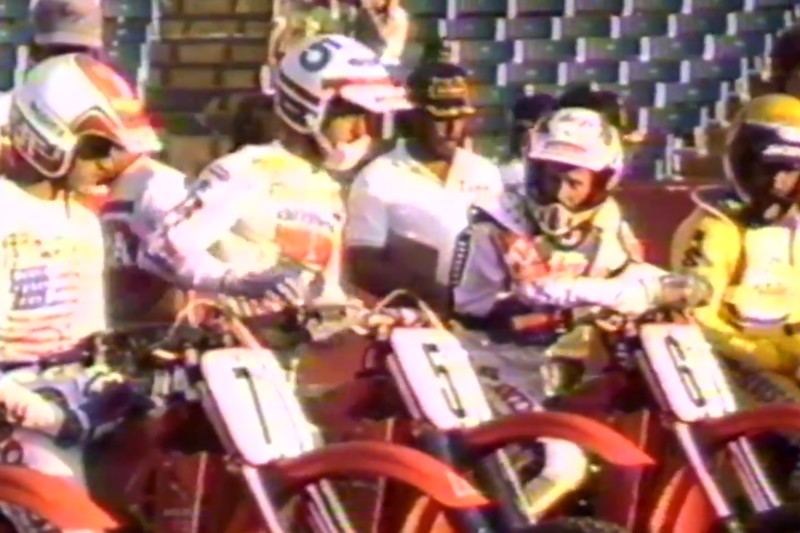
After 52 years, Highmark Stadium is about to become a thing of the past. When demolition begins in March 2027, also gone will be the ghosts of when the Buffalo venue hosted AMA Supercross for the first and only time in 1984.
The home of the Buffalo Bills hosted what was ultimately its final game on January 4, when the hosts blew out the New York Jets in the regular season finale. Since the Bills didn’t win the AFC East and entered the playoffs as the #6 seed in the conference, the only chance they had of playing one more game in Orchard Park was if they and the seventh-seeded Chargers both reached the AFC Championship Game.
Although the Bills beat the Jacksonville Jaguars in the Wild Card Round, the Chargers lost to the New England Patriots in theirs on Sunday. Even if the Bills beat the top-seeded Denver Broncos in the Divisional Round next Sunday, their seeding means they will have to visit either the Patriots or Houston Texans for the conference title.
The new Bills venue, also called Highmark Stadium and located right across the street from the old one, will open in time for the 2026 season opener. While it won’t be demolished until 2027 and could very well be used for something like a Super Bowl parade if the Bills pull it off this year or the next, the team has already started auctioning off the original stadium’s fixtures like seats, the turf, goal posts, and even the trough urinals.
Highmark Stadium I opened in 1973 as Rich Stadium to replace the Bills’ first home of War Memorial Stadium. The name came from a lucrative title sponsorship courtesy of Rich Products that would ultimately last through 1997, after which it became Ralph Wilson Stadium in honor of the team owner. It would also be known as New Era Field and Bills Stadium before Highmark, a healthcare and insurance provider, came aboard in 2021.
Football was basically the stadium’s only viable sport due to how the sight lines and field dimensions were built. Save for the inaugural NHL Winter Classic and larger concerts for the Buffalo area, it didn’t see much use outside of football.
Though there was a certain mid-July weekend in 1984…
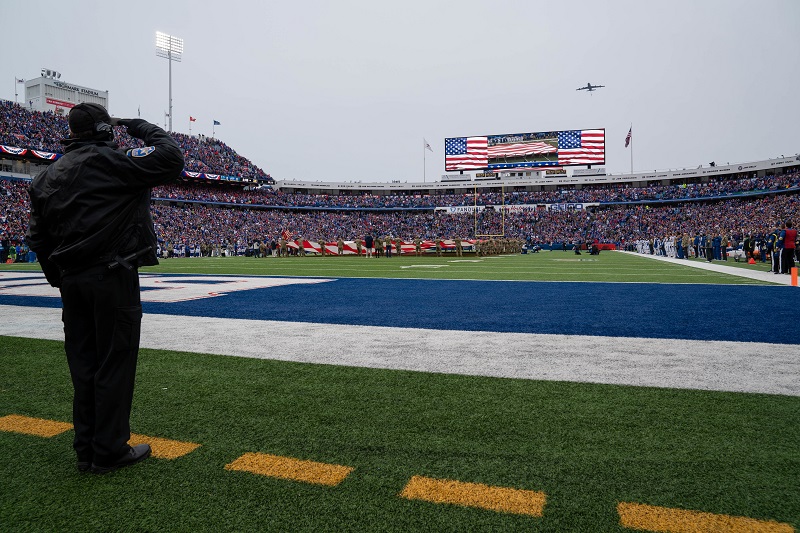
Credit: Senior Airman Michael Janker / 107th Attack Wing
Buffalo wanted to do something more to stimulate its sports scene. The Sabres were a perennial playoff contender, but the Bills were the NFL’s laughingstock save for a few ultimately fluke playoff appearances while the Bisons had modest results.
Even though Rich had only been open for a smidge over a decade at this point, its football-only status meant the city considered building a $50 million domed venue that could also entice an MLB team. Rich obviously wasn’t optimized to do that, with its 1983 itinerary consisting of ten Bills home games and the Section VI Football Federation high school playoffs.[1] The latter was a disaster as a paltry 7,446 fans showed up across the five games due to the cold, threat of snow, and possibly the $5 ticket prices.[2]
That didn’t mean people weren’t going to try to get something out of Orchard Park, and Mike Goodwin was behind that effort.
Goodwin is considered the father of modern supercross, helping to organize motocross races at America’s iconic sports venues. He and Mickey Thompson, the latter doing the same for stadium trucks, worked together to host races in the 1970s and ’80s until financial troubles led to their partnership falling through. The fallout was deadly as Goodwin hired hitmen to kill Thompson and his wife, for which he was sentenced to life in prison in 2007.
Four years before Thompson’s murder, Goodwin was looking to bring more AMA Supercross races to the Northeast. The region already had some rounds like in the Patriots’ domain of Foxboro, but Western New York was an untapped market. This naturally aligned with Buffalo’s interests, and Ralph Wilson Industries was onboard too. After some talks, the Miller High Life Supercross was scheduled for July 14, 1984.
As a sort of ‘dress rehearsal’, the stadium hosted the Grand National Motor Spectacular on June 30, a touring outdoor motor show that included events like a tractor pull and demolition derby. Dirt was hauled in by Kansas City-based United Sports and placed atop the AstroTurf.[3]
Stadium manager Don Guenther quipped to The Buffalo News that he was honestly “a little more nervous with a football game” when it came to the turf’s safety than for the GNMS or motocross. In particular, he remembered a 1980 game when the Bills beat the Miami Dolphins for the first time in a decade, leading to elated fans rushing the field and tearing up chunks of the turf. Monsanto, who made Rich’s replacement turf in 1981, also assured the Bills that any damage would be covered by their warranty.[3]
“It’s really no different than putting on a rock concert where you have tons of equipment on stage,” Guenther commented.[3]
After the GNMS, the dirt was hauled out before coming back two weeks later for Supercross.
To build the motocross track, United placed down a layer of construction grade plastic over the playing surface followed by double stacks of plywood and another sheet of plastic. 3,500 cubic yards of dirt followed, then another 250 to 300 truckloads of dirt for the track’s jumps.[3] Mike DiStefano, one of Goodwin’s lieutenants, designed the course.[4]
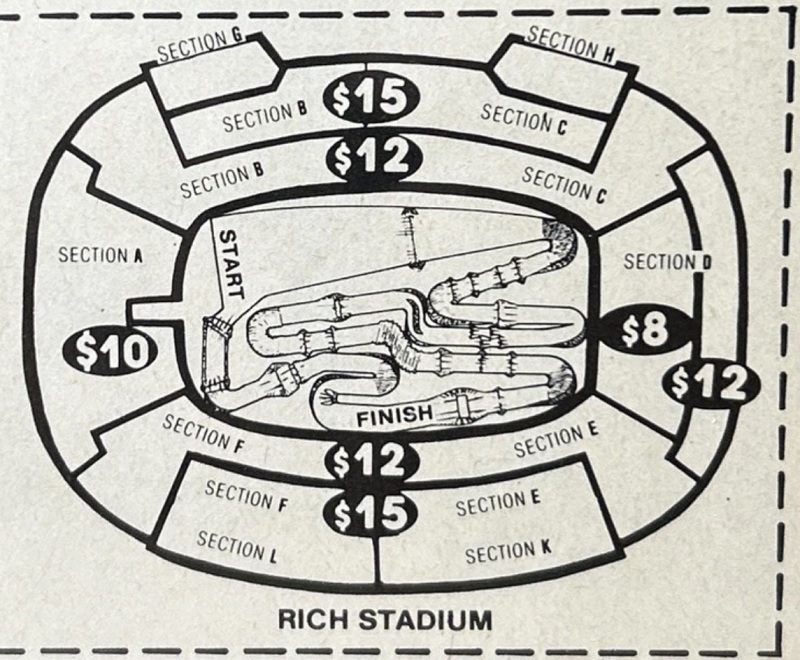
The Miller High Life Supercross was the 11th race of the 1984 Supercross season.
The racing began with four heat races. Bob Hannah claimed the first, Jeff Ward the second, Mark Barnett the third, and David Bailey secured the fourth. This was followed by Eric Hall and Jim Anderson winning the two quarterfinals, Ward and Bailey in the semis, and Rodney Smith taking the last chance race.[5] A handful of “support” races on Honda ATCs also took place as “comic relief”.[4]
Points leader Johnny O’Mara dominated the feature from start to finish. David Bailey tried to close the gap and gained some ground by Lap 10, but couldn’t find any opening before falling back so he settled for second. Ron Lechien held off Ricky Johnson for the last step on the podium and a Honda sweep.[6]
Whether because of sour grapes or legitimate complaints, other rivals weren’t exactly pleased with the track. Johnson was quoted by Dirt Bike Magazine as saying the “stupid promoters had their heads screwed on wrong,” while Hannah proclaimed the sport “has definitely gone downhill since InSport took over. Who wants to see a race where the holeshot guy always wins?”[4]
A crowd of 22,400 was in attendance for Round 11, a smidge below the expected turnout of 30 thousand.[5][7]
Series officials said there was a “very good possibility” of a return to Buffalo in 1985, but that never happened.[7]
Maybe things’ll change when the new Highmark Stadium opens.
References
[1] “To Be or Not to Be” by Salem Alaton, The Globe and Mail, April 7, 1984
[2] “Cold Weather Hurt Gate at Rich Playoffs” by Bob Dicesare, The Buffalo News, November 15, 1983
[3] “Stadium Gearing Up for Tractor Pull, Mud” by Michael Beebe, The Buffalo News, June 24, 1984
[4] “New fans & angry riders” by Lori Fontanes, Dirt Bike, October 1984
[5] “22,400 See Omara Win in Supercross” by Paul Mecca, The Buffalo News, July 15, 1984
[6] 1984 Supercross Highlights narrated by Gary “Professor” Bailey
[7] “Rain Plaguing Area Tracks” by Paul Mecca, The Buffalo News, July 16, 1984
Featured image credit: 1984 Supercross Highlights by Gary Bailey
 131 Off-Road
Leave a comment