
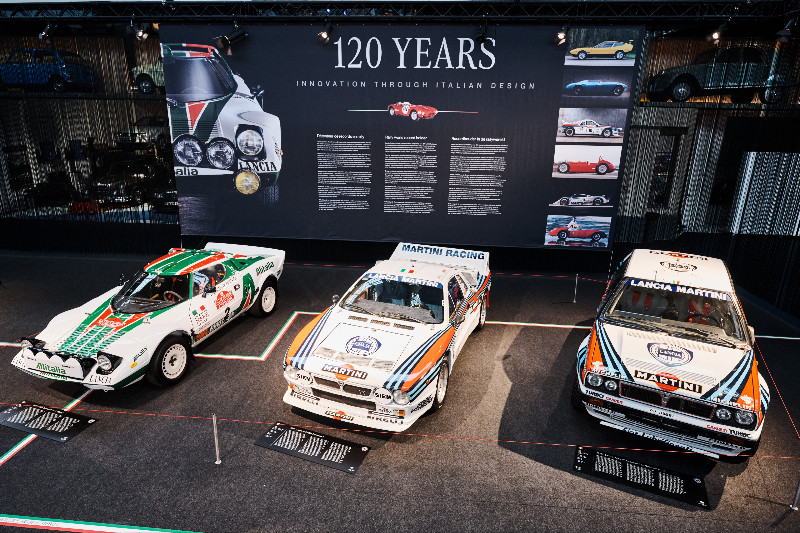
From February 27 to April 19, Autoworld in Brussels is hosting an exhibition to celebrate Lancia’s 120th anniversary. Known as “Lancia 120 Years – Innovation Through Italian Design”, 12 cars are on display including three from rallying.
The rally exhibit has a Lancia Stratos HF from 1974, 1984 037 Evolution II, and 1990 Delta Integrale 16v Gr.A. The wall behind them reads:
Rally world record holder
Lancia officially competed in the World Rally Championship from 1973 to 1991. To this day, it remains the most successful manufacturer in the history of the championship. In total, Lancia won ten Manufacturers’ titles and four Drivers’ titles. With the Delta, the brand secured six consecutive Manufacturers’ Championships. Lancia officially withdrew from rallying in 1994 but returns this year with the Ypsilon Rally2 HF Integrale.
From the 1950s onward, Lancia became increasingly prominent in rally competition. Its first major international victory came at the 1954 Monte Carlo Rally, with Louis Chiron driving a Lancia Aurelia B20 GT. The Flavia Coupé won the San Remo Rally twice. In the mid-1960s, Lancia professionalised its rally efforts with the Fulvia 1300 and 1800 HF models, achieving numerous prestigious international victories. In 1972, the Fulvia 1600 HF of the Lancia Marlboro Team secured the final International Manufacturers’ Title, before the official launch of the World Rally Championship (WRC) the following year.
Stratos: In 1974, the Stratos was introduced, effectively the first car in history designed specifically for rallying. That same year, Lancia claimed its first Manufacturers’ World Championship. The Stratos won numerous international events and went on to secure two additional Manufacturers’ titles. From 1978 onward, the Fiat Group favoured the Fiat 131 Abarth in the WRC, yet privately entered Stratos cars continued to win World Championship rallies on a regular basis. Its final international victory came at the 1981 Tour de Corse, driven by Bernard Darmiche.
037 and S4: In 1982, Lancia entered the new Group B category with the Rally 037, prepared by Abarth, as had been the Stratos. In 1983, the 037 achieved five victories and won the Manufacturers’ Championship, becoming the last rear-wheel-drive car to do so, despite growing competition from the Audi Quattro and Peugeot 205 Turbo 18. At the end of 1985, Lancia introduced its new rally weapon, the Delta S4. This era ended tragically following several fatal accidents, and from the 1987 season onwards the Group B category was banned.
Delta Integrale: The championship then moved to Group A regulations, and Lancia proved to be the manufacturer best adapted to the new rules with the Delta. In the years that followed, the Delta HF 4WD, HF Integrale 6v, HF Integrale 10v and HF Integrale 16v Evoluzione became the dominant forces in world rallying. From 1987 to 1992. Lancia won six consecutive Manufacturers World Championships. The brand also claimed the Drivers’ Championship with Juha Kankkunen and Miki Biasion in 1987, 1988, 1989 and 1991.
Most of the cars come from the Stellantis Heritage Hub in Turin, while the Integrale came about via a “collaboration that has brought together models of exceptional historical and sporting value, all in a single space.”
The rest of the exhibit is split into two parts. The first focuses on Lancia’s technological innovations and advancements starting with the 1922 Lambda, regarded as the world’s first productioncar with a self-supporting body. Also on display are a 1935 Astura, 1937 Aprilia, 1952 Aurelia B20 Coupé, 1952 Pininfarina PF200, 1956 Florida four-door prototype, 1961 Flaminia, 1986 Thema,
The second section centers around motorsports. Besides the aforementioned trio, there is also a Fulvia 1600 HF Fanalone and the late ’50s-era Lancia D50 F1 car.
Featured image credit: Stellantis
Leave a Reply