
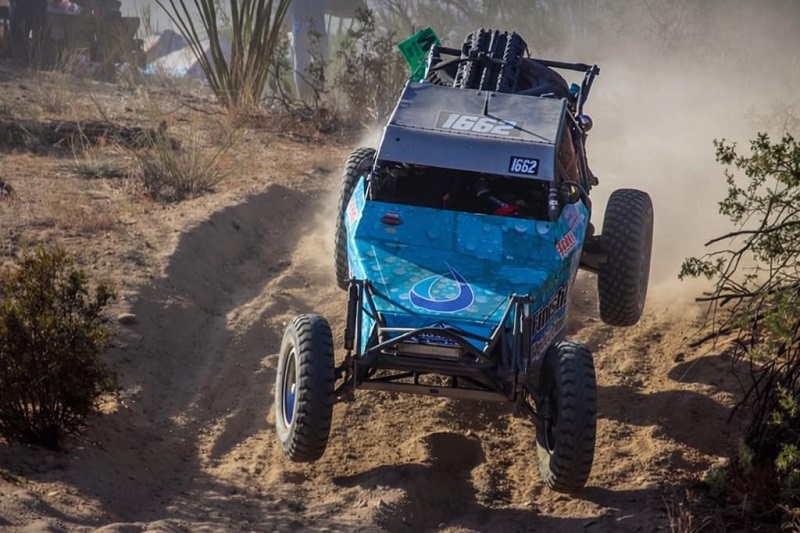
Three drivers were disqualified from last Friday’s Mint 400 Limited Race, two of whom were in Class 1/2-1600: Julie Boyer had gotten busted for non-regulation fuel, while Ezra Ebberts was flagged because of an illegal restrictor plate.
Although the offending parts technically did break the AORC’s rules for them, Boyer pointed out both are legal in other series. Each series obviously has the right to set its own regulations, but Boyer feels this only leads to confusion because drivers often compete in multiple championships with the same vehicles.
For example, the AORC mandates a 27-millimeter restrictor plate for two-seater 1600 cars. This was in line with what the AORC’s predecessor Unlimited Off-Road Racing used, but UNLTD’s merger partner Best In The Desert required the plate to be 24 mm. The Legacy Racing Association and SCORE also set the restrictor at 24 millimeters, whereas VORRA has it at 25. Two-seat 1600s in MORE and SNORE, on the other hand, don’t use plates at all.
On the fuel side, all of the aforementioned series except for SCORE and Legacy permit a maximum of 91 octane from gas pumps. This rule is in place to ensure engines don’t go faster than those on lower-graded fuel. However, Boyer noted it’s “largely outdated” since higher octane doesn’t increase horsepower or efficiency if it’s from the pump.
The lack of consistency between desert series has been a recurring issue over the years. The 2025 Mint 400’s Limited Race saw five Can-Am Maverick R drivers disqualified because the maximum width of the UTV in its stock form exceeded UNLTD rules; SNORE and UNLTD would eventually tweak their rules months later, though the DSQs remained in place.
In March 2025, the promoters of Ultra4, BITD, SNORE, Legacy, and VORRA hosted a summit to discuss issues they face and how to make their rulebooks more uniform. UNLTD and BITD merging to create the American Off-Road Racing Championship was also supposed to be a step in this direction.
Boyer advocated for having representatives from every category come together to create a standardized rulebook for use across every championship.
“This isn’t about criticizing any one organization,” wrote Boyer. “Every promoter is working hard to grow the sport and put on great races. But when racers compete across multiple series, one consistent set of technical rules would benefit everyone: racers, teams, builders, sponsors, and promoters.
“Off-road racing is growing rapidly, and if we want to continue growing the sport and supporting the racers who make it possible, it may be time for all of us to come back to the table and work toward one unified rule structure for off-road racing.”
Leave a Reply