
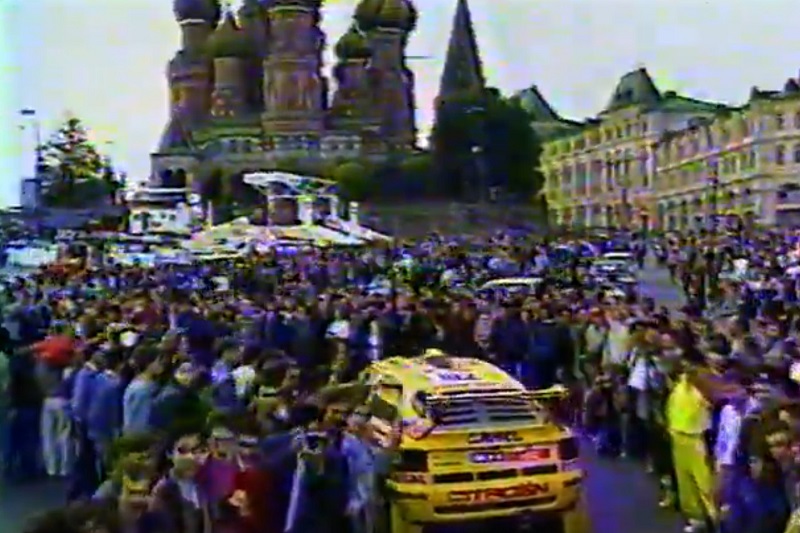
The ghosts of Lenin and Stalin don’t seem to be rally raid fans. When the country they created wanted to host its own raids, things went south each time. By the time a rally finally passed through the Motherland, the Soviet Union was off to the dustbin of history.
A disappointment for sure, but they could at least look forward to the fall of 1991 when an even more ambitious race was to take place and hosted by as good of an organizer as it got. The Paris–Moscow–Beijing Rally, overseen by three-time Dakar Rally winner René Metge and sponsored by Mitsubishi, was to commence in September as the ultimate adventure across Europe and Asia.
As luck would have it, that didn’t happen either.
Creating the Race
Metge was already a legend in the rally world at the turn of the decade. He was the first driver to win the Paris–Dakar Rally overall multiple times when he triumphed in 1983 and 1984, then added another in 1986. A year after his third victory, he became the Dakar’s director and spent the next two races in the position.
As the decade turned, he wanted to make the world’s toughest off-road races. In 1990, he organized the Harricana snowmobile raid from Montreal to James Bay. The Harricana took many pages from the Dakar, being a two-week race that tested one’s physical and mental endurance, and even attracted Dakarians like Hubert Auriol (who also served as Dakar race director like Metge), Serge Bacau, and Cyril Neveu alongside F1 race winner Patrick Tambay and Le Mans legend Henri Pescarolo.[1][2]
At the same time, Metge hoped to do something even bigger in his main trade. As great as the Paris–Dakar was, he envisioned going eastward across the width of Eurasia.
The announcement came on February 16, 1990. By far the longest auto race in the world, his project was to span 11,000 miles from Paris to Beijing with Moscow in the middle.
The Paris–Moscow–Beijing Rally, as it was named, was directly inspired by the Peking to Paris.[3] European attempts to revive or replicate that 1907 adventure couldn’t happen after the rise of the USSR and the Cold War, though similar efforts occurred over the years like Citroën’s Yellow Expedition in 1931–1932 and Operation Dragon in 1985. Pierre Tourlier, the personal chauffeur of French President François Mitterrand and a Dakar Rally veteran, and his friends tried a 1989 run from Paris to Tokyo with Moscow and Beijing as stops, though the Tiananmen Square protests and miners’ strikes across the Soviet Union forced them to turn back.[4][5]
As political tensions cooled at the turn of the decade, the perfect opportunity arose for a proper race. Metge even emphasized his rally was a celebration of reconciliation between East and West.[6]
Metge actually beat Vitali Smirnov and Ercole Cacciami to announcing his race by over two months. However, MOVLAD wanted to be more ambitious by kicking off on August 18 just four months after its reveal. The Paris–Moscow–Beijing, on the other hand, set a more feasible time frame in September 1991.
Whereas MOVLAD was independent, Metge and Société MAPS had blessings from plenty of the big names.[6] MAPS SARL was a non-profit subsidiary of Mitsubishi Corporation, who served as the race’s main financier.[7] The FIA, via the Fédération Internationale du Sport Automobile, and French ASN Fédération Française du Sport Automobile were to oversee race ops,[8][9] while Land Rover offered a fleet of 37 Discoverys and Defenders as service and assistance cars. The latter was a similar arrangement to what JLR currently has with the ASO at Dakar.[10] In total, organization cost about $24 million while the contract to run the race spanned five years.[6][11]
The Soviet and Chinese governments gave their blessings too.[12] Sovintersport, a branch of the Ministry of Sports and Physical Culture that handled Soviet affairs in international sports, signed a contract with Mitsubishi to better coordinate the race.[13]
“It is of great interest not only among motorsports professionals and amateurs, but also in the business world,” Pravda remarked.[13]
Route and Rules
Preliminary recces for the route were conducted by Chinese and Soviet personnel in September and October 1989.[12]
The race was to start at the Place de la Concorde in Paris.[1] From France, it would go through Brussels, Berlin, and Warsaw before reaching the Soviet Union via Brest and Minsk in Belarus and eventually Moscow’s Red Square. This 2,987-km stretch across Europe was the easy part as it’s basically a three-day liaison on paved highways.[6][7] The “real” racing would’ve began in Moscow with a prologue on September 3.
After heading south of the capital into Tula, the race made for Tolyatti, the home of AvtoVAZ and Lada. It then crossed the border into Kazakhstan via Aktobe.[14] Shubarkuduk would host the next stage, followed by a run along the Garabogazköl lagoon and further down to the Karakum Desert. Darvaza in Turkmenistan, the site of the famous Door to Hell fire pit, and the Uzbek cities of Samarkand, Bukhara and Tashkent were next on the itinerary followed by Kyrgyzstan’s Tian Shan mountain range. Naryn and Bishkek were the final stops in Central Asia.[6][7][11]
Kashgar would be among the first stops in China.[14] The route was to then go through the Taklamakan and Gobi Deserts and along the Yellow River. Dunhuang, a stop on the Silk Road, would have the last rest day before racers made for the final destination in Beijing.[6][7] Altogether, 75 towns and villages would get to see the race.[6]
The route in Asia later inspired modern raids like the Silk Way Rally and Taklimakan Rally, while Karakum is currently used by the Turkmenistan Rally-Raid Championship. What might seem like random towns in Central Asia was heavily emphasized since Metge opted to bypass large cities, feeling steppes and the countryside made for a more enticing journey as he loved visiting remote villages.[11]
Besides the massive route, Metge wanted the race to be “democratic”. Competitors whose cars (bikes were not invited)[15] broke down could not rely on their crews for help, meaning they must resolve the issues on their own, get the help of other drivers, or wait for the organization’s service vehicles to come. This stipulation is used in today’s rallies on marathon stages whereas Metge extended it to the entire race, and was supposed to bridge the gap between factory-funded teams and privateers.[11]
In December, FISA announced plans to create a world cup for marathon rallies like the Dakar and PMB. FIA boss Jean-Marie Balestre envisioned “one marathon rally on each continent”, including a “trans-American race and another rally in the Middle East”.[16] The FISA Cross-Country Rally Championship would eventually become the FIA World Cup for Cross-Country Rallies then the current World Rally-Raid Championship. Dr. Cacciami wanted to see MOVLAD on the calendar too despite Metge’s race filling the Eurasian slot, though MOVLAD’s quiet demise obviously put an end to that.[17]
Speaking of races that didn’t take place…
“The Great Route to the East is Open”
1990 came and went, and 1991 arrived. The race was set to tee off on September 1 and span 27 days.[7]
Intrigue ran high as the months passed. Approximately 50 journalists were invited to cover the race in person, including four Soviets. Pravda took issue with how few of their own were on the media roster and called it “discrimination”; Mitsubishi promised more would be invited for later editions, though the official newspaper of the Communist Party felt this was “scant consolation” because the rally was only scheduled to run for five years.[11]
In factories and dealerships, teams were gearing up for the transcontinental adventure of a lifetime. 220 crews in total were expected to take part, with the USSR being represented by a trio of Lada Nivas (built by AvtoVAZ’s chief engineer Vladimir Guba) along with two KAMAZ-master trucks.[11] Casio sponsored a three-pronged Land Rover Discovery factory team from Japan, which debuted its challengers at the Tokyo Motor Show.[10]
Danny LaPorte lamented that bikes wouldn’t be present, but the eventual 1992 Paris–Cape Town Rally runner-up was open to trying out driving. The American said, “From what I’ve heard of it, I want to be there. I love that kind of racing.”[15] Benoit Desroches, who finished third in the inaugural Harricana and 20th in 1991, had no rally experience but was signed up in a Jeep with future Dakar bike racer Charles Cuypers as his navigator. Their Cherokee was one of three to be fielded by Pierre Fougerouse, who finished third in the 1983 and 1985 Dakars.[6]
Not everyone could make the trip, unfortunately. Some of the larger manufacturers like Citroën had to politely decline because they were focusing on the Rallye des Pharaons in October.[18] It couldn’t be helped.
Even without the juggernauts of the sport, the TSO took notice. Officially, the main reason that the 1992 Dakar finished all the way down in Cape Town was to stimulate a race that head honcho Gilbert Sabine felt was “getting a bit tired. Why not cross Africa from North to South for a change?”[19]
SCCA ProRally regular and PMB entrant Andrew Wos felt there was a “bit of one-upmanship involved” in the TSO’s decision.[20] After all, despite being the crown jewel rally raid of the time and Metge’s previous role within the organization, the TSO wasn’t going to let an upstart race usurp the Dakar’s throne.
For Metge, he was basically on cloud nine. He emphasized repeatedly how much it meant to him that the race would be the bridge between East and West, sentiment that was growing apparent across Europe. Germany had reunified two years earlier, while Mikhail Gorbachev’s reforms like glasnost and perestroika enabled Western interest in the gradually-opening Iron Curtain (MOVLAD being an example of this as it was jointly funded by Italians).
“The fact that a caravan of over 200 vehicles will soon begin its almost month-long journey from Paris through Moscow to Beijing is, if you like, a sweet, magical dream come true,” said Metge on August 15.[11] “No, really, all of this seemed like an impossible fairy tale just yesterday. Now, every issue have been resolved. This became possible thanks to the radical and progressive changes taking place in the USSR and China. The great route to the East is open.”
The changes being “radical and progressive” was right. Maybe a bit too radical and progressive, even.

Credit: collectionalpha / eBay
The August Coup
Amid the optimism in the West about their soon-to-be friends in the East, the Soviet Union was unraveling. Besides the aforementioned reunification of Germany, a wave of revolutions toppled communist governments across Eastern Europe. The USSR still stood, but its seams were coming undone as several Soviet republics declared independence like the Baltics or sovereignty such as Ukraine. A referendum was held in March where voters agreed to reform the union into a confederation, though nearly half the member states boycotted.
Those policies Metge praised for their “radical and progressive” nature? They rubbed hardliners like Gennady Yanayev the wrong way. On August 18, 1991, the Soviet Vice President and his allies made their last-ditch effort to save the USSR: overthrow the presidency. A coup d’état.
Gorbachev was held hostage at his dachau in Crimea by KGB agents supportive of the GKChP (State Committee on the State of Emergency), but refused to resign as pro-coup tanks descended upon Moscow. Boris Yeltsin, whom the putschists failed to capture, led the presidency until Gorbachev’s return. The crisis would be resolved by August 22 with the GKChP’s arrests and Gorbachev’s restoration as leader.
State media and the public framed the debacle as potentially thrusting them back to darker times. A Russian journalist for Auto Motor und Sport wrote that had the coup succeeded in toppling what he described as “democratic forces”, the USSR would be “once again plunged into the darkness of totalitarianism” while adding it’d be a bad look for Mitsubishi to sponsor a race going through another dictatorship.[21]
The putsch didn’t even last a week, but it happening so close to the start of the race left Metge in a tight spot. He tried to proceed with preparations as usual even when Gorbachev was technically not in power, which was unsurprisingly quite difficult.
The GKChP claimed they would honor all international agreements made by Gorbachev’s government, but Le Monde felt it was unlikely they’d allow hundreds of foreign vehicles escorted by aircraft with satellite communications onto Soviet soil.[22] Even once Gorbachev was back in control, they needed time to let the dust settle.
“You’d have to admit, it would be reckless to approve such a large-scale sporting event in a country where desperate individuals, ‘on the request of the working class’, had launched a military coup,” AMuS quipped.[21]
On the bright side, Metge’s showrunners for the Soviet leg were fine with delaying for now. Alexander Klopichev, deputy chairman of the Soviet Automobile Federation, also assured MAPS that his team’s resources were fully ready for any circumstance.[21]
Thus, after being rushed to Moscow, Metge made the call: “The race will take place, but it will start on September 14, not 1.”[21]
So there you have it. A few days of worry finally put to rest, and all systems were go for the inaugural Paris–Moscow–Beijing Rally.
Well, not quite.
Talk like an Egyptian
The Rallye des Pharaons was scheduled to commence on October 10. While most teams prioritized one or the other, plenty intended to do both. Before the PMB was postponed, the plan was to finish in Beijing on September 28 before spending the next week bringing everything to Egypt for the next race. It certainly wasn’t going to be easy, but 12-ish days was still a decent cushion to catch your breath, send your stuff to Giza, then get back to work.
The postponement, naturally, complicated matters. If the PMB’s 27-day itinerary was kept, it would’ve overlapped with the first three days of the Pharaohs. Shortening the route on such short notice was a tall ask, while Pharaons couldn’t be pushed back either.
For a recent analogy, the end of this year’s Dakar Rally in Saudi Arabia and start of the Africa Eco Race in Morocco were seven days apart. Eight people attempted both in 2026, seven of whom were navigators calling the shots for different drivers at each event (Pascal Delacour, for example, worked with Jean-Luc Ceccaldi at Dakar then David Gérard in the AER) while Tomáš Tomeček was a service truck driver; Delacour is an exception here too because he and Ceccaldi crashed out of Dakar four stages in, giving him over an additional week to prep for Africa. Tomáš Ouředníček wanted to race both as a driver but the complex logistics and business obligations led him to pick the AER, while Willem Avenant—a friend of 131 Off-Road—thought of pulling double duty before deciding against it.
If the Dakar–AER double is a tall order today with the week-long reprieve to go with modern media and logistics, there was no way people in the early ’90s were going to go from a 27-or-whatever-day rally to a ten-day event in that short a period.
The Pharaons organizers sent a letter of complaint to the Soviet Automobile Federation urging them to reconsider.[21] With no other options, Metge gave in.
On August 28, he confirmed the cancellation of the 1991 Paris–Moscow–Beijing Rally. Officially, the verdict was made “in the interests of the safety of the contestants, press, organisers and everyone involved in the raid.”[10]
“A Paris–Moscow–Beijing auto rally, years in the planning, was called off Wednesday because of unrest in the Soviet Union,” reads an Associated Press report.[23] “The rally was to have started Sunday but was postponed while race officials studied the political situation.”
Wos received the fax from MAPS with the news soon after. He went to Paris to pick up his $40,000 refunded entry fee before making for the TSO headquarters to discuss a North American TV deal for the Dakar.[20]
“A lot of time, money, and energy went into this,” Wos commented.[20] “I think the organizers reacted a little too quickly on this, and now nothing can be done. It’s like a huge machine that you can’t just turn on again.
“So, for now, we’re all dressed up with nowhere to go.”
With no PMB, everyone was off to Egypt for the Rallye des Pharaons. Starting and finishing at the foot of the Great Pyramid of Giza, Ari Vatanen won the car overall for Citroën while LaPorte triumphed for bikes. Toyota racer François Lepeltier and Citroën support vehicle driver Fabrice Leroux were killed in accidents, while Jacky Ickx’s navigator Christian Tarin succumbed to burns sustained to over 80% of his body when their Citroën ZX burst into flames.[24][25]
The Soviet Union dissolved on December 26, 1991.

The Post-Soviet Rally
“Officials for Mitsubishi […] say even the breakup of the Soviet Union shouldn’t stop the 9,920-mile rally from starting.”
– The Tampa Bay Times[26]
So much for a rally going through the USSR. But the show must, and can finally, go on.
“No matter how great the temptation was for the organizers to carry out the daring project this year, they had to listen to the voice of reason,” AMuS wrote after the 1991 cancellation.[21] “Truth be told, the political events that unfolded in our country following the failed coup would not ensure normal operations for a competition whose battleground spanned the territories of several newly independent republics of the now-defunct USSR.
“[…] One would very much hate to see this race meet the same sad fate as MOVLAD, which journalists remember only for a presentation with its sales pitch-like bravado.”
MAPS was antsy for much of 1992. Only ten teams were signed up by April, an even smaller contingent than the crew that did reconnaissance for the 1991 race. Metge, meanwhile, had to find new partners in each of the countries that formerly comprised the USSR to ensure logistics would fare smoothly.[18]
The route needed to be adjusted too. While the European leg was mostly unchanged, Metge had to remove most of the Asian sections that went through villages because it was a “risk to people who don’t understand the rally.” Some stages in China were shortened as well, while Bishkek was the only rest day. Metge, his lieutenant Sasha Rusinov, and Kazakh horse riders spent two days going through the country to figure out a new route.[18]
The no-assistance rule was dropped, meaning teams were allowed one support truck to help their competitors. An additional spare tire refill point was added to make three total—two in Russia and one in China.[18]
Metge hoped the rule changes would entice bigger teams to join, and they certainly did. Timo Salonen, the 1985 World Rally Champion, made his rally raid debut as one of five Citroën drivers whereas Mitsubishi showed up with a four-man effort spearheaded by Kenjiro Shinozuka and Bruno Saby.[27] The Americans showed up too with Team Jeep USA—consisting of journalists Phil Berg and Chris Jensen along with rally driver Bryant Hibbs—racing a 1993 Grand Cherokee. In total, 24 manufacturers and 19 countries were represented in the 200-plus field with 93 competing cars, 20 trucks, and 15 motorcycles.[28]
“I joke when I say I won’t go (to a rally) unless there are five-star hotels,” Salonen stated.[27] “We had some testing and slept in a tent; it’s not too bad.”
As a bit of a prelude, Tourlier finally embarked on his Paris–Moscow–Beijing–Tokyo journey from July 14 to August 8. The group consisted of 31 chauffeurs for European heads of state, all making the trip in 14 four-wheel-drive vehicles adorned with the flags of the dozen European Community member states.[29] While Russia wasn’t in the EC, Yeltsin’s driver was part of the gang too; the President of the Russian Federation happily signed an executive order requiring the country’s ministries like Internal Affairs to ensure the convoy’s safety.[4] 13 of the cars reached Tokyo; the other broke down.[29][30]
After so much waiting and anxiety and over $50 million spent, the inaugural Paris–Moscow–Beijing Rally finally commenced on September 1, 1992.[31] The Trocadéro in Paris hosted the start, the Red Square the kickoff of the Asian leg, and Tiananmen Square the finish line.[27]
“You would not catch Nigel Mansell or Ayrton Senna sleeping in a tent for a month, not even for the eight-figure sums forked out of their services in the hospital-clean world of Grand Prix racing,” Jeremy Hart led in one of his introductory stories for the race.[27] “And the thought of them, tin plate in hand, lining up for a freeze-dried dinner served from the back of a massive mobile kitchen is unthinkable.
“It is the life of a long-distance rally driver, one where six hours after guzzling the steamed gunge, their bodies will be strapped into a $450,000 machine capable of the speeds of a Formula 3 car over terrain a tank commander would think twice before crossing.”
As advertised, it wasn’t an easy race. Only 50 cars or trucks completed the race (way below Metge’s predicted finish rate of 60%), as did just six of 15 bikes. Three people died: a French support truck driver when his vehicle rolled, a Chinese race official for MAPS in a crash, and a Chinese civilian whose truck got hit by a MAPS vehicle.[32]
Pierre Lartigue scored the overall car win in his Citroën ZX Rallye Raid ahead of Mitsubishi’s Erwin Weber, Saby, and Shinozuka.[33] The marathon class (T1) was claimed by Team Nissan Dessoude’s Jean Bouchet in tenth, wheras Gérard Sarrazin was two spots ahead as the T2 winner in his Land Cruiser.
“This rally cannot be compared with others,” Auriol proclaimed.[32] Also a Citroën driver, he finished fifth with teammates Björn Waldegård and Alain Ambrosino following. “The terrain was especially difficult and we were tried severely.”
Philippe De Baets, head of the Camel Citroën team, called it “a magnificient adventure.”[32]
Nissan’s corporate office published the following statement on Bouchet’s class win:[34]
The Terranos competed in the Marathon class for vehicles to which no modifications are allowed other than those required for safety reasons. The Terrano has already proven successful in this class with numerous victories in prestigious events such as the 1989, 1990 and 1991 Paris–Dakar Rallies and the 1992 Paris–Le Cap Rally.
The class victory of Bouchet and his Terrano was especially rewarding as it proved the car’s high durability and reliability in rugged terrain.
Bikes and trucks were won by that year’s Paris–Cape Town class champs. Stéphane Peterhansel was triumphant in the former on his Yamaha YZE750, while Francesco Perlini was victorious for the latter in a Perlini 105F.[35][36]
“We are content to have participated in the first edition of this event,” Saby said.[32] “I admire René Metge very much for having brought us into these forbidden lands.”
KAMAZ-master entered with a quintet of 431010Cs. Vladimir Marchenkov joined Perlini and Karel Loprais’ Tatra 815 on the truck podium in third.[36]
Its parent company gave the following press release:[37]
From September 1 to September 27, 1992, for the first time in the history of international motorsport, an unprecedented rally marathon took place along the Paris–Moscow–Beijing route.
More than 140 passenger cars and trucks from major manufacturers such as Mercedes-Benz, Renault, Mitsubishi, Tatra, and many others took part in the marathon. The marathon covered 16,000 kilometers across the roads of Europe, the CIS, and China. Only about one-third of the participants successfully reached the finish.
KAMAZ was represented by five crews, as well as 11 vehicles specially prepared to service the marathon. This played an important role in promoting KAMAZ as an official partner of the French company MAPS, the main organizer of the competition.
The KAMAZ crew consisting of Marchenkov, Kuzmin, and Vinogradov finished third among the trucks. Despite the difficult conditions of the race, all KAMAZ crews successfully reached the finish line.
The Paris–Moscow–Beijing Rally is considered the hardest race ever held. Even the African rallies are inferior to it.
In addition to extremely harsh off-road conditions and its record length, it also became known for its many long high-speed sections.
While the rally could be considered a success, it ended up being another one-off. Kind of.
Mitsubishi withdrew its backing, leaving Metge without the funding to keep afloat. He switched the rally to a biennial calendar, focusing on odd-numbered years to avoid taking global attention away from festivities like the Olympics, though this mattered little when he didn’t have the sponsors to afford running it.
Metge finally revived the race in 1995 as the Master Rallye, becoming the most prestigious event on the FIA World Cup after the Dakar Rally was removed from its schedule. The new iteration, which dropped the every-other-year schedule, initially followed the Paris–Moscow–Beijing route before Ulyanovsk and Ulaanbaatar replaced the latter two stops in 1996. Various cities across Europe, Central Asia, and Russia also hosted legs but especially the lattermost as the rally became increasingly Russified.[38] By 2002, the Master Rallye was solely on Russian territory as it began in Saint Petersburg and finished in Novorossiysk.[39] While Metge was still involved in matters like designing the route, the race had been taken over by Russian company MMG by this point.
That would be the seventh and final Master Rallye (1998 didn’t happen because of the financial crisis in Russia), though Metge still had plenty of love for the region. After the 2008 Dakar Rally was canceled, he oversaw the Trans-oriental Rally that ran from Saint Petersburg to Beijing as an opening act of sort to the Summer Olympics.
In 2009, the Silk Way Rally was created by Russians partly because they wanted to host a marathon raid without (as much) foreign involvement.
“International racing events have certainly been held across Russia, Kazakhstan, and Turkmenistan in the past; one need only recall the Paris–Moscow–Beijing Rally raid. However, the organizers of that event were foreign specialists,” KAMAZ-master manager Semyon Yakubov explained after the inaugural SWR.[40] “In this case, the responsibility rested entirely on the shoulders of Russians, making it a true triumph for them.
“Due to a certain cultural mindset, Russians often regard the work of their compatriots with skepticism. As a result, if the list of organizers includes even a single foreigner, all the credit is invariably attributed to that individual. Many publications covering the Silk Way said the French company ASO organized the race with Russian assistance. Was that really the case?
“Quite the opposite. This was the unique part of the Silk Way Rally. For the first time in the history of auto racing, Russians ran the race from scratch and brought it to its logical conclusion.”
Also in 2009, Metge and fellow Dakar great Jean-Louis Schlesser co-founded the Africa Eco Race. It and the Silk Way continue to this day.
References
[1] “Snowmobilers take cold comfort” by Jeremy Hart, The Toronto Star, March 3, 1990
[2] “Frozen trail-blazers” by Jeremy Hart, Observer, March 4, 1990
[3] “MOTOR SPORTS”, USA Today, February 16, 1990
[4] “Распоряжение Президента Российской Федерации от 07.07.1992 г. № 346-рп” from the Russian Federation Presidential Press Service, July 7, 1992
[5] “France winds down revolution revelry” by the Associated Press, The Houston Post, July 16, 1989
[6] “Quebecer set for 16,000-km race to Beijing” by Claude Arpin, The Gazette, August 25, 1991
[7] “Marathon gets the go-ahead”, Evening Sentinel, March 15, 1991
[8] “FISA plan three-race world cup for rallies”, The Daily Telegraph, February 16, 1990
[9] “Raid an historical link”, Cambridge Evening News, December 20, 1991
[10] “Coup de grace for Landy raid” by Geoffrey Rumney, Lancashire Telegraph, August 23, 1991
[11] “Бездорожье в аренду” by A. Koleshnikov, Pravda, August 15, 1991
[12] “AUTOMOBILISME: le premier Paris-Moscou-Pékin Le raid le plus long”, Le Monde, February 17, 1990
[13] “Готовы купить команду” by P. Vasilyev, Pravda, November 12, 1990
[14] “Супермарафон «Париж — Москва — Пекин»”, Auto Motor und Sport issue 2, 1991
[15] “The Farther, the Better” by Shav Glick, Los Angeles Times, February 6, 1991
[16] “FISA plan three-race world cup for rallies”, The Daily Telegraph, December 7, 1990
[17] “«МОВЛАД»: ПРОБЕГ ПО БЕЗДОРОЖЬЮ” by I. Andreev, Izvestia, April 23, 1990
[18] “Paris-to-Beijing rally will try organizer and teams” by Jeremy Hart, The Toronto Star, April 25, 1992
[19] “Exotic route for rally”, Grimsby Evening Telegraph, December 12, 1991
[20] “With Moscow race off, driver shifting gears” by Ron Fox, The Record, August 28. 1991
[21] “Ралли-рейд «Париж-Москва-Пекин» откладывается”, Auto Motor und Sport issue 4, 1991
[22] “Prévu en septembre Le raid Paris-Moscou-Pékin est compromis”, Le Monde, August 21, 1991
[23] “Auto rally canceled due to Soviet unrest” by the Associated Press, August 29, 1991
[24] “Two killed in Rally of Pharaohs”, The Star-Phoenix, October 17, 1991
[25] “Décès de Christian Tarin” by Agence France-Presse, October 16, 1991
[26] “Sports Digest”, Tampa Bay Times, December 11, 1991
[27] “Only 1 stop on 16,000 km Paris-to-Beijing rally” by Jeremy Hart, The Toronto Star, September 5, 1992
[28] “Grand Cherokee to enter Paris-Moscow-Beijing Rally” by Jeep
[29] “31 European chauffers drive to Tokyo” by the Associated Press, August 15, 1992
[30] “Chauffers take a busman’s holiday”, The Philadelphia Inquirer, August 16, 1992
[31] “The Drive to Survive” by Mack Chrysler, The Ottawa Citizen, November 22, 1992
[32] “The Ride Of A Lifetime” by Cheryl and Christopher Jensen, The Plain Dealer, December 13, 1992
[33] “Paris – Moscow – Beijing – Cars 1992”, eWRC-results.com
[34] “NISSAN TERRANO WINS THE MARATHON CATEGORY IN 1992 PARIS–MOSCOW–BEIJING RALLY RAID” by the Nissan Corporate Communications Department, October 26, 1992
[35] “Paris – Moscow – Beijing – Bikes 1992”, eWRC-results.com
[36] “Paris – Moscow – Beijing – Trucks 1992”, eWRC-results.com
[37] “ОБ УЧАСТИИ КОМАНДЫ АО ‘КАМАЗ’, В РАЛЛИ – МАРАФОНЕ ПАРИЖ – МОСКВА – ПЕКИН” by the KAMAZ Press Service for Public Relations and Mass Media
[38] “Москва переехала дорогу Дакару” by Andrey Medyaninov, Kommersant, August 21, 1997
[39] “Команда ‘КамАЗ-мастер’ выиграла ‘Мастер-ралли 2002’ в классе грузовиков”, NEWSru.com, August 13, 2002
[40] “Семен Якубов: ‘Премьера гонки состоялась. Продолжение следует’” by KAMAZ-master
Leave a Reply