
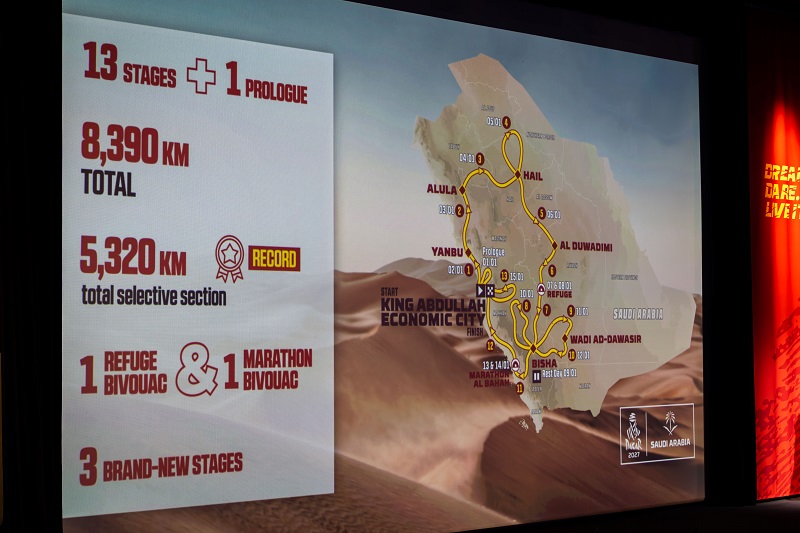
The eighth Dakar Rally in Saudi Arabia will run along the western half of the kingdom, with King Abdullah Economic City serving as both the start and finish.
The race will span 8,253 kilometers in total with 5,320 km in Selective Sections; the latter is the most in the Saudi era, surpassing the previous mark of 4,903 set in 2025. The Dakar Classic will be 7,075 km long with 3,930 in specials, while Mission 1000 retains its 100-kilometer daily format but will now have a marathon stage too.
King Abdullah Economic City, a planned city that was established in 2005 along the Red Sea, will kick things off with the Prologue. The FIA no longer uses prologues outside of Dakar, and the pre-existing caveat that times from the day don’t go toward the FIA overall will remain in place.
The first “real” days of racing will go through cities that hosted the first half of 2026’s Dakar like Yanbu, Al-‘Ula, and Ha’il. Rather than Riyadh, however, the race then heads to Al-Dawadmi for the first time since 2024.
Although the ASO assured there are fewer rocky sections than in recent years, the second and third stages will still have special pit areas to change tires since they are in volcanic zones. These zones were introduced in 2026.
Stages 6 and 7 will be run under marathon conditions. Bisha serves as the rest day on January 9, then hosts a loop near Majami’ al-Hadb Reserve for Stage 8. The race then heads out to Wadi ad-Dawasir and back to Bisha.
The second marathon will be on Stages 11 and 12. The latter will be the penultimate leg back to KAEC, which then has a final 44-kilometer special to close out the race.
“It will be a longer Dakar, and I really like that because it means the best-trained riders, both physically and mentally, will be in better shape at the end,” said reigning bike winner Luciano Benavides. “As a rider, I prefer long days. I also like the format with two marathon stages, and having the second marathon at the end of the race will make it even more interesting. There will be less information, less strategy, which can make the race even more exciting.
“It will be a great edition, and with this longer route, with more sand, I’m motivated to return to Saudi Arabia and defend my title, knowing that this race isn’t decided until the very last kilometer.”
The route was revealed by the ASO at the Institut du Monde Arabe in Paris on Tuesday.

Route
| Stage | Start | Finish | Selective Sections | Liaison | Date |
|---|---|---|---|---|---|
| Prologue | King Abdullah Economic City | King Abdullah Economic City | 23 km | 75 km | January 1 |
| Stage 1 | King Abdullah Economic City | Yanbu | 306 km | 224 km | January 2 |
| Stage 2 | Yanbu | Al-‘Ula | 444 km | 159 km | January 3 |
| Stage 3 | Al-‘Ula | Ha’il | 380 km | 358 km | January 4 |
| Stage 4 | Ha’il | Ha’il | 495 km | 219 km | January 5 |
| Stage 5 | Ha’il | Al-Dawadmi | 443 km | 260 km | January 6 |
| Stage 6 | Al-Dawadmi | Marathon Camp | 446 km | 122 km | January 7 |
| Stage 7 | Marathon Camp | Bisha | 431 km | 46 km | January 8 |
| Rest Day | Bisha | Bisha | N/A | N/A | January 9 |
| Stage 8 | Bisha | Bisha | 442 km | 296 km | January 10 |
| Stage 9 | Bisha | Wadi ad-Dawasir | 500 km | 138 km | January 11 |
| Stage 10 | Wadi ad-Dawasir | Bisha | 420 km | 414 km | January 12 |
| Stage 11 | Bisha | Al-Baha | 338 km | 276 km | January 13 |
| Stage 12 | Al-Baha | King Abdullah Economic City | 353 km | 240 km | January 14 |
| Stage 13 | King Abdullah Economic City | King Abdullah Economic City | 44 km | 361 km | January 15 |
Featured image credit: Arthur Reynier / DPPI / ASO
Leave a Reply