
Following the World Motor Sport Council’s meeting in Macau on Tuesday, the FIA Historic Motor Sport Commission has created a blueprint through 2030 that would improve the process of reviewing cars to ensure they comply with the period they raced in.
The federation, which oversees the FIA European Historic Rally Championship, released the following statement:
The FIA has unveiled a new Historic Motor Sport Roadmap, outlining a phased approach to period compliance scrutineering from 2026 through to 2030. The initiative is designed to strengthen consistency, fairness and credibility across historic motor sport, through a harmonized framework for eligibility control and compliance monitoring.
The roadmap includes the publication of specification guidance, the recruitment and training of FIA Eligibility Delegates, as well as enhanced support for organizers and competitors. A dedicated education and observation phase will follow before progressively introducing compliance monitoring, reporting and enforcement measures.
By 2030, the framework will be fully activated, with the implementation of enforcement mechanisms designed to ensure long-term adherence to period-correct specifications. The roadmap forms part of the FIA’s ongoing commitment to preserving the authenticity and integrity of historic competition for future generations.
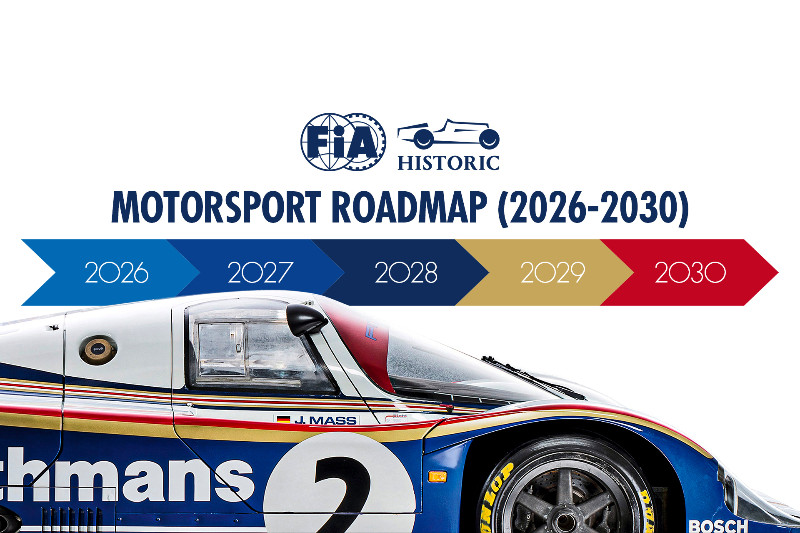
The “Historic Motor Sport Roadmap” consists of five phases for each year until the turn of the decade:
- 2026 (Phase One): Clarification, Recruitment, and Communication
- 2027 (Phase Two): Observation, Warnings, and Education
- 2028 (Phase Three): Penalty Enforcement
- 2029 (Phase Four): Deadline and Red Dot
- 2030 (Phase Five): Activation
The first phase entails producing spec sheets stating each vehicle’s qualities and strict rules for teams to ensure their vehicles are as close to the original model as possible, along with a specialty toolbox with accompany tools for inspection. The FIA will recruit Eligibility Delegates from a “mix of generations” to oversee scrutineering, and they must undergo training sessions at races and the car preparers’ workshops.
For Phase Two, the Eligibility Delegate will be tasked with attending each race to ensure “harmonized scrutineering” and issuing warnings where necessary. Infractions are to be logged accordingly.
Phase Three is generally the same, but also includes compiling a report for race organizers. The latter will also oversee a “soft handicap” enforcement for infractions.
Unlike in the third stage, Phase Four will begin using the red dot system for non-compliance. A red dot is marked on the first page of a Historical Technical Passport for any irregularities found, and must be corrected within the next race or the one after. If the car continues to not meet historical accuracy, a harder handicap should be enforced.
Finally, Phase Five will fully mandate the red dot system. The hard handicap will be in place with a ban if it persists.
The FIA has been keen on ensuring period compliance. Mathias Doutreleau, the head of the FIA Historic Motor Sport Commission, proclaimed in April that the federation has the “mission to be the guardians of the heritage.”
Featured image credit: Fédération Internationale de l’Automobile
Leave a Reply