
It happens all the time in sports. You have a bad day and try to keep your chin up, usually by thinking of a motivational quote from a great figure.
While important to distinguish between warfare and sports, military figures, wartime leaders, and adjacent readings have plenty of lines for the crestfallen athlete to cite. After losing Super Bowl XXV on a wide-right field goal, Bills head coach and World War II-era airman Marv Levy thought of the Sir Andrew Barton poem: “Fight on my men, Sir Andrew said / A little I’m hurt, but not yet slain / I’ll just lie down and bleed a while / Then, I’ll rise and fight again.”[1]
History is a cornucopia of this, hence why you can look up “motivational quotes” and immediately be bombarded by sentences written by people from decades to centuries ago. At the same time, however, it’s easy for the source of these quotes to be blurred or misattributed because they sound so much like what a certain person might have said even if they never did.
Winston Churchill is one such figure, and the subject of this latest flub.
Last Sunday’s Brickyard 400 was the third NASCAR Cup Series start for Daniel Dye, who debuted at the top level earlier in 2026 as part of a limited schedule with Live Fast Motorsports. The team is a small single-car operation who sold its charter in 2023 and hasn’t run a full season since, so expectations for Dye were never particularly high.
Still, it certainly would’ve been nice to reach the finish. Alas, he had a tire go down and sent him into the Turn 3 wall on Lap 93, ending the second stage under caution and his race. He wasn’t the only DNF for a tire failure as Kyle Larson suffered the same fate earlier in the day.
Unlike Larson, who is blessed with the support of Cup Series juggernaut and military supplier Hendrick Motorsports to move on, B.J. McLeod and Live Fast were in for a longer night of sorting out the #78’s damage. That’s just the way the cookie crumbles sometimes.
On social media, LFM gave a message of positivity: “one race never defines a driver. […] We’ll take what we learned, keep pushing forward, and come back stronger. That’s what this sport demands, and that’s exactly what this team will do. On to the next one.”
That’s fine and dandy. Very canned, so much so that some people quickly started wondering if it’s written by AI, but that’s not the issue for us.
The real concern is the quote in between. “As Winston Churchill famously said,” the post reads, “‘Success is not final, failure is not fatal: it is the courage to continue that counts.’”

Yeah, we’re gonna stop you there. It’s a pleasant quote for sure and a nice mindset to have, but the history nerd who runs this site isn’t going to let such travesty go unnoticed, especially not when it’s been posted to Twitter and Instagram.[2][3]
The British prime minister never actually said this line or any variant of it (like “failure is never fatal”), yet it continues to be attributed to him. The International Churchill Society openly states:
We can find no attribution for either one of these, and you will find that they are broadly attributed to Winston Churchill. They are found nowhere in his canon, however. An almost equal number of sources found online credit these sayings to Abraham Lincoln, but we have found none that provides any attribution in the Lincoln Archives.
Wikiquote singles out The Prodigal Project: Book 1: Genesis, a 2003 Ken Abraham and Daniel Hart novel about a post-Rapture civilization, for crediting Churchill with it. In Chapter Nine, protagonist and Prodigal Project leader Azul Dante cites Thomas Paine and Churchill while speaking to his followers on life for those left behind on Earth. Paine’s quote—”We have it in our power to begin the world over again”—was indeed written by the Founding Father in his pamphlet Common Sense. However, after taking a sip of water, Dante continues, “At another crisis in the world’s history, another great leader, Mr. Winston Churchill, reminded us that, ‘Success is not final, failure is not fatal: It is the courage to continue that counts.’”[4]
Churchill by Himself, a collection of his quotes arranged by Churchill-slash-automotive history expert Richard M. Langworth, has an appendix titled “Red Herrings: False Attributions” that includes it. Affixed is the following succinct description: No attribution. This isn’t the only success-related misquote either as it’s accompanied by “Success is going from failure to failure without losing your enthusiasm”, which Langworth notes is [b]roadly attributed to Churchill, but found nowhere in his canon.[5]
Alas, that hasn’t stopped people from thinking it’s a Churchillism. This has only spread with the advent of the Internet, but the misconception predates the World Wide Web. Each chapter of college basketball coaching great John Wooden’s 1972 autobiography They Call Me Coach has a quote affixed to the heading, with the 17th using it and explicitly giving credit to Churchill.[6] Jim Murray of the Los Angeles Times lauded this feature as “quatrains of Edgar A. Guest running wild on a field of Grantland Rice […] Everything he says should be identified by testament, chapter, and verse, it seems.”[7]
(In fairness, it is a cool quirk. Curiously, at least in the 1988 version, some chapter quotes don’t cite their speaker.)
Penn State coach Joe Paterno adopted the phrase as part of his coaching philosophy and commented before the 1979 season, “I always remember what Winston Churchill once said: ‘Success is never final; failure is never fatal.’ I think maybe that best explains my philosophy of football as well as life in general.”[8] JoePa was already using the mantra prior, reciting it to the 1967 WPIAL champion New Castle High School at their banquet.
(There is very low-hanging fruit here that we will not make.)
Of course, even with the clarifications, things have only gotten worse as the Internet runs with it. Academia isn’t exempt from this either; you know how bad it is when a journal article about finding a vaccine for respiratory syncytial virus begins with the same quote?[10] Not actually too bad since pediatricians have far more pressing things to address as opposed to those studying the humanities like yours truly, but it does unknowingly trigger our warning systems.
So where exactly does this quote come from? Quote Investigator found similar sentences throughout the years, with the earliest example being the 1905 “The Principles and Progress of English Poetry” (“[…] the vanities of life are not final, and the failures not always fatal.”). For the one closest to this specific wording, it seems to be… a Budweiser commercial.
In 1938 and 1939, Anheuser-Busch put out advertisements for the beer in newspapers that include the sentence, though the rest of the text varies.
The 1938 ad reads:
You can’t tell him there’s no fishin’
Let the Weather Man talk. Let the experts scoff. Youth goes fishing for the fun of it…in all kinds of weather…in all kinds of waters.
The man who has lost the spirit of youth is too busy with gloomy fore- casts to gather bait, much less go fishing.
Men with the spirit of youth pioneered our America…men with vision and sturdy confidence. They found contentment in the thrill of action, knowing that success was never final and failure never fatal. It was courage that counted. Isn’t opportunity in America today greater than it was in the days of our grateful forefathers? Good!
The 1939 commercial:
Why Make a Sunset of the Sunrise?
For some people the day is over just as soon as it begins—a tiresome twin of an empty yesterday.
There are others who meet the challenge of each new day with the hearty confidence of our pioneer forefathers, who believed—and proved—that success was never final and failure never fatal. Despite yesterday’s success—or failure—they greet every new dawn as a dare. They have seen people in America rewarded more generously with comforts. and conveniences than the peoples of other lands. They know that each sunrise in America ushers in new opportunities… to those who keep their chins up… who never lose that lusty courage and willingness that made ours the most envied nation on Earth.

The phrase would also be used invariably without attribution. R.C. Williams, assistant surgeon general with the United States Public Health Service, flat-out calls it an anonymous quote in his 1951 book covering the branch.[11]
Speaking to the graduating class of 1939 at Carrollton High School in Missouri, A.C. Smith stated, “To you, who did not make outstanding grades, it does not mean you will not be successful in business, profession, or whatever vocation you may enter. Many times, we have seen this statement substantiated: success is never final and failure is never fatal. If we are successful, we cannot expect to continue success without well directed efforts. If we have failed, there is always a possibility of success by our well-directed efforts.”[12]
Several newspapers of the time included it as a motivational quote between articles. Reverend W.B. Lockridge titled his guest speakership at the Mansfield Rotary Club accordingly in late June 1945 too.[13] Even The Nebbs, a newspaper comic strip by Sol Hess and W.A. Carlson, dropped the line in 1952.
Some publications did name a speaker, but not without much reliability either. Forbes in 1948 and The Owen Sound Sun Times in 1955 both say it’s the work of George F. Tilton.[14] Quote Investigator isn’t entirely sure who this is, simply noting the phrase was “credited to someone named George F. Tilton without a citation”. (George Fred Tilton, a mariner and author, doesn’t appear to have said it) The Dictionary of Modern Proverbs names both George Starr White in 1920 and Tilton, the former for the ‘success’ segment and the latter for the full quote.[15]
With some religious institutions also using it as motivation, it could have roots somewhere there or be something that gained steam in that field. It’s fairly reminiscent of how “Good better best / Never let it rest / Until your good is better / And your better is best”, the victory chant popularized by Bears coach Ben Johnson last season, is attributed to Saint Jerome but scholars have yet to find it in his works. The earliest published instance appears to be in 1896 by the Woman’s Improvement League.[16]

Crediting Churchill specifically, meanwhile, seems to have started in around the 1960s. The Big Stone Gap Post‘s Seminary News section on December 16, 1965, begins with the following paragraph: “Sir Winston Churchill once said: ‘Success is never final, and failure, never fatal. It’s courage that counts’. I always admired Sir Winston and in my opinion, he was one of the greatest!”[17] The Orlando Evening Star did the same four months earlier in its August 2 issue.[18] Delmas M. Clardy, the president of the Kentucky Medical Association, proclaimed “Sir Winston Churchill once said” it while calling to vote in Congress members supportive of the association’s causes, which was published in the KMA’s December 1965 journal.[19]
Churchill died on January 24, 1965. If we assume the above are among the earliest instances of his name being attached to the quote, it might be a reasonable theory that he was eulogized with it for whatever reason and the snowball continued from there.
Annoying, but that’s how it is with quotes sometimes. QI concluded that “the saying evolved over time, and the phrase about courage was appended to a preexisting adage. […] The linkage to Churchill appeared in the 1960s and has no substantive support.”
So, yeah. With how engrained the link between the quote and Churchill is, whatever AI was used by LFM—assuming it was generated—probably believed the same (does this technically count as a hallucination?). Churchill’s probably not going to roll in his grave about it. Why would he care about a random stock car team’s misattribution? Did he even care about racing?
He actually did! Okay, not of the automotive kind.
Churchill appeared to solely treat cars as a utility for personal travel, which probably wasn’t for the best. Langworth wrote at length in 2016 about how Churchill was, frankly, quite a menace on the road. Motor Sport covered his driving days in September 1991 too.
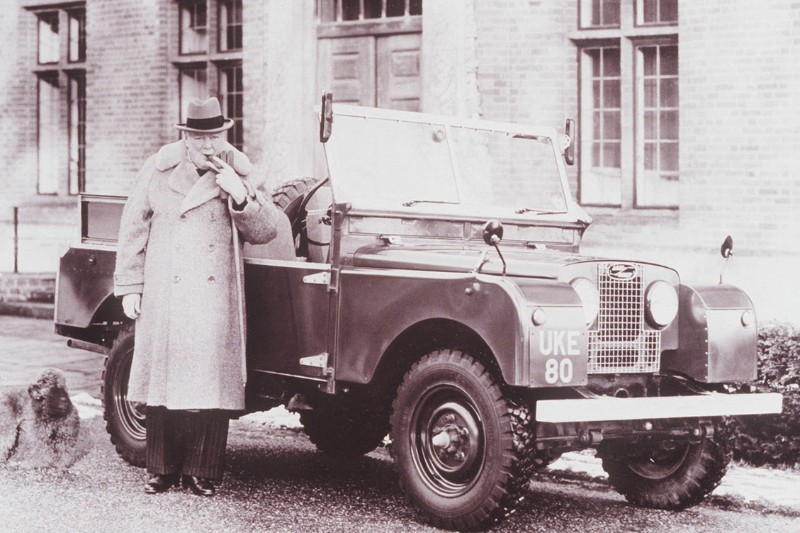
One of his rides was a Land Rover Series I, which he received for his 80th birthday in 1954. He used it until his death, after which the vehicle stayed in the family before being sold in 2012 for nearly £130,000.
As for racing, his interest was in the equine variety. Colonist II was the first horse he bought in 1949, which won 13 times. One of those wins came at the Victor Wild Stakes at Kempton Park Racecourse on May 13, 1950, the same date as the inaugural Formula One race at Silverstone roughly an hour away. He received applause from the crowd when he joined Colonist II in the winner’s circle.[20]
Needless to say, his heart wasn’t exactly one for the motor.
References
[1] America’s Game: The Missing Rings – 1990 Buffalo Bills, NFL Films, 2008
[2] Archived link to Instagram post
[3] Archived link to Twitter post
[4] The Prodigal Project: Book 1: Genesis by Ken Abraham and Daniel Hart, The Penguin Group, 2003
[5] Churchill by Himself: The Definitive Collection of Quotations by the Estate of Winston S. Churchill and edited by Richard M. Langworth, Ebury Press, 2008
[6] They Call Me Coach by John Wooden and Jack Tobin, Contemporary Books, 1988
[7] “A halo in place” by Jim Murray, Los Angeles Times, January 27, 1973
[8] “The Nittany Lions… ‘Success is Never Final; Failure is Never Fatal’” by the Associated Press, Huntsville News, August 24, 1979
[9] “Paterno not afraid to gamble” by Pete Mollica, New Castle News, January 27, 1968
[10] “In Search of a Vaccine for Respiratory Syncytial Virus: The Saga Continues” by Janet Englund, The Journal of Infectious Diseases 191, no. 7 (2005): 1036–39.
[11] The United States Public Health Service, 1798–1950 by Ralph C. Williams, Commissioned Officers Association of the United States Public Health Service, 1951
[12] “Large Crowd Attended Commencement Exercise”, The Carrollton Democrat, May 26, 1939
[13] “REV. W. B. LOCKRIDGE GUEST SPEAKER AT ROTARY CLUB”, The Mansfield Enterprise, June 21, 1945
[14] Quote attributed to George F. Tilton, The Sun Times, July 12, 1955
[15] The Dictionary of Modern Proverbs compiled by Charles C. Doyle, Wolfgang Mieder, and Fred Shapiro, Yale University Press, 2012
[16] “GOOD CITIZENSHIP” by M.J.C. Wilkins, The Minneapolis Times, November 17, 1896
[17] “Seminary News” by Molly Collier, The Post, December 16, 1965
[18] “Langford Offers ‘Hot’ Latin Revue” by Hanley Pogue, Orlando Evening Star, August 2, 1965
[19] “Report of the President” by Delmas M. Clardy, Journal of the Kentucky Medical Association, December 1965
[20] “COLONIST II WINS STAKES” by the Associated Press, The Tampa Tribune, May 14, 1950
Featured image credit: Land Rover
Leave a Reply