
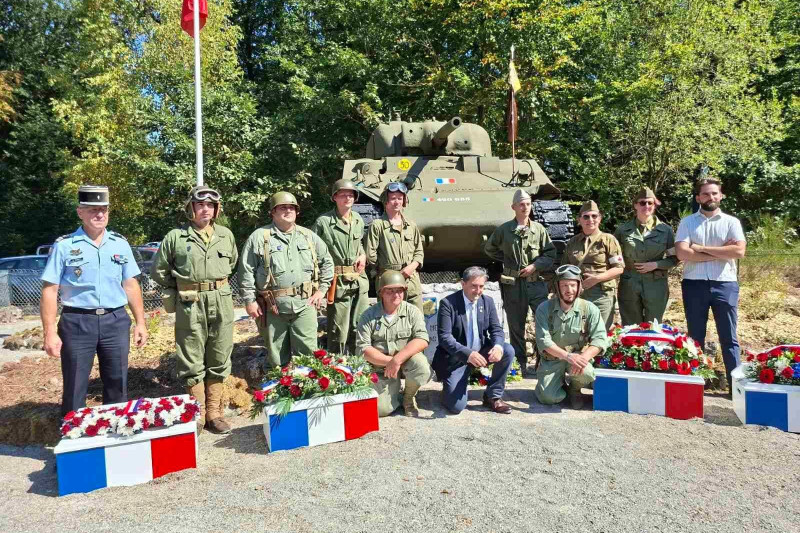
After being vandalized in late May, the Sherman tank nicknamed “Valois” underwent an extensive restoration that was fortunately complete by August 12. This ensured the town of Alençon could celebrate the 82nd anniversary of its liberation at the momument without issue.
Valois is an M4A2(75) that served with the 12th Cuirassier Regiment of the 2nd Armoured Division. While in the Écouché forest on August 13, 1944, it took several hits from German anti-tank fire, which bent the 75-millimeter barrel and killed two Free French soldiers. Still, the division successfully repelled the occupying Germans. Although disabled in battle, the tank was saved and preserved atop rocks at the Croix de Médavy crossroad as a memorial.
On May 25, night watchmen discovered the tank and plaque at the front had been covered in bright pink with anti-war messaging. Two suspects—men of ages 45 and 43—were identified via DNA from spray cans and masks left behind, leading to their arrest on June 8. Their trial is scheduled for September 3; they were supposed to be tried on June 25 but had the hearing pushed back to ensure they could had proper legal counsel. The two face charges of “damaging or defacing a cultural asset being exhibited, deposited, or preserved by a public or private entity charged with a mission of public interest or located in a building of worship”.
Cleaning Valois was not an easy feat because doing so too aggressively or incorrectly risked damaging the original livery underneath. Some of the pink paint and graffiti were scraped off before city officials began the proper restoration.
Rather than scrubbing the paint off or using cleaning solvents, dry-ice blasting was the primary method to clean Valois. Dry ice is non-abrasive and doesn’t use chemicals, while shooting it is also quicker than doing things by hand. Cold Jet, whose equipment was used for the tank, even has a page on its website about dry-ice blasting’s role in historical preservation because of how safe and fast it can be.
“Irreplaceable artifacts require cleaning methods that are proven non-abrasive under microscopic examination,” the Cold Jet site notes. “Failed cleaning attempts can permanently damage artifacts.
“Dry ice blasting has successfully conserved US Civil War naval artifacts, World War II aircraft, and vintage vehicles. The USS Monitor conservation project—funded by a National Park Service Maritime Heritage Grant—tested dry ice blasting under 350× magnification and found zero pitting, abrasion, or surface damage. Structural plates that would take 2–3 weeks to clean by hand were completed in approximately one hour. This combination of proven safety and dramatic time savings makes dry ice blasting ideal for conserving priceless museum collections.”
Jean-David Desforges, the deputy mayor of Alençon, led “Operation Flamingo” with help from the office of the Délégation Militaire Départementale de l’Orne, the Association Garand de la Mémoire, and Ordnance Militaria. The former, also known as DMD 61 for short, is the Chief of Defence Staff’s representative for the Orne department while the association’s mission is to preserve the memory of the Second World War in the area.
Once the vandalism was taken off, the tank was sandblasted. While doing this, they uncovered a Cross of Lorraine—the symbol of Free France—stamped into the turret, which had apparently gone unnoticed over the decades. The association said the discovery “moved us deeply”.
Three to four layers of anti-rust coating were applied to protect the surface, followed by repainting with a gray undercoat and the final olive drab. Newspapers and plastic bags were then laid over the body to stencil and spray the relevant markings: the Valois name; the French flag; a blue square with a C to symbolize being part of the 12th Regiment’s 3rd Squadron, Second Platoon; the 2nd Armoured Division’s logo; and the turret’s ID number 42. Ordnance Militaria provided the stencils and logos. Black paint was also applied to the treads and wheels. Roughly 25 liters of paint were used in total.

“He’s exactly as when he landed on Utah Beach,” volunteer Julien Tanguy told Actu.
The team worked well into the night for several days, hoping to beat the August 12 deadline. Even with the tight schedule, they ultimately pulled it off.
Festivities began at another tank monument, the M4A2 nicknamed “Keren”, in honor of the 501st Combat Tank Regiment. From there, everyone went to greet the newly-restored Valois and Les Gateys National Cemetery, where 19 soldiers from the 2nd were buried after dying in the battle for Alençon. The day ended back in Alençon with a ceremony.
“To see our association honored, to see our members’ work recognized, and to know that Valois has regained its historic appearance, that is why we do all this,” reads a statement from the association. “Not for ourselves. For them. So that their story continues to be told. So that their sacrifice is never forgotten. So that future generations understand the freedom we enjoy today was won by men who were willing to risk their lives for it. An exceptional day. A day of remembrance. A day of pride.
“Thank you to our members. Thank you to the City of Alençon. Thank you to our partners. Thank you to everyone who supports us. And above all, thank you to those who made it possible for us to be free today. From the heart, for remembrance.”
Another celebration took place on August 13 in Écouché-Les-Vallées to recognize its liberation. This ended with a ceremony in front of the Massaoua tank, also from the 501st and the first tank restored by Association Garand de la Mémoire.
Alençon was the first major French city to be freed by fully French forces. After taking Le Mans, the Allies swept in different directions: the Americans turned toward Chartres while General Philippe Leclerc and the 2nd made for Alençon.
The city was described by Associated Press correspondent Edward D. Ball as “one of the most important highway hubs in western France”, though “only minor German resistance was encountered.”[1] Once in Alençon, the Germans simply blew up their ammo dumps and torched part of the forest before fleeing. American troops followed soon after.[2]
“Strange as it may seem, the Germans left the city without any attempt to blow up the bridges or mine the streets and buildings,” Eugen Currivan remarked.[2] “[…] With the exception of the results of the aerial bombardment on July 17, the city is almost untouched. There is compartively little damage. The only large building damaged with the 14th century cathedral of Notre Dame, whose priceless stained glass windows were shattered.”
Morale ran high as the Americans passed through. Ball wrote:[1]
Despite the sweltering heat that drenched the doughboys’ uniforms with perspiration, their speed was unslackened and their spirits were at their highest since D-Day.
From general to GI there was exuberance at the swift pace maintained since the breakthrough.
“I’ve spent the best years of my life in this here war and now we’re going somewhere,” rejoiced Sgt. Elmer J. Kist of Natrona Heights, Pa. “On to Berlin!”
There was no flower tossing and little flag waving here. Perhaps the enthusiasm of the citizens wore out when the first armored elements passed through Friday.
An old Frenchman tapped my shoulder and pointed to a bomb blasted cathedral.
“Bombs,” he said. “Americans. Fifteen days ago.”
Then he shuffled up the street without another word.
“Up to here we have had an easy time of it after the breakthrough,” said a brigadier general sitting in a jeep under a shade tree.
“This is one of the nicest pieces of maneuvering I have ever seen and I have been on the battlefield for 18 months here and in Italy.
“We’ve used their own tactics on them—that is, scatter them with armor, then encircle them and chew them up.”
The general, who led the dash from Periers to Le Mans and who is leading one force here, said that after the initial breakthrough around Periers “we came so fast the Germans didn’t catch on to what was happening. My outfit alone captured 1,500 prisoners west of Le Mans.”
Fanning himself with a field map, he added:
“I am ready to end this thing up and get back to my air conditioned bank back home. I am a banker turned soldier for this war.”
He said the Germans began checking out Aug. 9.
“They left a few here and we have been smoking them out in two’s and three’s,” said Pfc. Ray H. Dunnigan of Fort Worth, who teamed up with Pvt. Joe Cassini of Memphis, Tenn., on patrol duty.
References
[1] “GERMANS IN A HURRY LEFT BRIDGES INTACT” by Eugen Currivan, Evening Standard, August 15, 1944
[2] “Americans Enthusiastic On Dash Through Alencon” by Edward D. Ball (AP), Fort Worth Star-Telegram, August 14, 1944
Featured image credit: Association Garand de la Mémoire
Leave a Reply