
The article on this interview can be found here.
Some text has been altered from the actual dialogue to improve readability.
Transcript
131: Tell us a little about yourself, like how you got into rallies.
DP: It’s a really interesting story actually, because I don’t think it was really planned at all.
On Instagram, I saw an advertisement a few years ago about the Panda Raid that happens in Morocco. It’s 500 Fiat Pandas through the desert. I just said to my business partner, “Hey, I think we should just buy a Panda and sign up to this shit because we have no idea what this is about, but it looks like fun.”
Anyway, we ended up buying a car. We were lucky enough to find a car with the inscription for the race already because there was a guy that was already inscribed. He’d prepared the car, but he wasn’t able to join because he had an illness, he had to have an operation. We bought the car and the inscription all in one package and we just went for it. That was our first race. We had no previous experience. It was 500 cars and we ended up being #42, so we thought, “Oh, wait, wait a second. If we’re in the top ten, it means we’re not that bad at this shit.”
So, we decided to pursue it. We did another two Panda races after that, and then we decided it was time to switch to a bigger car. That’s where we decided that, you know, we were already thinking of the horizon to do a Dakar Classic, but obviously, we needed to prepare before that and we needed more experience than just the Panda races.
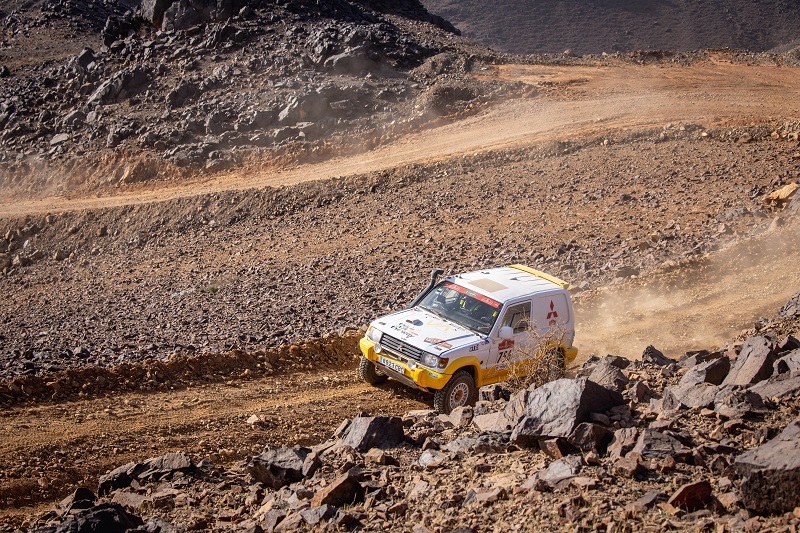
We started searching for the car that we wanted. Since childhood, I remember watching Dakar and I was very obsessed about the Mitsubishi Pajero. It was my favorite and I said if we’re going to do this, we have to do it with a classic Pajero. We set out to find a car that we could work with. We ended up even going to the Czech Republic to see a car; it was a combination of a car and a support team, but that didn’t come through. We didn’t like it very much. In the end, a Spanish guy from the south of Spain started talking to me about this Mitsubishi Pajero but that it was cursed, that it had been to Dakar Classics twice, and that both times it wasn’t able to complete the race. The first time, it only did like 500 meters and they burnt the engine.
I said, “Well, yeah, I know, but what’s the story?” They said, “Well, nobody wants the car because nobody wants to invest in it and take it all the way out to Saudi Arabia because there’s too much risk because everybody thinks the car is now cursed.” I said, “Ah, that sounds like a challenge for me, you know.” We agreed to a really, really cheap price. I think we bought the car for €15,000 and it was pretty much prepared. All it needed for a Dakar Classic was just a bigger fuel tank and some reinforcement in the clutch and the suspensions. We said, “Let’s do it.”
We bought it, we fixed it up. I partnered with a local mechanic friend of mine here because, you know, I’m running my business. I didn’t have much time to prep the car. Anyway, he prepped the car for us here in Madrid, and then we decided we needed to have an on-site support team because we started investigating into Dakar and we thought, ‘Well, if there’s nights when you only have like four or five hours, you have to choose between repairing the car yourself or sleeping.’ We decided that having a support team would be a good idea because we like to sleep, then we reached out to a few different options and we ended up signing up with Pedregà because they’re from here, from Barcelona.
The rest is just the Dakar story, shipping the car out to them, getting it there, and just getting the race done.
131: How different was the Pajero compared to the Panda?
DP: I’d say completely different because the Panda, even if it’s a four-wheel drive Panda, it’s a Panda. Yeah, eventually, you’ll get it to go anywhere with patience and time and finding the right route, you can get that damn car almost about anywhere.
But the Pajero is a different story. There’s definitely an upgrade there. It’s a three-liter V6 engine. Of course, it has the great Mitsubishi, the original gears in it. It’s just an amazing machine for me. Also being the short version, I think specifically where it becomes… Well, it’s an all-terrain. It does really well everywhere, but in the dunes is a different story. You’ll see lots of people with the dunes struggling and the truth is if you put the low gear into the Pajero and you go about it the right way, that damn thing will just start clipping. It won’t stop and it just keeps on climbing. It’s like a bloody tractor. That makes it a lot a lot of fun in the dunes.
Also, Fran and I are very lucky that we’ve had lots of experience with the dunes in Morocco. In the end, that counts a lot. We call it the Moors’ Way when we understand we’re able to see the profiles of the dunes and we’re able to understand and navigate a safe way through it. I think that’s played very well to our advantage because some people, when they get to the dunes, they see it as a huge challenge and they’re kind of thrown back by it. But for us, it was like, “Oh yeah, this looks like fun.” We had amazing fun. It was great.
131: How similar was racing in Saudi Arabia compared to Morocco? Like how similar or different?
DP: I think everything is just bigger in Saudi, isn’t it? I mean, Morocco is like a tiny-scaled miniature version of Saudi. I think that’s the real difference is the distances. When we’re racing in Morocco, you wake up in the morning and your connection to the race start is maybe 20 kilometers on the road. But when we get to Saudi Arabia, there’s some mornings that you have to do like 280 kilometers before you actually start racing. When you’re doing that in a 1993 Pajero, top speed on the road is 110, so it takes time. It takes time and patience. But yeah, I think the dimensions is the biggest difference. Of the terrain itself and of the racing, it’s the sheer scale because what we do in Morocco, like RallyClassics Africa or Rallye du Maroc, you’re doing five or six days of racing and those days you’re racing maybe five, six, eight hours.
But Dakar is just a different beast. Two weeks nonstop, 18-hour days, the scale is just… I mean, it’s uncomparable. When you face a Dakar, you realize that you’re probably going to do more hours driving than all of the previous races combined. You reach there and then, all of a sudden, that dawns on you and you’re like, “Oh my god, what have we done?”
131: What was your goal for Dakar? Was it just to make it to the finish or did you want to finish a certain place?
DP: Yeah, 100%. It was our first time. I don’t know if we’ll try again, but from the get-go, our goal was just to get to the end however possible. You can tell by our classification that that was our goal because obviously, we did come in pretty near the bottom.
But that was our goal from the beginning. Our other teammates that traveled with us, they had a little bit more of ego going on. They said, “Oh no, we want to be in the top ten.” We realized and talking to the professional drivers, they said, “Well, if it’s your first time, you know, don’t try and push it.” Our friends pushed it and they rolled the car on the second stage and they were sent home because they damaged the rollbars. They made the whole effort, the whole investment, and they only got to race the Prologue in the first day and it was over for them. We’re lucky we kept our wits about us and we were true to our strategy, which was, “Let’s make the car survive and let’s get to the end.”
I think one learning for us is our car could have been in H1 or H2 category. Probably, we should’ve chosen the slower category because we did want a bit of a challenge and we didn’t want to feel like we were just going for a ride. But honestly, for the car and for what it’s capable of, you have to think that our car is just barely off stock. Especially for the suspensions, the speeds that were expected at the category that we were in were almost pushing the car to the limit. I think if we would’ve chosen the lower category, we would’ve done a better classification because we would have been a lot better with times, but also maybe we would have been a little bit more bored.
There’s also the fun aspect that needs to fit in there, especially when we’re not competing as professionals. We’re just competing to enjoy and live the experience. I think it was maybe not the right choice, but it was the choice we did and we enjoyed.
131: Was there anything from Dakar that took you by surprise or was different than what you’re used to? Maybe the super regularity tests or any of those other features?
DP: No, I think we were expecting all of that and we knew what it was about. We are happy. I mean, it is challenging but it’s fun. Sometimes, regularity can just become very, very boring. [laughs] But you know, also it can become very, very tiring because you’re trying to keep the speeds and be as precise as possible for so many hours. Sometimes, it’s a bit too much.
I don’t think anything really surprised us. I think what surprised me most anyway was the sheer scale of Dakar itself. You know I arrived there and it was like, ‘Hoooooly god, this thing is a bloody city. This is Mad Max. This is like, incredible.’ The amount of people, the logistics involved, the amount of helicopters that were available, I mean, it’s just… the sheer scale and size of the event itself was just like, wow. It set me back completely. I expected a big event, but when I got there, the size, it had escaped me until that point. When I got there and saw the city in Yanbu, I’m like, “Oh my god, this is a beast.”
131: In the topic of scale, what was the atmosphere like in the bivouac?
DP: Well, the atmosphere is incredible. If you’re a petrolhead and you like the cars, you have to go and live that once in a lifetime. It’s just such an experience. The freedom of moving around if you do have free time, when you do have it, it’s great to be able to go and see the professionals and see the cars being repaired. It’s just such an experience. Also, you get to share with so many people from around the world. You have all nationalities of the world. Everybody has a different story of why they’re there or how they got there. There’s just so much sharing going on with that common interest of racing. Because you’re under strenuous circumstances, you’re sleep deprived, it’s hard, you do build very strong relationships with the people that are supporting you there. I think it just becomes an incredible atmosphere. It’s something that’s definitely worth experiencing.
131: Was there anyone in particular that you remember you became close with or friends with? Like you helped them out or them helping you out or anything in a bit like
DP: Well, nobody in particular. I think it’s lots of people. There’s the… I can’t remember his name, the CEO of Sportiva Shoes (Lorenzo Delladio), an Italian who races with two custom Porsches. We kept on bumping into him all the time. It was incredible. It was such an experience because he had many mechanical problems but he was always able to solve. We were going on like, “Oh, this guy, he’s screwed. We won’t be seeing him again,” and then in the next stage, he’s there again. You’re like, “Oh, wow, you made it! How did you do it?”
I remember the second dune day. There was one day where Fran and I left, we got out of the car because we wanted to climb up the dune and find some visibility. We saw him walking around the dunes and we’re like, “Hey, what’s up?” And he was walking with his accelerator pedal in his hand and I’m saying like, “What the hell?” And he said, “Yeah, we flew.” They went up the dune, they flew over the other side. His navigator was taken out in the helicopter and he was just walking around with the accelerator pedal in his hand. Unbelievably, in the next stage, he was there again. He not only has backups for the car but he had a backup navigator that he could use to continue the race. It was an amazing experience. That guy, hands down, those people are crazy. Nothing will stop them.
131: What would you say was your main strategy for Dakar? It’s obviously about driving precisely rather than just fast.
DP: Yeah, 100%.
131: What’s your mindset for each stage?
DP: God, our main strategy was conservation. Conservation of ourselves, our energy, and conservation of the car. As I said before, the car was pretty much to the limit. We were arriving almost every day, we had broken suspensions—either rear, back, or both. We were always coming back with our hands full. Let’s say that we were making it, but you know the mechanics would be… [grimaces] “Let’s see if we can fix this to make it go out tomorrow.”
But I have to say, they are magicians. They made the car able to go out every day except for one stage. There was one stage where we were not able to continue due to mechanical problems, but that was because we had a rupture in the joint to the radiator, and they had to have a custom weld onto a new radiator, and that took too much time. So there was one stage where we missed out due to mechanical failure, but that was it. We were able to restart the stage after that.
131: Do you feel there’s anything from your day job at VA361 that you felt you probably could have applied to racing Dakar, like a certain mentality or how you approach any problems?
DP: Yeah, I think definitely. I think it works both ways and I think it’s a mindset. There is a certain mindset of never giving up, always finding the solution. There is lots of resilience, lots of grit. Also, there’s years and years of experience of pushing through and pushing through. I think that has helped both ways. What I’ve learned in my business has helped me come through Dakar, and after Dakar, I have brought back new ways of thinking about business. It’s amazing. It’s incredible how two things so different can actually have crossovers with knowledge, tasks, and learning.
131: After all of this, what was the mood in the cockpit for you and Fran when you finally made it to that finish podium?
DP: It’s really funny because you have all the technology in the car and you have the little navigator where you receive instructions from the organization in Dakar. When you make it to the final podium, a little notification pops up and says, “Congratulations, you made it!”
That was just before going up the podium. I remember Fran and I, we both looked at the notification, we looked at ourselves, and we had tears falling down our eyes. We’re like, “Oh shit, we made it. It’s incredible, but we made it.” It was an amazing moment. When you think of it now, it doesn’t seem like such an important moment, but at the time, I’d say it’s a life-changing moment. It is an achievement that only a very small percentage of the world population can say they’ve done. Yeah, it feels like a huge achievement.
131: Given how you said that the Pajero was cursed because it never finished the Dakar Classic before, how did it feel actually being able to break that “curse”? Like did you ever contact the owner or anything?
DP: It was amazing. I mean, I was 100% sure we were going to make it.
The mechanics at the beginning, they were like, “Yeah, okay. Well, good luck. Blah, blah, blah.” Then, after a few days, their faces started to change like, “Wow, these guys are actually making it.” The closer we got to the end, the more surprised the mechanics were. They were like, “Oh, you’re here again!” It’s like some days, they weren’t expecting us to make it back.
Honestly, we can say that the curse is completely lifted. When we finished the next day, we already received three offers to buy the car from us. It’s the complete opposite now: now it’s not a cursed vehicle, now it has the seal of approval. Boom, this car can actually complete Dakar. We had three offers the next day and we said no to all of them because we want to continue using the car and we’re happy with it. Before the next race, it still needs some work. Poor thing. But we’ll take care of it and we’ll keep it safe.
131: In your Dakar.com bio, you talk about how you’re sure it’ll be tough, but also to quote, “Fran and I have overcome harder challenges in our professional and personal lives.” Now that you’ve actually done Dakar, where would you rank it among your biggest challenges, either like in general or as a racer?
DP: Let’s see…
As a racer, it’s the biggest challenge we’ve done. As a person, it’s hard, but it is very short-lived if you compare it to other challenges. If you compare it to parenthood [laughs] or if you compare it to entrepreneurship, it’s a short-lived thing. It is something that you need to prepare for. It is something that is going to push you to your limits for those two weeks. There are going to be moments where you’re going to be saying, “What are we actually doing here?”
But you know, even if it is a really hard challenge, life has thrown so many challenges at us. During COVID, we had to liquidate businesses, we had to fire huge amounts of people, we had to rebuild, we had to pivot our businesses, and then on top of that, also family life is a very hard task too. Huge challenge, but it obviously it falls short with the bigger challenges of life. I don’t think they can be compared in the same categories.
131: On the topic of personal challenges, you’ve been doing a lot of training lately for the past couple of years to lose weight and become fitter. Given how demanding a rally can get, how much of an impact has your training had in terms of improving your physical ability for rallies?
DP: Huge. When I started in the first race that we ever did in the Panda, I was probably about 135 kilos weight total. While doing the Dakar, I was at 100 kilos so that’s 30, 35 kilos lighter. Obviously, the difference in the physical being makes the challenge a lot more manageable. Could I have done it in my previous weight? Maybe. Would I have suffered a lot more? Yes, for sure.
Thanks to the few years of training I’ve been doing previous, I am in a physical state where I’m probably in my best physical state ever. I say that has helped a lot. I’m not saying it will impede, and you will see all types of physiques and all types of people participating in Dakar, but I would have to say that it has been a great advantage. Even if it’s just the comfort of getting in and getting out of the car, it’s a completely different story with that weight difference. Even that little detail or the bucket seats, general comfort makes it a lot easier at this body weight and this strength than the previous me.
131: I believe you call yourself a hybrid athlete because you blend all these different styles of training together. In a way, could you consider rallies another part of that?
DP: Oh, yeah, 100%. Some people will say motorsport is not a sport. I consider motorsport definitely a sport. There is a huge physical part to it. Yes, the car is doing all the mechanical hard work with the terrain, but the endurance that you have to have in an off-road race is huge. The strength you need in upper body, the strength that you need if you have to change tires in really bad terrain, the endurance you have to have to be able to unbury the car in the sand, there’s a huge physical component to it.
So, I would say yeah, definitely, I would consider it a physical sport. The more prepared you are for it, the better. You can do it in a more relaxed way, but preparation physically will give you an advantage 100%.
131: Speaking as someone who considers himself kind of a fat guy, what would be your advice for someone who sees what you’ve been doing and wants to do something like that?
DP: One step at a time. Also, think of a realistic timeline. Throughout my life, whenever I’ve gone on a weight loss journey, I always considered it like a temporary diet or a temporary restriction. What has changed this time is I have planned it out as a lifestyle change. It’s not, “I am going to do this diet or I am going to achieve this weight.” It is, “I am going to change the way I live to become the person I want to be.” If you integrate small habits one at a time and you keep at it for a constant time, then the changes come. In the end, the new you becomes the you, and the old you stops to exist.
It’s not so much as you are doing a challenge or doing a diet. It is, you are transforming yourself. You’re becoming somebody new. I think that’s the right way to approach it. It doesn’t need to be a radical change. It just needs to be small habits that can be sustained in time that make you a different version of you.
131: I believe at the Dakar start podium, you and Fran mentioned something called This Is (Not) the Way and it’s like this documentary project. Can you tell us a little about it?
DP: This Is (Not) the Way is a documentary project of ours. We started this at the end of 2020? I can’t remember exactly, but our whole idea was…
We travel all over the world for our business. We go to amazing places, and everybody said, “Well, you need to record. You’re living these experiences, you’re traveling to these places, but you’re not sharing that with the world.” So we decided we’d create this little project to record that, but we had to give it a reason for being, not just recording our travels because it seemed very shallow to us.
We decided to create a project where what we would do was travel around the world for our business, but also interact and take along with us young entrepreneurs that were just starting out on their business, so that we could give visibility to other people that are looking to start their own business, for people to understand that there are many different ways of making a living and that not necessarily, it always has to be working for somebody else. You can be self-employed. You can create your own project, that kind of stuff. That’s how it was born.
We recorded and released six episodes, I believe, and we have about another six episodes ready to be released at the end of this year. It’s just a little project. There’s no specific monetization idea behind it. We just want to share with the world, get it out there, and hopefully just inspire people.
131: I believe after that, you also did the Defender Trophy. What was that like?
DP: I did. I did Defender Trophy in June. It was incredible because in one year, I completed two of my childhood dreams which was participate in Dakar and then, surprisingly, the Defender Trophy came up.
When I was a kid, it used to be called the Camel Trophy. I think most people will know it as the Camel Trophy. Because of how the world works these days, to create an actual Camel Trophy would be logistically impossible, I think. Defender has taken it upon themselves to do the best they can. I participated in the Spanish finals, which were here in the north of Spain. It was a four-day endurance test where we had physical tests, we had lots of driving tests also, and we also had to put the car through different challenges. We had to get a car across a river without using the engine. All sorts of different challenges.
It was great fun. For me, it was amazing also because I’m quite senior at my age. Most of the people there were probably 20-something years younger than me. But it was amazing. The spirit was there. The original Camel Trophy spirit was present there. There was just so much collaboration, there was learning, there was support between the teams, it was really, really nice. Unfortunately, I did injure my foot on the second day, but I decided not to inform the medics because I didn’t want to get pulled out of the race. I knew if they found I had a fractured toe, they would probably want to pull me, so I kept quiet and I managed to finish the challenge. As soon as I got back home, I did go to the hospital and get it checked out.
But it was amazing. We did nighttime orienteering, we did obstacle courses in nature, we did extreme driving techniques, it was really, really good. I just feel that I am so grateful to have been able to participate in something like that. It’s been a gift for me.
131: To play off what we said earlier, how different was driving the Defender compared to the Mitsubishi or the Panda?
DP: [laughs] Oh, no, no, no comparison. No comparison. No, no. There’s no way you can compare that.
When you sit in the Defender, that is some incredible technology. When I was doing some of the extreme obstacle courses with the car, the only thought that came to me is like, ‘Overlanding and off-roading is over.’ Anybody with this car can get anywhere. You could be like on the top of bloody Everest and you could find just a… I don’t know, like a mom coming back from grocery shopping and she’d be able to make it there.
That damn car. Oh my God, the technology involved in the off-road systems is just incredible. Whereas before, you’d have to be thinking a lot about what you’re doing, where you’re positioning the wheels, about traction, where you’re going to lose traction, about where you need to balance the weight of the vehicle, all of it is automatic. That damn thing will just go up a straight wall. It doesn’t care. It just goes up. It’s amazing. I mean, it blew me away completely.
It’s a different experience, but I think they’re both valid. It’s just as good. It’s a great product. I know there’s been lots of pushback on the Defender and especially on the design change when they went for the modern look, but after completing that challenge, I have to say that car is a piece of work. Yeah, it’s amazing.
131: Did you get to see the Defender Rally team while you were at Dakar?
DP: Oh, yeah, 100%. I spent a morning talking with Sara Price out there. It was a great team. They were very, very busy. They did really well.
What is most impressive about that is everything they have behind. We talked about Dakar City, but then within Dakar City, there’s a small city which is called Defender City. Those people, oh my God, the budgets they must manage. They had the five tents for the five cars, at least five mechanics for every car, both the manpower and everything that is put into that, they have an incredible team. It was just incredible to watch. That comes through also in what they achieved in the race, but that that car is brilliant. Now, there’s talk of a road-legal version of a Defender Dakar coming out. I’d like to see that.
131: Looking ahead, what are your plans for 2027? Are you going to do Dakar again?
DP: No. This year, you know how it is right now. I think it’s just finally been confirmed that it’s coming back to Europe and Morocco. But for us, since we completed it already this year, we’re definitely having a rest for now. Our next planned race is probably Rallye du Maroc or RallyClassics Africa on September 27. We still have a few more months to recover.
But yeah, it will be really good fun to see Dakar come back to Africa. I don’t know. There is a possibility that even if we’re not participating, we might make a little escapade down there for a few days and see some people. It could be fun just to visit the camps and maybe get a little bit of involvement even if we’re not racing this time.
131: Could we ever possibly see you try the Dakar Rally itself instead of the Classic?
DP: [laughs] Yeah, 100%. But we’d need somebody to sponsor us. You need a team for that. I don’t know.
To be honest, it would be cool, but the dedication that we’d have to put in, I don’t think we could do it. Honestly, you’d have to get really serious and you’d have to participate in all the races. You’d have to get your classifications right from the beginning. Just the sheer amount of not only money—because money is a huge factor, you need to have a good team behind you—but also the dedication that it requires. I don’t think it’s something that we could give because both Fran and I still run the business, we are very family focused. I think as amateurs we enjoy a lot, but moving on to the pro side, I think would be too much of a scope for us.
131: Obviously, the Dakar Rally is the one big one that everyone cares about, but as someone who’s done the Classic, what is it about these vintage rallies that draws you to them?
DP: I think it’s the beauty of man and machine. Obviously, if you’re doing the actual Dakar and you’re racing FIA, it’s a different race. Those people are racing for speed. They’re not racing regularity, and the machines they have are just next level. They’re nowhere near comparable to what we’re driving.
But for us, I think it’s because it is closer to the original spirit. It’s more about a combination of race and survival, because there is a survival element to it. The day that we broke the radiator in the race was a very good example of that because we were stuck in the middle of nowhere for seven hours before we were rescued. Seven hours in the Arabian desert in the middle of nowhere, it started to feel like survival because we were hiding from the sun and then we were shivering with the cold, and then finally we got picked up by the rescue trucks. The reality is that the nearest road link was about 80 kilometers away of off-road. We were linked onto the truck and we were dragged across rocks at five kilometers an hour for 80 kilometers. What was left of us was dumped to the road to try and make it back to camp before the next day.
I don’t think any of the FIA racers go through a similar experience. I think their support team is different, how they work obviously because they are really fighting for a classification is different, but it’s a different experience altogether. I believe that our experience is more closer to the original idea of Dakar.
131: Similar in that regard, you share the same bivouac with the Rally guys, but is there any difference in the atmosphere between the Classic side and the Rally side?
DP: On the Rally side, there is a little bit more of fame going on. There is all sorts. There are people that are very close and approachable, and then there are other teams that’re not so much. They don’t like to mingle. But in general, most people will interact. You can chat and you can share time with some of the teams and it just depends on the team, also their stress moment. You will find them sometimes extremely stressed, sometimes they’ll be more relaxed, so it depends on finding the right moment and finding the right opportunity. But definitely, the conversations and the mingling is there.
If you’re participating, there is an opportunity to go and say hi to those amazing drivers there and respect to them. They really have a hard job too. It’s probably the hardest challenge on Earth.
131: Before we wrap this up, is there anything else you’d like to add?
DP: Absolutely not. I think it was a great interview. I think you prepared the questions really well. I’m very happy because you made it really easy and you did some good work. That’s it.
I’d like to add maybe that if anybody actually has the opportunity and they’re thinking about it, they need to stop thinking about it and just go and do it. It’s something that no matter, you know, it’s like one of these things in life that you’re never going to regret. No matter what happens, whether you make it, don’t make it, it’s still an incredible experience to live. If you have the opportunity, you got to do it.
Interview on YouTube
Featured image credit: Vandrei Stephani / FOTOP / ASO
Leave a Reply