
“From beautiful Hawaii,” Al Michaels’ voice begins as the Madden pre-game guitar riff plays. “Today’s game is coming to you from Honolulu and Aloha Stadum. Aloha, and thanks for joining us for this year’s Pro Bowl. All the big names from each conference are here, as the NFC team match up against the AFC team.”
Aloha Stadium never hosted a Super Bowl, but it did have the Superbowl of Wheels. Not quite as glamorous, but certainly more fun in our totally unbiased opinion.
52 years after opening, the Honolulu venue is officially a figment of the past as demolition wrapped up mid-November. The process was expected to be completed at the end of 2026, but finished well ahead of schedule.
While much of the building is now gone, the concrete structures in the north and south end zones remain in place and will be built upon for the new Aloha Stadium. Groundbreaking is projected to be in the first quarter of 2027 with the hope of opening by 2029. The Hawai’i Sports Hall of Fame will also move in from its current home at the Bishop Museum, with plans of residing under the south end zone’s interior.
Since the new ballpark will also be called Aloha Stadium and is built atop the original, would it make sense to bid farewell with an “a hui hou” (“until we meet again”) rather than something with finality?
It’s sad for sure, but this might be the best-case scenario after a depressing decline for such an iconic venue. Despite its roles as the longtime home of the Pro Bowl and Hawaii football, along with unique quirks at opening like being a moving structure to convert between football and baseball, Aloha was in bad shape by its final years. Severe corrosion within the structure led to its condemnation in 2020, and the stadium sat in a dilapidated state before teardown began years later. Tearing the thing down is basically putting it out of its misery.
Still, considering all that Aloha has held over the years yet probably won’t be coming back to the islands anytime soon for one reason or another, deconstruction marked the end of an era. The NFL’s all-star game visited Hawaii the most with 33 games between 1980 and 2016, was officially canceled before the 2026 season. While the Pro Bowl as an honor still exists, the game itself has also been cast to the dustbin of history. On the collegiate side, the Hawaii Bowl was moved to the Clarence T.C. Ching Athletics Complex alongside the Rainbow Warriors and will likely follow them back to new Aloha, but the Hula Bowl is now in Florida. Memories of the World Football League’s Hawaiians and the Hawaii Islanders minor league baseball team will also live on but without their physical home to show for them.
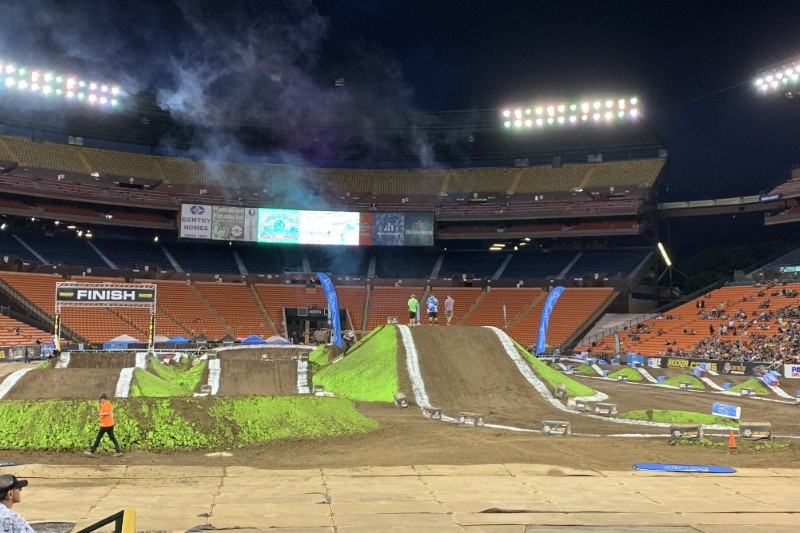
Given how expensive racing has gotten, chances are the New Aloha Stadium Entertainment District won’t be welcoming Supercross like its predecessor. Probably.

Top: February 27, 2026
Bottom: October 26, 2026
To preface, the Aloha Supercross-slash-Alohacross-slash-Gas Expess Supercross, the Superbowl of Wheels, the Hawaiian International Supercross, and the Hawaiian Supercross were never points-paying rounds for the AMA Supercross Championship. Save for the Hawaiian International Supercross, they were solely independent races put on by local organizers that invited stars from the continental United States.
The first Aloha Supercross was held on June 30, 1984. Bart Tunick served as the promoter via his company Pro Motion Inc. (get it?); he quipped, “What is more unbelievable is that the stadium is letting us do this.”[1]
Just for added clarity, although unprecedented for the stadium, general manager Charles Bessette had conducted a study to see if motocross was feasible at Aloha. After some math, he confirmed it would work.[1]
The entire event cost Tunick about $100,000 excluding the offsetting help from sponsors, with $55K being for track work. Ron Crandall, a high school science teacher and motocross track official, led the 21.5-hour construction process.[2]
Course construction began on June 27.[1] Workers laid 104,000 square feet of heavy plastic sheeting, 50,400 square feet of plywood, and more plastic before hauling in 42 truckloads of dirt.[2] 4,000 tons of dirt were used in total, all coming from a nearby Genty subdivision project. R.H.S. Lee, Inc. handled trucking the dirt in.[1]
The stadium was in its baseball configuration for Supercross, and the track was situated in right-center field occupying roughly 60% of the playing surface.[1][3] It was smaller than the usual Supercross track, spanning a quarter mile in length with nine turns. Retired motocross star and Hawaii native John DeSoto felt the tighter confines would make for a “tight, aggressive race. […] But it’s not the type of aggression that you use when you’re mad. You have to think, especially on the doubles and big jumps. You can’t hold back and say, ‘I’ve just got to cool it,’ because if you cool it, the other guy is going to pass you. If you cool it, you have to work twice as hard.[3]
It featured 22 obstacles like dips and jumps, and a 12-foot hill shaped like a volcano.[3] Nicknamed the “Lava Leap”, the hill was built using three Matson shipping containers.[2] There were also track features with monikers like “Burger King Whopper”, “Hawaii Dynasty Dips”, and “Funway Freeway”, while the whoops were called “Glenn’s Gulch”.[4][5]
“Aloha Stadium has many functions, but being a landfill probably isn’t one of them,” Curtis Maruyama of The Honolulu Advertiser quipped when it was revealed.[1] “If you wonder into Aloha Stadium on June 30, don’t be alarmed if you see not a baseball game or a rock concert, but mounds of dirt. Yes, dirt. Lots of it[.]”

Credit: David Yamada and Carl Viti / The Honolulu Advertiser (June 28, 1985)
32 riders, 27 locals and five from the mainland, were signed up; Jimmy Ellis, Jo Jo Keller, Brian Myerscough, Rodney Smith, and Ron Turner comprised the outsiders.[4] The locals were simply a roster provided by the Hawaii Motocross Association on short notice, so short that there was hardly any vetting and DeSoto was the only person on the list with Supercross experience.[5]
12 made the 20-lap final. In front of 15,000 fans who paid up to $15 for their seats, Turner led the entire race ahead of Myerscough. DeSoto came out of retirement for the race, only to crash with Thomas Key.[6] Ka’a’awa resident Philip Oveland was the top Hawaiian in fifth, while Royce Racoma—who once played at Aloha Stadium as a quarterback for Saint Louis School—crashed on the Lava Leap.[6][7]
While he was 37 at the time, DeSoto quipped that returning to racing here made him “feel old, like I’m 62.” Still, the fan enthusiasm was palpable and “it felt like 1972 all over again” to him.[6]
The success of the inaugural event led to its return in 1985 and much enthusiasm. Neal Jacobs, another promoter, envisioned Supercross as a way to begin the summer in Hawaii, comparing it to college football’s bowl games in January. The Hawaii Motocross Association also upped their game by obtaining a copy of the track, building a replica, and hosting proper qualifying races to determine who could represent the home state in the Aloha Supercross.[5] Skoal also came aboard to sponsor the Lava Leap, christening it the “Skoal’s Lava Leap”.[8]
Myerscough redeemed himself from the year before ahead of Jim Holley and Turner. DeSoto also came back for another one-off, fnishing tenth of 12 riders in the final. 20,000 attended Aloha Supercross ’85.[9]
Dave Reardon of the Honolulu Star-Bulletin wrote:[10]
The only events that attract people to Aloha Stadium besides football and swap meets involve lots of noise… a Police concert, tractor pulling, Fourth of July fireworks — or motocross, as was the case last Saturday night.
If the constant roar of the motorcycles wasn’t enough, Larry The Mouth” Huffman’s running commentary at what seemed like 100 decibels made the ears ring.
The second annual Aloha Supercross drew 20,000 people — which is nearly what the Hawaii Islanders, one of the best minor league teams in baseball, get in a good homestand.
Does this say something about the tastes of Hawaii sports fans?
Maybe. It’s been said that baseball’s too slow for casual fans to enjoy. Baseball is a game in which most of the time is consumed by one guy who stands on a hill of dirt, deciding what to do with a ball. Everyone else, including the other players, wait.
For most fans here, it can’t compete with the high-speed racing and potential for danger that motocross offers.
Some fans, no doubt, left the stadium disappointed. After all, no blood was spilled, except by a spectator who was getting patched up at security after a fight in the stands. Just an isolated incident all the way — there were a few fans who got out of hand… but nothing major.
[…]
But in fairness to baseball, one night of motocross a year is probably enough for all but the most avid biking enthusiasts. It’s doubtful, no matter how well it’s promoted, that motocross would bring in a lot of fans night after
night.The promoters realize this. That’s why Supercross and Superpull, despite their phenomenal drawing power, are being brought along slowly.
Events such as these have filled soem of the biggest stadiums on the Mainland. The ingredients of novelty, familiarity (a lot of people ride motorcycles and drive trucks), danger and high speeds, and good promotion are reasons for such popularity.
The Hawaii sports fan’s appetite has been whetted.
Who knows? Maybe someday 50,000 fans will fill Aloha for a Superpull or Supercross. It may not be the Super Bowl, but it’s exciting… once a year, that is.
15-year-old Shaun Kalos won Aloha Supercross ’86 after taking the lead from Mike Larson when he fell on Lap 11, while Williee Surratt took the ’87 edition.[11][12] Phil Oveland, Hawaiian national champion and former California BMX star, rounded out the former’s podium and finished fifth in the latter in his final race.[13] Conversely, DeSoto announced his retirement again after the 1985 race only to come back a year later.[11]
In November 1987, Aloha Motorcycle U-Drive sued promoter Neal Jackaway and the Aloha Stadium Authority. Claiming both stole the company’s rights to organize the event, U-Drive sought $1.5 million in damages from Jackaway and 50% of the profits from that year’s race.[14]
The Gas Expess Supercross, as it was renamed, was held for the fifth and final time in 1988.[15] Unlike in previous years, this was done in the football configuration so that “more people will be a lot closer to the action”.[16] Bessette retired at the end of the year.[17]
It was reorganized into the Pepsi Superbowl of Wheels in 1989, technically fulfilling Aloha Stadium’s destiny of hosting a Super Bowl. Unlike its predecessor, it used the entire stadium floor.[18] While support classes were present at the Aloha Supercross, the Superbowl of Wheels also included dune buggy racing and extreme sports like vert skateboarding and BMX.[19]
Ricky Johnson and his Honda factory team were among the headliners.[18] DeSoto’s son John “Bu” DeSoto also took part, and then broke both of his wrists when he crashed in 1990.[20]
Although never part of the AMA Supercross Championship, the 1991 and last Superbowl of Wheels was the third round of AMA’s new Pan-Pacific Supercross Series. It was accordingly renamed the Hawaiian International Supercross III, the Roman numeral to be a nod to its original identity.[20]
DeSoto helped design the new track, which included six thousand cubic yards of red dirt from Oahu and 500 bales of hay. At the finish was a 35-foot jump that required 20 truckloads of dirt. It spanned 11 turns with three hairpins and 55 whoops and bumps.[20]
“We wanted to make the track a little bit technical and give it some height. In past years, it was rough,” DeSoto explained. By this point, his racing career was long over and he was on the city council.[20] His wife Pati was a consultant for race organizer Motorsports Hawaii.[21]
The course might’ve been a little too tough, though. Nearly everyone was involved in a crash, including the favorite Jeff Ward when his front wheel grazed the rear wheel of a lapped bike while chasing down teammate Jeff Matiasevich with five laps to go. Matiasevich pulled away to win, Ward and Darryl King following. Troy Sanford was the top Hawaiian in eighth.[22]
Despite being another hit for the stadium, the 1992 Hawaiian International Supercross was moved to Hawaii Raceway Park in Oahu because Motorsports Hawaii wanted to promote the renovations there. After all, it was more economically and logistically feasible to take the money that went into building the temporary track at Aloha and invest it into something permanent at an actual racing facility.[23]
“We can make the track exciting because we don’t have to worry about putting too much weight on second base or the pitcher’s mound because they would collapse,” said DeSoto.[23]
Hawaiian International Supercross V in 1993 spelled the end of organized Supercross in the state after Eldon Kekahuna’s fatal crash in the double hump.[24]
It wouldn’t be until 2019 that Aloha hosted Supercross again. The Hawaiian Supercross was ultimately just a one-off.

Credit: David Yamada / The Honolulu Advertiser (May 31, 1986)
References
[1] “Stadium hits dirt for Aloha Supercross” by Curtis Maruyama, The Honolulu Advertiser, May 30, 1984
[2] “Doing Dirty Work for Supercross” by Catherine Enomoto, Honolulu Star-Bulletin, June 28, 1984
[3] “Wild rides forecasted at Supercross” by Stephen Tsai, The Honolulu Advertiser, June 30, 1984
[4] “Riders ready for big clash at Supercross” by Stephen Tsai, The Honolulu Advertiser, June 29, 1984
[5] “Aloha Supercross” by Dave Koga, The Honolulu Advertiser, June 22, 1985
[6] “Turner’s victory and 15,000 fans make Aloha Supercross a success” by Stephen Tsai, The Sunday Star-Bulletin & Advertiser, July 1, 1984
[7] “Atisanoe loses first senior division bout”, The Honolulu Advertiser, July 2, 1984
[8] “Supercross features a joy ride to satisfy thrill-seeking fans” by Dave Koga, The Honolulu Advertiser, June 30, 1985
[9] “20,000 watch California biker master Aloha Supercross ’85” by Dave Koga, The Honolulu Advertiser, June 30, 1985
[10] “Supercross Becomes Roaring Success at Aloha Stadium” by Dave Reardon, Star-Bulletin, July 1, 1985
[11] “Supercross’ high-octane show attracts 20,000” by Stephen Tsai, The Honolulu Advertiser, June 1, 1986
[12] “Isle File”, The Honolulu Advertiser, August 3, 1987
[13] “King of the hill is easy rider at heart” by Scott Kauffman, Honolulu Star-Bulletin, July 29, 1987
[14] “Atisanoe wins 2nd bout”, The Honolulu Advertiser, November 11, 1987
[15] “Louden named to top job at Maryknoll”, The Honolulu Advertiser, July 29, 1988
[16] Column by Don Chapman, The Honolulu Advertiser, July 26, 1988
[17] “Bessette to retire Dec. 31” by Stephen Tsai, The Honolulu Advertiser, December 14, 1988
[18] “‘King Ricky’ wheels his throne into Aloha Stadium” by William Kresnak, The Honolulu Advertiser, August 4, 1989
[19] Advertisement in the Star-Bulletin, August 4, 1989
[20] “Riders ready to do dirty work” by Paul Giblin, The Honolulu Advertiser, June 28, 1991
[21] “Motor sports revving up” by Dave Reardon, Star-Bulletin, June 26, 1991
[22] “Smooth, steady ride to victory” by Paul Giblin, The Honolulu Advertiser, July 1, 1991
[23] “Supercross vaults to new venue” by William Kresnak, The Honolulu Advertiser, July 15, 1992
[24] “Race death casts pall of biker gloom” by Stu Glauberman, The Honolulu Advertiser, August 10, 1993
Featured image credit: Josh Pacheco
Leave a Reply