
Since the Dakar Rally’s inception in 1979, there had always been at least one woman competing on a bike. Unfortunately, that trend is set to come to an end after 47 years.
All of the 117 riders entered for the 2026 race are men, which will make it the first Dakar without a woman in the bike field. There are certainly female drivers and navigators on the FIA side, but it’s basically a sausage party for FIM.
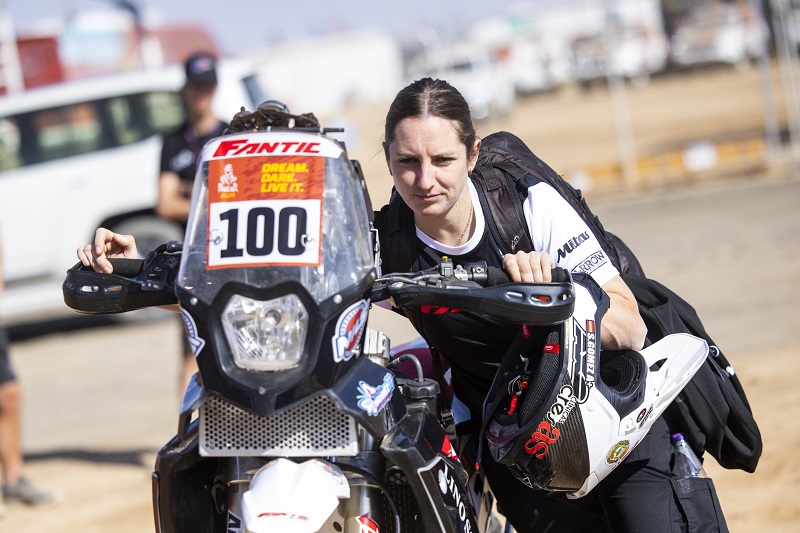
Sandra Gómez, the only female rider in the 2025 race, hoped to return but couldn’t get together the budget to make it happen. She finished 33rd in Rally2 with Fantic.
“Obviously, I wanted to go back,” said Gómez. “Last year was tough, but it was the one I enjoyed the most. I think I still have a lot to offer in the race. The opportunities to be on the starting line are practically nonexistent, and that’s the only reason I won’t be there: I haven’t found a team or a sponsor.”
The 2024 Dakar had two women in Jane Daniels and Yael Kadshai, the former being a Fantic rider like Gómez. While faces typically came and went, there was usually a female rider who became a mainstay even in years where she was the lone woman. Mirjam Pol looked to be that after doing the Dakar annually from 2017 to 2023 before medical complications from COVID-19 has kept her sidelined.
Laia Sanz, widely regarded as the msot successful woman rider in the race’s history, starred during the Dakar’s South American stint in the 2010s. She eventually made the switch to driving, and is entered for 2026 in an EBRO. Taye Perry, who’s worked with Sanz as her navigator, did the first Dakar in Saudi Arabia on a bike in 2020.
The inaugural Paris–Dakar Rally in 1979 had as many as six women on motorcycle: Christine Martin, Marie-Dominique Cousin, Martine de Cortanze, Marie Ertaud, Corinne Koppenhague, and Pascale Geurie. Ertaud and de Cortanze returned each year on bikes during the early 1980s, the former making her last start in 1983 (de Cortanze became a driver in 1982). Riders like Nicole Bassot kept the streak going in the ’80s as she showed up annually from 1983 to 1989.
The 1990s included faces like Patricia Watson-Miller, Marianne Bernard, Isabelle Jomini, and Andrea Mayer. Mayer, who later married Stéphane Peterhansel, led the way which included a three-peat of the women’s trophy at the turn of the millennium.
In the aughts, the final run for the Eurafrica, there were riders like Mayer, Patsy Quick, and Annie Seel. Those such as Silvia Giannetti and Christina Meier also took part once the race moved to South America.
Featured image credit: Julien Delfosse / DPPI / ASO
Leave a Reply