
Given the ongoing war in West Asia, it’s no surprise that organizers are canceling their races in the region or postponing them.
MotoGP pushed its Qatar round from April 12 to November 8. In cross-country rally, the Rally Jameel in Saudi Arabia and inaugural Oman International Baja were moved. Formula One will go over a month without a race after its announcement that the Bahrain Grands and Saudi Arabian Prix “will not take place in April”. The latter’s wording suggests the FIA will try to find new slots rather than outright cancellation, though it is obviously contingent on whether the now-three-week-long conflict in the region reaches a resolution.
Taking the Middle East’s weather and the very loaded schedule into account, F1’s opening could very well be at the end of the season after its races in Qatar and Abu Dhabi. This depends on if the war is over before Christmas, an optimistic sentiment that history has taught us never ends well. In fact, the war which spawned that remark also took a hold on international motorsports.
2026 will be the 100th running of the legendary International Six Days Enduro, yet the inaugural edition was in 1913. This discrepancy exists due to the World Wars wiping out 13 years (1914–1919, 1939–1946) while 2020 was called off due to COVID-19, all three major global events that are pretty understandable reasons. A centennial celebration did take place in 2013, though.
When the 1914 and 1939 races—when it was known as the Six Days Trial—were canceled, everyone was already on site and raring to go. Of course, things escalated very quickly when war broke out.
So let’s talk about the 1914 ISDT and what happened when the Great War came.
The 1914 ISDT
1914 was the second running of the International Six Days Trial after a successful debut in 1913 in Britain. The French city of Grenoble was awarded the following year’s edition, the culmination of a busy motorsports summer in Europe that included the English Six Days Trial in Sheffield, the International Cup in Le Mans, and most notably the French Grand Prix in Lyon.[1]
The Fédération Internationale des Clubs Motocyclistes, predecessor to the modern-day FIM, organized the event alongside the Union Motorcycliste de France. It was scheduled for August 3–9 with 70 riders across three categories: 350cc, 500cc, and 1000cc sidecar.[1][2]
The ice skating rink in the Grenoblois neighborhood of Rue Condorcet served as the main hub, with racing in the nearby Alps. The Birmingham Post noted in July, “The conditions prevailing for the competition in August are on the same lines as those which were obtained in the last English Six Days’ Trial.”[1]
Day 1 was to begin with a 16-mile run into the Alps toward Saillans. After lunch, the stage continued 12 more miles to the mountain pass of Col du Rousset. A few more loops totaled up the day’s distance to 149 miles.[3]
The second day was planned to run for 124 miles. The first stop was Col du Fau before getting lunch in Gap, then the summit of Col Bayard and Le Motty. It’s a fairly simple run through “minor French passes” compared to what’s to come.[3]
The mountain passages ramped up on the 141-mile Day 3 as the trial passed through Col du Frêne, Col du Pré, and Les Déserts. Lunch break would be at Pont de Lescheraines before heading 24 miles through Chambéry and to the next mountain. Another pass by Col du Frêne followed, then Col du Cucheron, the monastery of Grande Chartreuse, Col de Porte, and Col de Vence.[3]
August 6 would be the rest day where the bikes were put on display at the skating rink.[3]
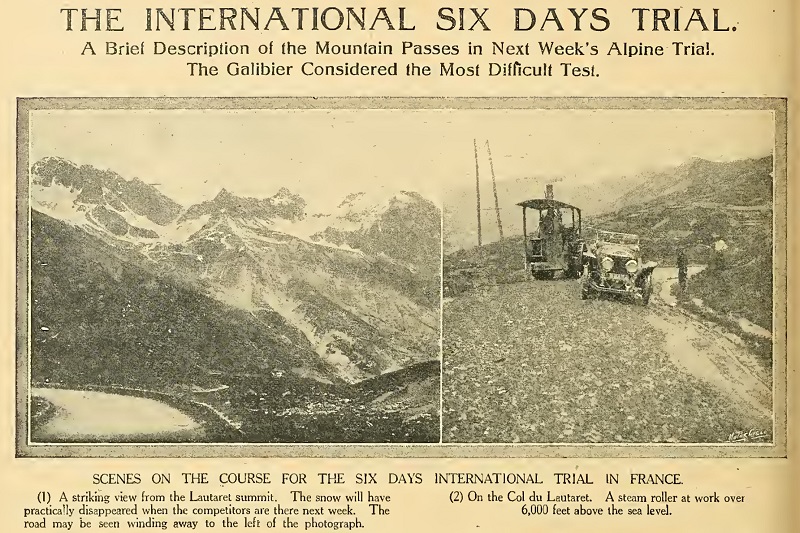
Finally, Day 4 would’ve gone through what The Motor Cycle called “the finest scenery to be found in the whole of South-eastern France, and equal to any in Switzerland.” After passing Col du Lautaret, riders would hit Galibier. This section was considered the most treacherous, the centerpiece being a poorly-lit tunnel that took everyone downhill to the lunch break. Once nourished, they headed for Col de la Croix de Fer and a particularly dangerous and narrow road without fencing.[3]
Finally, the ISDT was to end by climbing Col du Glandon.[3]
The Motor Cycle, the preeminent source for motorcycle racing news at the time, sent a team of journalists across the English Channel. Upon landing at the port city of Le Havre, they linked up with some competitors to make the drive to Grenoble. Other riders opted to take the train to protect their bikes.[2]
Everyone was in relatively high spirits as they headed for Grenoble. Well, mostly. Some of the British contingent was just hoping the show would be a little cleaner than their own Six Days Trial, which was overshadowed by some controversy when a judges’ report opined that sidecars were too weak to survive their course.[4] Surely, their French counterparts would fare a lot better.
They never got to find out.
War!
While excitement was contagious on the caravan and among those already in Grenoble, things were spiraling out of control across Europe. The July Crisis produced a domino effect of alliances being activated and growing hostilities that were stoked by prior hostilities, making it nigh inevitable that war was nearing. As track construction was finishing up and everyone was nearing France, Austria-Hungary had already declared war on Serbia while Russia was preparing to mobilize.
The first day of the ISDT coincided with Germany’s war declaration on France. It didn’t take long for the FICM to announce the race would be indefinitely postponed. The news was then relayed to other national motoring clubs like the British ACU.[5]
“Strange though it may seem,” started The Herald and Leader from Retford, “the latest addition to the list of victims of the Austro-Servian [sic] War is the sport of motor-cycling.”[5]
“Continental touring, usually at its height at the present season of the year, has also been checked,” wrote the Western Daily Press before optimistically adding, “though not necessarily abandoned.”[4]
The Liverpool Evening Express quipped, “The present European crisis is affecting world affairs in many unexpections. Who would have supposed it would have been motor-cycle trial?”[6]
Mobilization across the continent was rapid. France had issued a general mobilization order on August 2, while the ACU’s motorcyling members back in the UK were either already part of the Territorial Forces or prepped for the military. The Western Daily Press even hyped up personnel who competed in trials since such events “are run under severe conditions applicable to efficient military service.”[4]
Speaking of mobilization, the turmoil immediately raised another issue: all the ISDT attendees were either still in Grenoble or on their way.

Escape from the City
The Brits were in a pickle. Many had just reached Grenoble when they got word of the war. It’s a massive hassle even today to show up to an international event and immediately be ordered to turn back, and even more so in 1914.
Grenoble was on the opposite side of the country from Havre, meaning they certainly had to refuel their vehicles to make the trip back. However, the French authorities had seized all petrol stations for the war effort. Other challenges faced included the military stopping them, by land and even by sea in some cases because the English Channel had already been mined, and trying to navigate the chaos as everyone else tried to go home.[7][8]
For the record, everyone did get home in the end. That didn’t mean it was a smooth trip, of course.
Geoffrey Smith, a rider from Coventry, was among the lucky ones in this regard. The Coventry Evening Telegraph published the following about his journey:[7]
A DASH ACROSS FRANCE.
Exciting Adventures which befell “The Motor Cycle” Representatives on the way home from Grenoble.
The experience of Mr. Geoffrey Smith, Coventry motorist, who found himself with a party of others in the South of France on Saturday evening at the time when the order was given for the general mobilisation of the French Army, make interesting reading.
The party had only left England on Wednesday, and had set out for Grenoble in connection with the six days’ international trial for motor cycles, which was to have been held this week, but which, of course, was postponed. Instead of being able to spend some time in the Alpine district, as was intended, the party found that in consequence of the war developments it was necessary to quit France at once in accordance with the order which was issued to foreigners. To make matters worse it was found that almost all the petrol available had been commandeered for the purposes of the French Army, but the party was lucky to get sufficient for a 300-mile journey and accordingly set out on Sunday morning in a powerful “five-seater” on a hurried flight across France.
The object of the party was to reach the coast line before the Channel service was stopped, and the journey was continued all through the night. Armed gendarmes were stationed at all the level crossings and bridges along the route, and the car was frequently stopped, the occupants being treated as suspects. So good was the progress made, however, that in 24 hours 415 miles were covered, and Havre, a distance of 490 miles, was reached after 27 hours’ travelling. The members of the party relieved one another in driving the car, and they were naturally well pleased at having got out of the danger zone so expeditiously.
Their Channel steamer was overcrowded, and considerable excitement prevailed amongst those who endeavoured to get aboard. There were no boats available, and the car could not be put on the steamer. During the passage a torpedo boat stopped the vessel, and toured round it, and off Southsea a pilot came aboard to take charge, as it was understood that the Channel was heavily mined. More delay was also experienced on the train journey to Waterloo, and Mr. Smith arrived in Coventry at half-past six last evening after continuous travelling since Sunday morning, during which time he did not see a bed!
The announcement of the race being called off came while The Motor Cycle‘s reporters were still en route to Grenoble. They documented their trip as well:[8]
The representatives of The Motor Cycle who went over to France last week in connection with the International Six Days Trial had a most interesting if not exciting trip. A start was made from Havre last Thursday morning in company with Mr. and Mrs. Loughborough and Rev. E. P. Greenhill. Three competitors, in W. B. Little (Premier), Frank May (A.J.S.), and J. Greenwood (Connaught), followed the pilot car, which contained five persons. At that time the situation had not assumed the seriousness it now has, and none imagined that the trial would be postponed.
It so happens, however, that the event was cried off the same day the party started across France by road, but the stopping places not having been fixed beforehand, wires failed to intercept the party. A fast pace was set up; and May had engine trouble at Romancourt and elected to train to Paris for repairs.
Near Glen on the second day, H. F. S. Morgan. who had started the day previously, was met returning, he having been troubled with a main bearing bush on his engine.
The Trial Abandoned.
The car and the two motor cyclists managed to lose one another, but all arrived at Grenoble safely last Saturday evening and learned with the greatest concern that a general mobilisation of the French Army had been ordered an hour previously, that the trial was abandoned, that petrol had been commandeered by the French Government, and that foreigners must quit within twenty-four hours. Here was a serious state of affairs!
The car party at once decided to return at the earliest possible moment. There were no trains available, and on Sunday morning the British Consulate was visited. Here we found a number of other competitors and their passengers making enquiries as to the best course. All were advised to leave as quickly as possible, and the British Consul gave it as his opinion that essence would be obtainable in the villages. This news led Pressland (Crouch Carette) and W. Chater Lea (Chater-Lea) and their passengers to discuss a return via the Galibier Pass in order to enjoy same of the gorgeous scenery of the French Alps. What became of them we do not know.
Finn and his passenger with the Enfield sidecar had managed to lay in a store of petrol and intended returning by road. R. A. Bishop with the 8 h.p. Enfield sidecar which Greaves drove in the English Six Days Trial seemed undecided what to do, though he had journeyed down by train. Little and Green-wood elected to return by the route they had traversed.
Petrol Obtainable at Last!
By dint of diligent enquiries a source of petrol supply was privately forthcoming, and our party therefore took on board some fourteen bidons. There was naturally great excitement in Grenoble, and a military air on all sides. Only a few trains were running to certain restricted spots, and weeping women and children bidding good-bye to their menfolk made matters look ominously black.
A start was made on Sunday morning on the 500 mile trip to Havre, the party having decided not to lose a moment. Railway crossings, of which there are a large number in France, as well as the bridges, were guarded by gendarmes, and the car was pulled up on many occasions and the occupants interrogated as to their nationality and as to the nature of the baggage, the presence of explosives being feared. We had taken the precaution to display the emblems of the Entente Cordiale on the car and many times they were recognised and enthusiastically cheered.
The increased vigilance of the authorities, however, impressed upon the party the extremely serious nature of their position, and the probability of being cut off in France should the Channel service be stopped, which it was anticipated would he the case.
A Dash through the Night.
At Decize, where the party dined, it was resolved to continue throughout the night by changing drivers and relying upon the Michelin Guide and Baedeker for the route. Splendid progress was made, and, curious to relate, during the night only once was the party challenged by a sentry. As dawn broke cart loads of reservists from the country were encountered on their way to the mobilising centres, and twenty-four hours after the start the distance recorded was 415 miles. But our petrol supply was now becoming exhausted, and many times our requests for replenishments were met with a shake of the head. At Dreux, however, our luck was in, and once again we laid in a good store. How thankful we were that the French roads were so straight! Speed was quickened as daylight improved, but now another trouble threatened the party, which, of course, was absolutely reliant upon the car to see them safely through. It was feared that the ferry across the Loire at Quillebeuf would be suspended, which fear was later discovered to be a well timed one, and the route consequently changed to the longer stage via Evreux and Rouen.
Occasionally we were able to pick up scraps of war news, but the alarmist reports were in the main proved later to be unfounded, but they served to increase our determination to go through to Havre to avoid risk. The sentries were not so much in evidence as the frontier was left behind, but the military preparations were by no means relaxed. Havre came in sight at last after twenty-seven hours’ continuous running.
It was generally believed that Wednesday night’s boat would be the last across for some time, and, consequently, we fear that the remainder of the British party may be subjected to great inconvenience, as nothing had been heard of them when we left Havre.
The boat on which the writer sailed was stopped in the Channel on Wednesday morning while a torpedo boat encircled her; a pilot was taken aboard off Southsea to navigate the boat by a roundabout route (it was said and believed to avoid the mines), and after many delays in the Customs at Southampton, the train due at Waterloo at 9 a.m. got there at 3 p.m., and there was not a single traveller who was not heartily glad to set foot on English soil again.
Chater-Lea and Pressland followed up with The Motor Cycle a fortnight later to reveal their trip through the Galibier Pass was a success. In fact, they “thought less of it actually than they had been led to expect” since they just cruised in low gear for three-and-a-half miles. They eventually ditched their rides at Dieppe before getting back to England.[9]
TCM published the following story on the duo’s alternate route on August 27:[10]
TWO CYCLE CARISTS’ ADVENTURES.
An Exciting Trip from Grenoble to Havre under War Conditions.
The last we saw of Mr. Chater-Lea was at nine o’clock in the morning at Grenoble on the memorable Sunday on which France declared war with Germany. He, in company with other English drivers who had entered for the International Six Days Trial, had been told by the British Consul that there was little likelihood of his having any trouble in getting through to England, and he therefore decided to see the Lautaret and Galibier Passes. At the Consulate Mr. Lea met C. Pressland, the driver of a Crouch Carette, and they both decided to take the Galibier together, and after doing so they descended and made for the Lautaret summit, where they met a Danish professor and his wife who were in a terrible state owing to all vehicular traffic other than military being stopped on the pass, so Pressland took one and Chater-Lea the other and brought them back safely to Grenoble the next day. The tunnels on the passes were in very bad condition owing to damp and wet, and passing was exceedingly difficult owing to the number of troops on the road, and so bad was the condition of the latter that Mr. Lea assures us that anyone on a motor bicycle would have had to dismount.
A Petrol Difficulty.
Next morning a start was made for Aix-les-Bains, where on the road round the Lac de Bourget Mr. Chater-Lea began to realise the seriousness of the situation. Every crossing was, of course, guarded. A genuine difficulty was experienced in getting petrol, and thinking that probably it would be easier to obtain in the country, they refused to pay the exorbitant prices demanded, but at the next village, when he stopped at a grocer’s shop and asked the woman behind the counter to sell him some, she absolutely refused, but finally the daughter persuaded her mother to sell one can only, and that to be shared between the two cars. The man, who overheard the conversation, flew into a passion and said he had undertaken to sell no petrol, and nothing would persuade him to do so, but fortunately the Maire, who had come along, recognised that it was a case of two Englishmen in dire distress, and the one can was allowed to be sold. France was under martial law, and no one was allowed to be on the roads after 6 p.m.; consequently they had to stop at Culoz, a little station on the main P.L.M. line. Here Mr. Lea, who was the only member of the party who could speak French, went to the Maive and asked him give him a laisser-passer. This was made out for W. Clater-Lea and his family in two cars to be free to pass from Culoz on their way to England.
An Unpleasant Experience.
The next village they came to was quite a small one, and all the population appeared to be in the street, and they were forced into the Mairie, where their papers had to be shown. This was an unpleasant experience, but nothing in comparison with what was to follow. Pressland and Sanders, his companion, thought they knew the road to Virieu-le-Grand, but at one turning they mistook the way, and here a car containing an officer and some soldiers passed by them. Pressland went back to look for the road and Chater-Lea waited. As the car passed it was remarked that its occupants scrutinised the Chater-Lea very carefully. A few minutes after it passed again, going in the reverse direction. Chater-Lea came back and found Pressland had been arrested. His passenger had been turned out and put in the car, and a soldier was sitting beside him holding a revolver in a threatening position. Matters looked truly serious, and, of course, Chater-Lea stopped. While he was not looking, and conversing with the officer, a soldier roughly pulled Mrs. Chater-Lea out of the small car and put her into the big one carrying the soldiers. Chater-Lea was told to take the wheel again, and had an armed soldier sitting at his side. Both small cars, in front of the big one, then drove to Virieu. Evidently both had been mistaken for Germans, and an hour and a half was taken up in searching the car, the luggage, and the occupants, but, of course, nothing incriminating was found, but Pressland was made to open his camera, and the films were torn up and scattered to the winds. Fresh passes were then issued, and they were told to make their way to Bourg and report themselves to the Prefecture. If they missed the way they were to go on as best they could, but whatever happened they were strictly enjoined not to turn back. On the road from Mâcon to Charolles, which leads to Nevers, the Crouch suffered tyre troubles. An officer in a car stopped and said that there must be no loitering on the road. If they had tyre troubles they had better cut off the offending covers and drive as best they could on the rims. Eventually they reached Charolles, where patches were purchased, and thereafter things went more smoothly.
A good run was made to Orleans, where in one of the large squares Pressland and Sanders were recognised as Englishmen. They were lifted out of their cars and carried shoulder high round the town. A man who was sellinor, plums came up to Mrs. Chater-Lea, took hold of her affectionately by the shoulder, and thrust a handful in her hands and would not hear of payment. So enthusiastic was their greeting that it became quite embarrassing. The next morning a more was made to the Commissaire de Police, with the object of getting the papers vised. This, however, could not be accomplished before nine o’clock which was indeed hard luck, as one might only travel between the hours of six in the morning and six at night. At last the offices opened and an attempt was made to get the papers signed. Matters looked pretty hopeless at first, standing amid carters, peasants, foreigners—in fact, anyone who wished to travel from place to place. It was not, therefore, till nearly eleven o’clock that they were on the road again. All along sentries were found posted on bridges, at level crossings and at the beginning and end of every village and town, and as on one day Mrs. Chater-Lea counted more than one hundred stops it will be understood that no great mileage could be accomplished.
Here Mr. Chater-Lea related to us that down in the south yokels in their working garb and wearing only the képi of the French soldier kept guard, all armed with rifles with fixed bayonets. Barricades were put in the villages, which varied in efficacy according to the ingenuity of the Mairie of the place.
Difficulties at Rouen.
At Rouen, where they expected to get through quite easily, they found the greatest trouble. After waiting three-quarters of an hour at the Mairie, the Maire refused to sign the papers, and they had to go before the Commissaire de Police, who refused the papers as no photographs were attached to them. In previous places the photographs on the international pass had been accepted, but at Rouen the Commissaire de Police refused to recognise this procedure, but on being appealed to to help them out of the country, he agreed to allow the photographs to be taken by the prison photographic department, at a nominal charge of one franc per photograph. Here again a difficulty cropped up, as by this time all the French money had been absorbed, but the Commissaire, who by this time had assumed a more kindly tone, sent out and got the money changed. The photographs were taken in double quick time, and in surroundings such as an ordinary law-abiding citizen does not ever see. All round were measuring instruments for taking the stature of a criminal, a special chair which, when a prisoner sat upon it, made him assume a position in which he could be instantly photographed, apparatus for taking finger pronto, and charts for recording the colour of the prisoner’s eyes.
From Rouen to Dieppe is not a long journey, but three days they had to wait for a steamer, which was the last boat before the suspension of the service. The cars, of course, had to be left behind.
Fellow British rider Maurice Greenwood had a misadventure of his own, which he recalled in a letter submitted to TCM upon getting home:[11]
Six Days of Trials.
Motor Cyclists’ Adventures in France in Time of War.
After the abandonment of the F.I.C.M. Six Days Trials, the British Consul at Grenoble had advised us to get out of the country as quickly as possible, and things to us began to look rather serious.. There were four in the party—myself with a Connaught, W. B. Little with a Premier, and R. A. Bishop with a Royal Enfield sidecar and passenger. Our tanks were all nearly empty, but we put our trust in good luck, and started off at 11 a.m. on our journey to the North Coast. The streets in Grenoble were rather quiet, for a lot of the troops had gone away by train in the early morning. Our luck was in all right, for we came across a small garage in a village two miles out of Grenoble where we obtained enough essence to fill all the tanks. This eased our minds a little , and we accelerated speed up to forty and forty-five miles; one speedometer jammed at fifty-eight, so we were “travelling some.” We kept on at this rate till we reached a small place named Bourgoin, where we had lunch. I rather think we might have got into trouble at this place, for a French soldier ordered us to garage our machines in a shed and not to take them out again, but as he had disappeared when we came out of the hotel, our machines disappeared also, as fast as we could make them, on the road to Lyons. It was nearly 4 p.m. when we neared Lyons, keeping well together all the way. It took us some little time to find the way through the town, but we were soon on the road to Roanne.
A Breakdown delays us.
My old two-stroke was running splendidly, and I kept well ahead, for the road was fairly good though twisty, and well fitted up with guide posts. On reaching the octroi at Roanne, about 6.30 p.m., I pulled up to wait for the other two, but as they had not appeared in sight after twenty minutes waiting, I jumped on the machine and rode back to see what was wrong. I found them about twelve miles back at a village called l’Arbresle; the Enfield had developed bearing trouble in the back wheel, and it was impossible to repair it. We tried our best with the tools we had till 10 p.m., and then gave it up. The villagers crowded round us and gave us moral support, which was not worth much, but better than having bricks thrown at us. We stayed the night in l’Arbresle, and in the morning, after a council of war, we left the Enfield at the hotel, and then went back to Lyons to see if we could obtain a spare ball race for the back wheel. Bishop and his luggage rode on my carrier, and Little took the passenger and his luggage.
We reached Lyons safely and went to the Motosacoche depot, but found out that we could not get a spare in the whole town. We were in a fix all right. So off we went to see the Consul, for things began to look a wee bit serious, and not one of us had a passport. When we got to the Consul’s office there were about sixty waiting their turn to see him. Two girls fainted in the crush while we were there. However, we got certificates of registration after waiting eight hours and went outside again.
Our Machines are Commandeered.
We had barely got into the street again when three soldiers came up and informed us that they required our machines to be left with them as they would be required for national service. This put us in a worse plight than before, but there was no help for it, according to the Consul, so we obtained receipts for the two machines and left the receipts in the care of the overworked Consul.
It was hardly a nice situation for us; stranded in a foreign country in a state of war. If they had left us our machines, we should not have felt so helpless, but there we were and we had to make the best of it. We asked the Consul’s advice, and he promised to get us on a troop train which was leaving for Paris at noon the following day, Tuesday. He fulfilled his promise, and Tuesday, 12.30, saw us steaming out of Lyons in a crowded troop train at the headlong speed of ten miles per hour towards Paris. We did not worry about the speed as long as we got there. It was 2.30 p.m. on Wednesday when we arrived at Paris.
We had to find the Consul in Paris and see what he could do for us, and after a weary and anxious wait of eleven hours, we boarded the train for Havre, and arrived at that port at 9.30 a.m. on Thursday. The boat left Havre at 11 p.m. the same day, and, after a very crowded crossing with all lights out, we arrived at Southampton about 8 a.m. Friday, glad to get back to Old England. The first thing was a good English breakfast and then home.

It would be six years before the ISDT was revived. At the FICM’s January 1920 meeting at the Royal Automobile Club, the UCM proposed bringing back the trial under the 1914 rulebook and once again in Grenoble.[12]
Everyone agreed.
References
[1] “Motors and Motoring” from the Birmingham Post, July 3, 1914
[2] The Motor Cycle, July 30, 1914
[3] “A Brief Description of the Mountain Passes in Next Week’s Alpine Trial. The Galibier Considered the Most Difficult Test.” by The Motor Cycle, July 30, 1914
[4] “IN THE MOTOR WORLD” from the Western Daily Press, August 7, 1914
[5] “EFFECT OF WAR ON SPORT” from The Herald and Leader, August 11, 1914
[6] “Interference of War With Trials” from the Evening Press, August 5, 1914
[7] “Back from the War Area” from the Coventry Evening Telegraph, August 5, 1914
[8] “A DASH ACROSS FRANCE.” by The Motor Cycle, August 6, 1914
[9] “Cycle Car Drivers in France.” by The Motor Cycle, August 20, 1914
[10] “TWO CYCLE CARISTS’ ADVENTURES.” by The Motor Cycle, August 27, 1914
[11] “Six Days of Trials.” by Maurice Greenwood, The Motor Cycle, August 20, 1914
[12] “SIX DAYS’ TRIAL AT GRENOBLE” from The Times, January 26, 1920
Featured image credit: The Motor Cycle (July 30, 1914)
Leave a Reply