
Arrowhead Stadium has looked like a glorified landfill for about a month now. Any Chiefs season-ticket holder probably would be appalled to see a sea of mud where their Sunday heroes play, but it’s all in the name of the Miller High Life Supercross motocross race tonight.
“Some people think only Kansas City would put dirt in their stadium, but they do this in sophisticated California and the nation’s capital, Washington D.C.,” said Russ Cline, director of promotions at Arrowhead. “Kansas City is lucky to have this event.”
– The Kansas City Times, May 7, 1983[1]
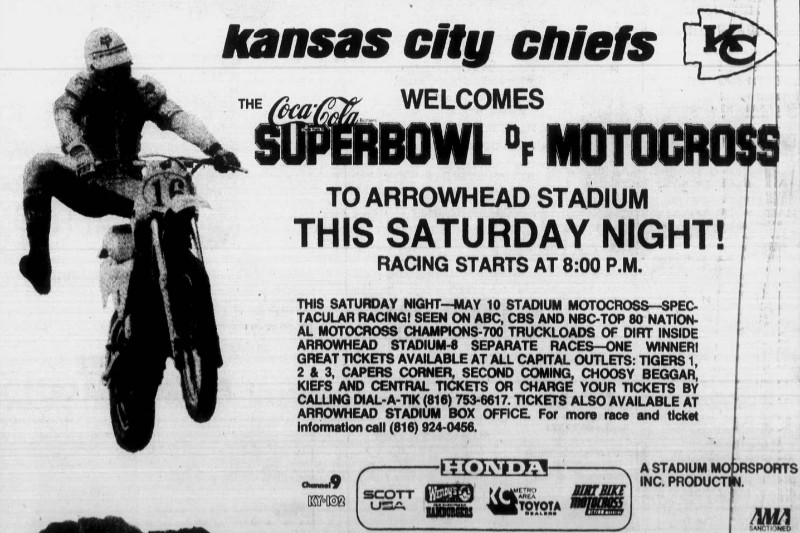
Arrowhead Stadium is known today as one of the loudest stadiums in the NFL, and that reputation has only grown thanks to the Kansas City Chiefs’ dynasty. Between Len Dawson and Patrick Mahomes, after Emmitt Thomas but before Derrick Thomas, the stadium was where Ken Howerton and Mark Barnett shined. In the early 1980s, when the Chiefs still had just one Super Bowl win, the Superbowl of Motocross visited the 78,097-seat stadium on four occasions.
Somewhat annoyingly for Chiefs fans, much of their team’s dominance since the turn of the decade technically came at “GEHA Field at Arrowhead Stadium”. Of course, very few actually called it by that full name because of how wordy it is, and it seemed the involved parties were aware of this.
Last Wednesday, the team and GEHA announced the stadium name would be simplified back down to “Arrowhead Stadium”. GEHA remains a team sponsor for campaigns like youth and military programs.
“Together with the Chiefs, we made the decision to return the stadium to its iconic Arrowhead identity, honoring the legacy, tradition, and community pride it represents,” GEHA executive vice president of growth and strategy Raj Vavilala stated. “We are proud to have been part of this chapter in the stadium’s history and to celebrate the return of a name that is synonymous with Chiefs Kingdom. We look forward to continuing our partnership with the Chiefs and investing in programs that make a difference in the communities where our members live, work, and serve.”
G.E.H.A. (Government Employees Health Association), an insurance company in the Kansas City area, acquired the naming rights to Arrowhead’s playing field in 2021 on a ten-year deal.
Venue name changes for sponsorship reasons, as common as they are in America, are highly unpopular as communities have to adjust to the new moniker and many see them as just another cog in the increasing corporatization of sports.
Renaming the playing surface is a middle ground that allows the sponsor to get its brand on while preserving the original identity. Other examples of this among fellow ex-Supercross tracks include “United Airlines Field at the Los Angeles Memorial Coliseum” and more recently “Uniqlo Field at Dodger Stadium”. The venues keep their OG names and everyone still calls them such, but their respective tenants get that sweet promotional money from sponsors.
“GEHA is a tremendous partner and this mutual decision reflects a shared commitment to honoring the rich history of Arrowhead Stadium and the Chiefs organization,” Chiefs president Mark Donovan offered. “We are thrilled to continue working with GEHA on all of the key community, military, and veteran-focused programs that they have helped us bring to life over the years.”
With the deal being altered (pray they don’t alter it any further), the Arrowhead Stadium name will likely stick until the vneue’s inevitable demise. The original contract stipulated GEHA Field would run until 2030 when the Chiefs’ lease expired, after which they would move into a new stadium for the 2031 season.
What happens to the Truman Sports Complex, which consists of Arrowhead and the adjacent Kauffman Stadium, is still in the air. Jackson County has considered redevelopment projects like shopping centers and even turning the former into a horse racing track called Arrowhead Downs. In the meantime, the Chiefs seem poised to cross state lines from Missouri into Kansas.
If the 2030s truly do mean the end for Arrowhead Stadium as we know it, at least it’ll go out with its classic name. Buffalo’s Highmark Stadium didn’t quite get the same luxury but it had gone through several name changes anyway. With the Bills opening a new Highmark and the Chiefs looking to leave Arrowhead, that makes two ’80s Supercross venues set to be exiled to history; incidentally, what was then Rich Stadium hosted its only Supercross race in 1984, just a year after Arrowhead’s last.
The Coca-Cola Superbowl of Motocross added Kansas City to its schedule in 1980. It was held on May 10, the 12th race of the season as the final round in a mid-spring gauntlet before the series took a month off.

Credit: John Spink / The Kansas City Times (May 7, 1983)
Building the half-mile course, which was also used for a tractor pull, took 28 days.[2] A tarp was laid over the Tartan Turf playing field, followed by plastic sheeting and 3,500 sections of plywood before the dirt was poured on top.[3] 2,000 bales of hay were installed along the drainage areas to soak up moisture and keep the mud out, followed by a one-foot layer of dirt atop. The dirt was sourced from a construction site in northern Kansas City.[1] Some of the surface compound was even used at what was then Royals Stadium to pad the pitching mound.[4] Part of the track curved into the stands.[5] The work meant Arrowhead was unavailable for the Chiefs to use for OTAs, so head coach Marv Levy moved them up earlier than he liked and to an open grass practice field.[4]
In total, the track work cost $100,000 compared to $75,000 for something like setting up a stage for concerts.[1]
Jim Kintchens, a California contractor who handled track work for Supercross races, explained in 1983 that “you’ve got to be much more careful in a place like this. You’ve got to deal with the time factor and a terrible factor called rain. If we get a day of rain, we’re usually set back a day of work and then another day while it dries out.”[1]
“If I were a Jackson County taxpayer I probably wouldn’t be too excited about seeing Arrowhead Stadium filled with dirt using heavy duty equipment vehicles to make it possible to stage a tractor pulling contest and motocross racing,” joked Jim Finley, sports editor of the Bonner Springs-Edwardsville Chieftain.[6]
The Chiefs oversaw the entire project from organization to construction. Russ Cline, the team’s promotional director, said in 1983:[7]
The course is computer designed by Stadium Motocross, a company in Laguna Beach, California.
The secret in designing a course is the spacing. The bumps have to be in the right place. There have to be certain speeds to attain. But speed isn’t the only thing, it’s the degree of difficulty in getting around.
This really is a family-spectator sport.
It was a cool homecoming for Kansans like Chandler Baker (a farmer from Kansas City), Joe Burke (a carpenter from Pittsburg), and Jeffrey Schumacher (an independent rider from Independence, Missouri, who had just graduated from Truman HS the year before), all of whom were the first riders to test the track.[8][9]
“The football field is lost, smothered beneath bales of strawy and dirt sculptured into miniature hills,” wrote Jeanne Meyer for The Kansas City Times.[8] “It looks like a setting for a livestock show.
“But from a tunnel under the stadium — the one where Chiefs’ helmets bob in the crowd on a bright fall Sunday — comes the sound of a motor, loud and buzzing like an angry lawn mower.”
Schumacher, whose only previous stadium experience was at an amateur race at the Astrodome, called it “a lot more challenging than the local race tracks.” Having broken his arm two years prior, he had developed a habit of racing conservatively if he failed to get the holeshot, but felt Turn 1 here should be better since everyone rode with more respect. Still, “you just have to get a good start.”[9] Howerton concurred, saying that “a good start is everything.”[2]
The race day consisted of four qualifiers followed by two semi-finals and a consolation race before wrapping up with the 20-lap feature.[2]
It wasn’t the holeshot, but the good start was what Howerton got. He was fourth off the line and moved up to third into Turn 1, settling behind Donnie Cantaloupi and fellow Suzuki rider Brian Myerscough.[2][5] Cantaloupi led the first half on his Yamaha before losing the top spot to Myerscough.[5] Meanwhile, Howerton battled with Mike Bell.[5]
The sand pit and the jump along the north goalpost proved to be Howerton’s best friends as he erased much of his gap to Myerscough through them. As Lap 12 began, he made his move.[5]
Howerton explained:[5]
I really didn’t plan that pass. I got a good takeoff coming out of the sand, and got an inside line on Brian.
The most tricky part of the course was the sand. The tunnel or whatever they call it (goalpost jump) was also a good part of the course. I think there I made up aa lot of my time. That’s where I passed Bell.
On this kind of track, there’s nothing to separate the good rider from the rest of them. The track wasn’t really to my liking. I don’t know why I rode so well. You just accelerate as hard as you can, jump, and turn. A little bit more technical-type track shows a better rider.
I don’t want to see this surpass our nationals, but this is good in the aspect that a lot of people get to see motocross, and the riders and get exposed to the sport.
26,401 fans attended the race, the lowest attendance of the year but to be expected since Kansas City was the smallest market.[5] Once it was all said and done, the dirt was removed and brought back to the south parking lot, where it sat 48 of 52 weeks.[3][1]
The race returned in 1981, this time following a much larger Budweiser Invitational Mud-A-Thon that included a demolition derby and a “human bomb” daredevil. This meant far more dirt—700 dump trucks for over 6,000 cubic yards—was hauled into the stadium to accommodate the seven-foot-deep track in addition to the layers of plastic and steel to protect the turf.[10]
Kansas City was Round 10 of 12 in the 1981 Mr. Pibb Superbowl of Motocross, using the same format as the year before. Barnett rode a two-race win streak into KC as the championship leader with 173 points to Howerton’s 148.[11]
“You won’t see Kansas City Chief quarterback Steve Fuller tossing any touchdown passes to J.T. Smith Saturday night at Arrowhead Stadium (5-2-81),” wrote the Chillicothe Constitution-Tribune.[12] “What you will witness is one of the nation’s fastest growing new sports — Supercross racing.”
Bell, the reigning champion seeking his first win of the year, took the holeshot ahead of Donnie Hansen. Barnett quickly pressed the attack and caught up to Bell, getting squirrelly while going through the whoops. The two continued to go blow-for-blow before Bell ran wide and off track into the streamers.[13]
Barnett seized the opportunity to pull away. Bell held off Hansen for second, while Howerton was a distant tenth.[13]
29,000 showed up, once again at the bottom. Not entirely surprising as SoCal was and remains the biggest hotbed for motocross; that year’s season opener in Anaheim was filled to capacity and an additional six thousand had to be turned away as a result.[14]

Credit: Earl Richardson / The Kansas City Star (May 3, 1981)
Kansas Citians, meanwhile, had hotter takes about their newspapers. One reader trashed the Star‘s coverage in a letter to the Times:[15]
Supercross coverage fell flat
It appears that, once again the Star has been given minimal coverage to the recent Supercross in Arrowhead Stadium. One of the pictures had a caption that read something like “Here is some rider going over a jump.”
Come on now, the Star can’t be so “bush league” that they can’t afford to buy a program that listed all the riders with their numbers. Maybe if your intrepid reporter had asked someone, he might have been able to get one free.
Perhaps your sports department’s motto should be, “We cover stick and ball, that’s all.”
Brian E. Capps
Kansas City
The Miller High Life Supercross Championship returned to Arrowhead in 1983, who built taller jumps to “make the course more spectacular,” as Cline put it.[7] Danny Reed, a daredevil nicknamed “Mr. TNT”, also performed a stunt jump on race day.[16]
Hansen hurt his wrist in practice, but was the leader for the first half of the final before being passed by Barnett. Johnny O’Mara beat Hansen for second, but he held on to third ahead of Howerton.[17] Among the locals were Center High School students and brothers John and Jack Lambert, who gave up their chances to qualify for the Missouri state track championships to go racing as amateur riders.[18] The amateur races took place the day after Supercross.[19]
“I would miss my own wedding for a race. The district meet isn’t anything compared to this race,” Jack quipped.[17] “[…] Besides, I’m too short to be a great high jumper.”
Thomas B. Shropshire, the senior vice president of Miller Brewing Company, published the following letter to fans in the race program:[20]
Dear Race Fans:
Welcome to Miller Time!
The men and women at the Miller Brewing Company are both pleased and proud to sponsor the Miller High Life Supercross Championship here at Arrowhead Stadium. 1982 was a great year; there’s a new champion, more events are planned for 1983, and best of all – Miller High Life has now become a major sponsor of the series! Miller High Life has recently agreed to be the major sponsor for the 1983 Supercross events.
With each year, stadium motocross racing continues to grow in reputation and esteem. This growth is a tribute to the outstanding support that you, the racing fans, have given this spectacular sport. The Kansas City area especially has always exhibited a true passion for this action-packed competition.
We hope you find this weekend’s racing most enjoyable and exciting. The battle for the Series Championship is on! Team Honda is hot; Barnett and the Suzukis are full throttle, too. You can bet the competition will be tough here in Kansas City. The Miller High Life Supercross Championship is guaranteed to be a tremendous race. Sit back and cheer on your favorite riders and teams. And remember, when the checkered flag has dropped and the buzz of the engines has faded away – It’s Miller Time!

Entering Round 11 trailing Bob Hannah by three points, Barnett won yet again to take the lead.[21]
“You don’t just say you want to race motorcycles. That’s like saying I’m going to the NFL to be a quarterback,” Barnett fittingly remarked.[22]
References
[1] “Slinging a little mud has never bothered him” by Dennis Dodd, The Kansas City Times, May 7, 1983
[2] “Quick Start Usually Determines Winner” by the Associated Press, Kearney Daily Hub, May 12, 1980
[3] “Cleanup at Arrowhead” by John Switzer, The Kansas City Star, May 14, 1980
[4] “Tractors plowin’ up big bucks” by Mike McKenzie, The Kansas City Times, April 19, 1980
[5] “Crowd of 26,401 watches motocross” by Kent Pulliam, The Kansas City Star, May 11, 1980
[6] “SPORTS” by Jim Finley, Bonner Springs-Edwardsville Chieftain, May 1, 1980
[7] “Arrowhead Stadium next for motocross riders” by Jack Lindberg, The Kansas City Star, May 6, 1982
[8] “Arrowhead will spotlight the chiefs of motocross” by Jeanne Meyer, The Kansas City Times, May 10, 1980
[9] “Helmet, pads, Arrowhead: it’s motocross, of course” by Kent Pulliam, The Kansas City Star, May 9, 1980
[10] “Arrowhead Stadium ready for Sunday Mud-A-Thon”, The Kansas City Times, April 9, 1981
[11] “Motocross races set for tonight”, The Kansas City Times, May 2, 1981
[12] “Motorcross Nationals staged at Arrowhead”, Chillicothe Constitution-Tribune, April 25, 1981
[13] Duel in the Desert, Honda promotional film
[14] “Stadium Motocross Sport Of The ’80s?” by Dan Vierria, The Sacramento Bee, July 31, 1981
[15] “The Sporting Mind”, The Kansas City Times, May 16, 1981
[16] “Plenty of thrills, spills” by George D’Alessandro, The Herald Statesman, May 22, 1982
[17] “Motocross or track? It’s easy” by Janis Carr, The Kansas City Star, May 9, 1982
[18] “He hopes his job doesn’t blow up in his face” by Dennis Dodd, The Kansas City Times, May 7, 1983
[19] “Rocky Mount youth takes 2nd”, The Miller County Autogram-Sentinel, May 12, 1983
[20] 1983 Kansas City Supercross program
[21] “Motorcycle Title” by the Associated Press, Tulsa World, May 8, 1983
[22] “Motocross rider discovers life has become just one big joy ride” by Dennis Dodd, The Kansas City Times, May 7, 1983
Featured image credit: The Kansas City Star (May 7, 1980)
Leave a Reply