
Friday marks 25 years since the September 11 attacks. Obviously, the deadliest terrorist attack on American soil had major ramifications in the immediate aftermath and long term, and sports was no exception.
The NFL and MLB postponed their upcoming games, the PGA and LPGA pushed back the start of their tournaments, and MLS called off the final two weeks of its regular season. It was only the fourth time in Major League Baseball’s long history that an entire day’s slate of games was postponed for reasons outside of labor disputes and weather after August 2, 1923 when Warren G. Harding died; June 6, 1944 as the invasion of Normandy commenced; and April 14, 1945 after the death of Franklin D. Roosevelt.[1] For the National Football League, moving Week 2 was a break from when it controversially continued playing in the wake of John F. Kennedy’s assassination whereas the rival AFL rescheduled (for what it’s worth, college football was split between canceled and proceeding; the NHL, AHL, and NBA went ahead with their weekends too).[2]
Even across the pond, UEFA pushed back its Champions League and UEFA Cup matches. While stressing there were no known security threats at that time in Europe which could’ve endangered the games, UEFA communications director Mike Lee stated the move “properly reflects the mark of respect that needs to be shown at this moment.”[3]
As for racing, F1’s Italian Grand Prix and CART’s German 500 proceeded as scheduled that weekend. Still, both had tributes to the victims like the latter being renamed the American Memorial. Gil de Ferran opined before the American Memorial that “I think if you listen to television and what Americans back home are saying, they would want us to go on and get back to some normalcy as soon as possible.”[4]
Series with races in the United States mulled their options. ARCA president Ron Drager, who owned the series’ upcoming track Toledo Speedway, spent a day wondering what to do before deciding to run the Jasper Engines & Transmissions 200 on September 16. He explained before the weekend, “I guess I knew what I felt in my gut and heart, and then I listened to President Bush, I listened to Mayor Giuliani. That made me feel even more strongly about what the appropriate thing to do is this weekend.[5]
NASCAR, meanwhile, delayed the New Hampshire 300 all the way back to November 23. The post-Thanksgiving date was risky with the winter weather approaching, but the schedule was too tight to find a better option and NASCAR wasn’t keen on canceling. The great stock car journalist David Poole wrote that “it’s a 36-race season. If you run 35 races, you didn’t finish the season. […] Racing in New Hampshire on Nov. 23 is going to be an inconvenience. But that’s all it is, an inconvenience.[6]
“Stacked up against everything else we’re all dealing with these days, it just simply isn’t that big a deal.”

Best in the Desert similarly wondered about the Vegas to Reno on September 27–30, but figured that was far enough in the month to commence as planned.
Conversely, SCORE International had to make a decision soon. The Primm 300 was to take place on September 15, four days after the attacks, as the fourth (fifth if you count the non-points Terrible’s Cup) and penultimate race of the 2001 Duralast SCORE Desert Series.
Speculation also surrounded the season-ending Baja 1000 in November given the increased security at the US–Mexico border. Juan Tintos Funcke, then the secretary of tourism for Baja California and current general manager of SCORE, said on September 13:
The Secretary of Tourism on behalf of the State Government of Baja California, joins in mourning the irreparable loss suffered by the people of the United States during the tragic events that took place last Tuesday.
Our prayers go out to those whose lives were touched by this catastrophe. We have great admiration for the American people’s indomitable spirit of resolve and heroism shown in these trying times.
We share your grief and offer our sincere solidarity, reiterating our friendship and respect. God bless you all.
Sal Fish and his team at SCORE were at a crossroads. Charlie Engelbart, the series’ contingency director who passed away last December, found that safety shouldn’t be an issue “out West” so it’s not like the 300 would be targeted.[7] The question, of course, was whether it was ethically right to race so soon.
This wouldn’t be the first time SCORE grappled with such a dilemma. A decade prior, the 1991 Parker 400 was very much on the verge of being canceled due to Operation Desert Storm kicking off the week before. While the Gulf War was limited to said region, the operation—which consisted of the actual bombing campaign and boots on the ground to liberate Kuwait—prompted various sporting events around the world to be canceled or postponed. Even if Saddam wasn’t going to bomb the Davis Cup (which postponed several games) or your high school basketball tournament or Super Bowl XXV, it didn’t sit right among some to play as if all is well.[8]
On the other hand, is sports not a good way to take your mind off what’s going on in the world? There’s a reason pro sports soldiered on during World War II. Johnie Cooks, linebacker on the eventual Super Bowl champion Giants who had an uncle and cousin serving in the Middle East at the time, opined that “it would be better to be playing and give people something else to think about for three hours. We’re sad about what’s going on, but it’s something we’ve got to deal with.”[9]
Tony Kornheiser, a writer for The Washington Post who later did color commentary for Monday Night Football, wrote a column where he called out the corporatization and excessive patriotism of the Super Bowl but still advocated to play on. As he pointed out, if you postpone a game because you’re afraid of it being attacked, what’s stopping a terrorist group from simply waiting until the rescheduled date to strike?[10]
President George H.W. Bush thought so too. While asked by a reporter about his plan to have everyone attend his State of the Union despite the potential threat of attack, he answered:[11]
Somebody asked me a while back about the Super Bowl. Do you think we ought to cancel the Super Bowl because of this situation? One, the war is a serious business and the Nation is focused on it. But two, life goes on. And I’d say one thing: The kids over there in the Gulf—somebody told me to stop saying “kids.” They look like kids to me, frankly, but I say it with a great affection. I say it with affection. But the boys and men and women in the Gulf, they want to see this game go on, and they’re going to get great instant replays over there.
And so, life goes on. And this is priority, getting this war concluded properly. But we are not going to screech everything to a halt on terms of our domestic agenda. We’re not going to screech everything to a halt in terms of the recreational activities, and I cite the Super Bowl. And I am not going to screech my life to a halt out of some fear about Saddam Hussein. And I think that’s a good, clear signal for all Americans to send halfway around the world.
I admit he does irrational things. This thing today troubles me very much because there’s no rationality to it. It looks desperate. It looks last gasp. It doesn’t measure up to any military doctrine of any kind. But it’s kind of sick. And yet, we are not going to be held captive to this kind of outrageous expression; nor will we be to the bombing of population centers or the brutal parading of American prisoners. And, boy, that one has hit me right square in the heart, I’ll tell you. It’s just outrageous what he’s done.
It ended up being a last-minute call, but Parker kicked off the 1991 SCORE season as scheduled. Everyone showed up with American flags and Dave Shoppe’s Class 8 even rocked an anti-Saddam graphic.
But what about in 2001, now that terrorists have struck the nation for real? Well, if you could say for sure that everyone present will be okay, why not? If anything, doesn’t racing show defiance toward your enemy?
Scott Steinberger, then a Protruck driver and now the PCI Weatherman, proclaimed he would race the 1000 even if he had to swim to Ensenada because of the increased security.[12]
“Listen to the President and live your lives,” Steinberger emphasized, “giving into terrorism and staying home gives power to those evil SOBs. The Baja 1000 is the roots of our sport and any true off-roader would be there whether the wait to get home was 1 hour or 10.”
Soon enough, Fish gave the following statement:
SCORE would like to acknowledge and make a statement concerning the tragedies that took place on September 11, 2001. America is in a state of despair at this time and all we can do is be there for one another and continue to offer our thoughts, prayers and condolences.
There are no answers to our questions and no understanding to the reason behind this insanity. Many lives have been affected by this horrendous act against our country. Our thoughts and prayers go out especially to the people of New York City, Washington DC, and the family and friends of those on the four airplanes.
We are all sitting, watching, and waiting for the final outcome. However, as a desert racing family we can do something to help some of our fellow Americans who are in desperate need at this time. On Friday, September 14, we are attempting to have a blood drive during contingency at the SCORE Las Vegas Primm 300 race at Buffalo Bill’s Resort & Casino.
Racers, race teams, staff, family, friends and spectators it is so important to show your support during a time like this. More details on the blood drive will be posted as arranged.
In regards to the race, we are following the direction of President Bush that America must not retreat in the face of terrorism. Therefore, the SCORE Las Vegas Primm 300 race will be held as scheduled on Saturday. While we continue to grieve with America, SCORE will honor all of those impacted by this incredible tragedy with the running of this race as atribute to them and our great country.
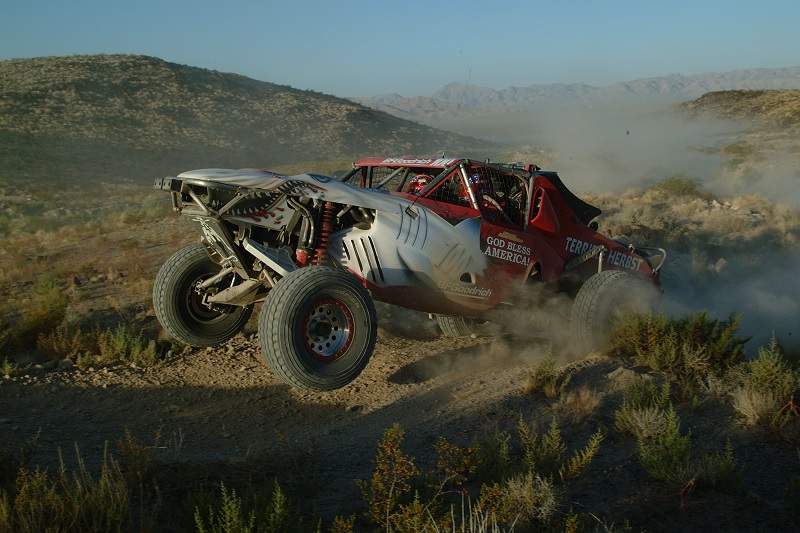
And so, the race was on. September 15 arrived, as did 136 competitors across 17 classes. 1,500 American flag stickers—1,000 of just the Stars and Stripes while 500 had the word “PAYBACK”—were distributed by SCORE during contingency. Troy Herbst’s legendary Landshark truggy had an American flag affixed to the rear and “GOD BLESS AMERICA!” written along the side.

Even if there wasn’t overly tight security like at stick-and-ball sports given they’re in the middle of the Nevada desert, some post-9/11 limitations applied. Most notably, the airspace was restricted to pilots flying using IFR (instrument flight rules, or flying by using the instruments in the cockpit) like media, law enforcement, and medevac helicopters whereas team pilots—who usually fly with VFR (visual flight rules, flying based on what you see outside) in order to see their vehicles on the ground—were grounded.
The Primm 300 spanned four laps and 279.20 miles.
While there were only three Trophy Trucks, they were fastest early on as Dave Ashley set the fastest time on Lap 1 in one hour, ten minutes, and 59 seconds ahead of Brian Collins’ 1:11:03. The top Class 1s followed in Jeff Darland (1:11:08), Doug Fortin (1:11:29), and Chuck Hovey (1:11:30) while Herbst posted a 1:13:29. Even his brother Tim, the last TT, was faster than him on the opening lap by 25 seconds.
The Landshark wasn’t fazed. Troy was fastest on Lap 2 with a time of 1:15:09 ahead of classmate John Gaughan (1:16:39) and Troy (1:17:51), while Ashley and Collins were starting to fall behind. Ashley topped Lap 3 with 1:13:15, a minute and 32 seconds ahead of the Landshark, but the latter sealed the deal with a screaming time on the final lap of 1:10:04.
From taking the start at 6:39:30 to the finish at 11:32:59, Herbst set an overall time of 4:53:29 to win both Class 1 and outright. Ashley settled for second and the TT win, nearly three minutes behind.
Nobody else in any class besides Herbst could get a lap time under 80 minutes. Herbst was also the only driver with an average speed exceeding 57 miles per hour as he clocked in at 57.079 mph.
Steinberger won in Protruck by over an hour and 11 minutes on Ryan Herzog. Other class winners included Rob MacCachren, who won Class 16 by 22 minutes over Rick Boyer, and Chris Harrold, who had the race’s closest margin of victory of just 2:41 ahead of Danny Anderson in Class 10. Cory Susag claimed the Mini Metal Class 7S Shootout, which awarded extra prize money.
The Herbst family donated their winnings to the Red Cross.
Class winners
| Class | Overall | Number | Driver of Record | Total Time | Laps | Average Speed |
|---|---|---|---|---|---|---|
| Class 1 | 1 | 100 | Troy Herbst | 4:53:29 | 4 | 57.079 mph |
| Class 3 | 79 | 399 | Billy Bunch | 7:33:47 | 3 | 27.687 mph |
| Class 5 | 32 | 500 | George Seeley Jr. | 6:19:03 | 4 | 44.194 mph |
| Class 5-1600 | 47 | 551 | Ernie Negrete | 7:24:50 | 4 | 37.659 mph |
| Class 7 | 26 | 701 | Craig Turner | 6:11:04 | 4 | 45.145 mph |
| Class 7S | 43 | 720 | Cory Susag | 7:11:11 | 4 | 38.851 mph |
| Class 8 | 45 | 802 | Jesse Jones | 7:22:04 | 4 | 37.895 mph |
| Class 9 | 74 | 902 | Cisco Bio | 6:07:21 | 3 | 34.201 mph |
| Class 10 | 10 | 1006 | Chris Harrold | 5:29:19 | 4 | 50.868 mph |
| Class 11 | 80 | 1100 | Eric Solorzano | 7:38:10 | 3 | 27.422 mph |
| Class 16 | 25 | 1604 | Rob MacCachren | 6:06:32 | 4 | 45.703 mph |
| Protruck | 16 | 270 | Scott Steinberger | 5:41:58 | 4 | 48.987 mph |
| SCORE Lites | 14 | 1214 | Kory Halopoff | 5:35:49 | 4 | 49.884 mph |
| Sportsman Class 3 | 73 | 302 | Ikuo Hanawa | 5:47:11 | 3 | 36.188 mph |
| Stock Full | 76 | 862 | Marc Stein | 6:30:30 | 3 | 32.174 mph |
| Stock Mini | 82 | 761 | Robert Land | 9:41:20 | 3 | 21.612 mph |
| Trophy Truck | 2 | 8 | Dave Ashley | 4:56:27 | 4 | 56.508 mph |
References
[1] “Major league baseball, TV programs canceled, postponed”, The Idaho Statesman, September 11, 2001
[2] “Major Football Games, Other Sports Cancelled” by Jim Becker (Associated Press), Hickory Daily Record, November 23, 1963
[3] “UEFA call off Euro ties”, Evening Herald, September 12, 2001
[4] “CART officials give green light to German 500 race” by the Associated Press, The Hamilton Spectator, September 14, 2001
[5] “Reigning ARCA champ agrees with decision to race at Toledo” by Steve Crowe, The Indianapolis Star, September 14, 2001
[6] “NASCAR made best call it could on postponing New Hampshire race” by David Poole, The News Leader, September 27, 2001
[7] Comment by Tony Barraza on “PRIMM still on?”, race-deZert, September 11, 2001
[8] “War has trumped sports before”, Seattle Post-Intelligencer, March 18, 2003
[9] “Persian Gulf war hitting home on sports fields” by the Associated Press, The Laredo Morning Times, January 19, 1991
[10] “Play the Super Bowl, but spare us the glitter” by Tony Kornheiser, Lexington Herald-Leader, January 18, 1991
[11] “Remarks on the Nomination of Edward R. Madigan To Be Secretary of Agriculture and a Question-and-Answer Session With Reporters”, The American Presidency Project, January 25, 1991
[12] Comment by Scott Steinberger on “Going to Mexico…. Is it worth it?”, race-deZert, September 21, 2001
Featured image credit: TrackSide
Leave a Reply