
While the Goodwood Revival’s focus is on the vintage cars and bikes going around Goodwood Circuit, the skies will also be decorated with classic aircraft participating in the Freddie March Spirit of Aviation Concours d’Elegance. For 2026, it will commemorate the 90th anniversary of the Supermarine Spitfire’s maiden flight and the 80th of the de Havilland Canada DHC-1 Chipmunk.
The Spirit of Aviation is held at the aerodrome in the infield grass surrounded by the aforementioned circuit, all of which comprised RAF Westhampnett—a satellite base for RAF Tangmere—during the Second World War. The airfield reopened on Easter Monday 1958, with roughly 75 planes landing despite only 30 being expected; former pilots of the Royal Auxiliary Air Force’s 601 Squadron also took part.[1] Captain Charles “Coincidence” Morice, the air controller at Goodwood Aerodome when it came back to life, led a Hawker Typhoon wing at Westhampnett during the war. Morice, who was 68 by 1958 (and liked to stress that he was 54 when he was wing leader), said “this place conjures nostalgic memories for me. I still love flying. It keeps me young. Years ago, I used to fly down to Tangmere to see my wife—before we even married. And now we’ve retired here. Strange, isn’t it?”[2]
“We felt sure there was a need for the airfield,” the Duke of Richmond remarked.[1]
22 vintage aircraft will take part, ranging from civilian planes to former military units and even a Cassutt racer. G-AKKB, one of just two remaining airworthy Miles Geminis, was the first plane to land at the Goodwood Aerodrome on its reopening. For the aforementioned anniversaries, a pair of Spitfire Mk IX fighters will be present along with two Chipmunks.
One of the Mk IXs is the Suffolk Spitfire. Registered as RW382, it bears the markings of the Spitfire flown by Lt. Robert Connor of the 309th Fighter Squadron in the Mediterranean theater in 1944. It was built in July 1945 and retired from RAF service for good in 1953, eventually being put on a display pole at RAF Uxbridge and appearing in the 1969 film Battle of Britain. The Spitfire went into private ownership in 1988 and restored, and has been an annual face at the Revival since.
“This year’s entries present a remarkable cross-section of aviation history, celebrating the aircraft, anniversaries and pioneering stories that continue to inspire generations of enthusiasts and aviators alike,” proclaimed Goodwood.
A panel of judges will assess the participating aircraft. Head judge Jeremy Warren and Juliet Sierra are joined by military historian Bruce Crompton, RAF pilot Mandy Hickson, Solent Sky Museum head and squadron leader Alan Jones, gliding instructor Amelia Richardson, and Matthew Wilkins of the British Air Display Association.
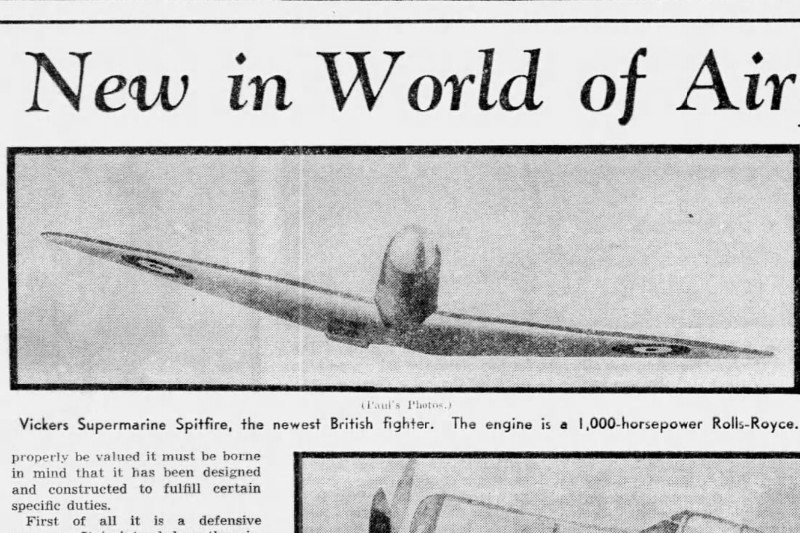
The Supermarine Spitfire remains a symbol of the Royal Air Force to this day. It completed its maiden flight on March 5, 1936, after which the Air Ministry proclaimed it was the fastest and most graceful military plane in the world.
Oliver Stewart, a British flying ace during the Great War, liked it when he visited Atlantic Park Aerodrome in Southampton in June of that year: “Speaking upon my own information, which past experience shows to be at least as trustworthy as that obtained officially, I can say that the Spitfire is the fastest fighter which has yet flown. Its armament is open to criticism, but the aeroplane should be effective solely on account of its performance. Moreover, the landing speed is low and, on the authority of the R.A.F. pilot who has done most of the Martlesham work, the aeroplane handles well and is not difficult to fly.”[3]
After World War II, the Canada-produced Chipmunk flew for the first time on May 22, 1946. It replaced de Havilland’s Tiger Moth, one of which will also be at the Spirit of Aviation, as the RAF’s trainer plane after 16 years. The Canadians were more than pleased, with The Toronto Telegram saying the switch was a “tangible indication of the full status of the Canadian aviation industry to have this aircraft compete and establish itself in the world market.”[4]
Wing commander Gordon Olive, on the other hand, mourned the “elimination of the Tiger Moth” as its demise would “mean a lot to the many thousands of pilots who fought in World War II. Nearly everybody flew the Tiger Moth when they started. It had an amazing record for doing a good job, and was tactically foolproof.”[5]
The Goodwood Revival will run on September 18–20. The 2025 festival celebrated the 80th anniversary of VE Day.
Entry list
| Aircraft | Model |
|---|---|
| C460 | 1934 Caudron Rafale |
| Cosmic Wind | LeVier Cosmic Wind |
| Dragon Rapide 6 | 1934 de Havilland Dragon Rapide DH.89A |
| G-AAZG | 1930 DH60 Gypsy Moth |
| G-AERV | 1936 Miles M.11 Whitney Straight |
| G-AH1Z | 1944 DH89A Tiger Moth |
| G-AHUJ | 1939 Miles M.14 Magister |
| G-AKKB | 1947 Miles M.65 Gemini 1A |
| G-ARUL | 1960 LeVier Cosmic Wind |
| G-RUNT | 1983 Cassutt Special IIIM |
| HB-RAM | 1950 Pilatus P2 |
| HB-RBG | 1940 Boeing PT13D Stearman |
| HB-RBX | Pilatus P3 |
| Little Rebel | 1945 North American P-51 Mustang |
| MK9 | Supermarine Spitfire |
| N18V | 1944 Beech Staggerwing |
| N192H | 1944 Beech Staggerwing |
| N2726D | 1952 Cessna 170A |
| N999MH | 1948 Cessna 195B Businessliner |
| Suffolk Spitfire RW382 | 1945 Supermarine Spitfire |
| WD390 | 1951 DH Chipmunk |
| WZ884 | 1953 DHC-1 Chipmunk |
References
[1] “75 aircraft at races”, Evening Standard, April 7, 1958
[2] “Groupie is back as the ‘air marshal’”, Evening Argus, April 9, 1958
[3] “AIR EDDIES” by Oliver Stwart, The Tatler, July 1, 1936
[4] “Khaki and Blue — and Civvies”, The Evening Telegram, April 24, 1948
[5] “Moth dies”, The Courier-Mail, December 2, 1948
Featured image credit: Paul’s Photos / Chicago Tribune (October 25, 1936)
Leave a Reply