
Note: Still not a toy review, dipshit.
What, we’re writing about a diecast released in current year? Has Hell frozen over? Have pigs flown? Have the Browns stopped being a national embarrassment?
Yes to the first sentence, no to all the others. Especially that last one (sorry, Clevelanders, y’all deserve better).
2026 marks the ten-year anniversary of Hot Wheels’ Car Culture series. It is described as a premium line of 1:64 models intended for adult collectors, differentiated by having realistic Real Riders tires and bodywork made from metal rather than plastic.
“They have realistic castings and authentic decos, celebrating the most on-trend vehicles from around the world,” reads Mattel’s description.
Each release is done in waves based around a certain theme. In the Lancia Stratos’ case, it was part of the Vintage Racing set about… you know.
While its set—which also includes the 1976 Greenwood Corvette, Ferrari 250 GTO, Jaguar XJS, Porsche 917X, and gold Nissan Skyline GT-R (BNR32)—came out in February, the Vintage Racing line goes further back to 2011. The premise then consisted of licensed sports cars and NASCAR Grand National cars of the 1960s and ’70s. Another Vintage Racing set came out as part of the Club Series in 2024 with roughly the same idea, albeit lacking the licensed paint schemes.
Of course, the Lancia differs from its classmates in that it wasn’t made for just the pavement.
“The Lancia Stratos dominated the World Rally scene in the 1970s with its short wheelbase and wedge-shaped design,” Mattel proclaims. “The packaging art enhances collectability, making each one perfect for play or display.”
The Fulvia had been Lancia’s rally car of choice prior to the Stratos, but was starting to grow outdated by 1973. Eventually, the Stratos was introduced for Group 4 competition. It was presented in 1971 before rolling out a few years later.
By 1974, it was already dominating the scene. Sandro Munari won the Rallye Sanremo and Rally of the Rideau Lakes, while Jean-Claude Andruet took the Tour de Corse as Lancia secured the manufacturers’ title. The Stratos repeated over the next two years with eight more rally wins coming from Munari, Bernard Darniche, and Björn Waldegård.
The car would claim 18 WRC wins in total, including three in a row at the Rallye Monte-Carlo, with Markku Alén, Tony Carello, and Antonio Fassina also standing atop the podium. Munari, who passed away in February, was the first person to win a WRC drivers’ title when the FIA Cup for Drivers was introduced in 1977.
However, the Stratos was already losing international momentum by the late ’70s as the Fiat 131 Abarth took precedence. Eventually, the plan became for Lancia to prioritize the European Rally Championship while Fiat tackled the WRC. Darniche, with support from French dealerships, led the Stratos’ remaining privateers until 1982. His 1981 Tour de Corse win was the last in the WRC for the car.

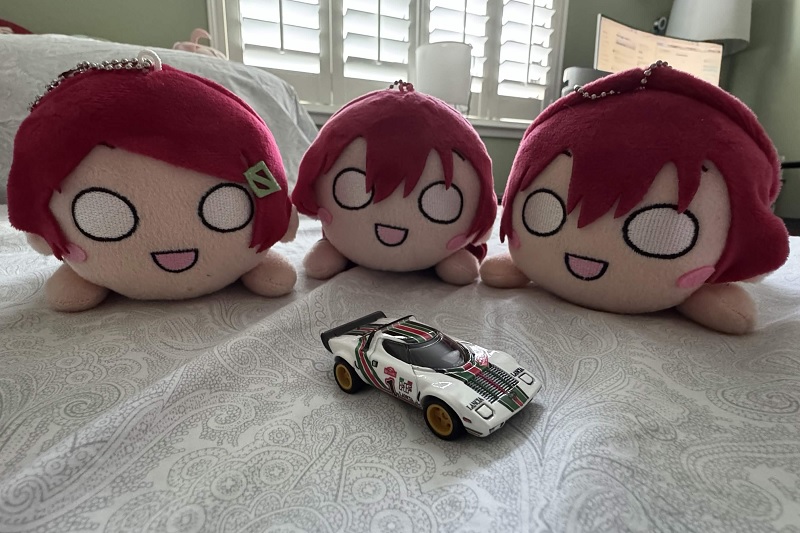
Hot Wheels’ is a pretty impressive replica of the actual Stratos given the liberties that had to be taken. Like the Toyota not-an-SR5 stadium truck and Datsun King Cab, Mattel can’t get the rights to every sponsor from the original.
In place of a real-life race decal, Mattel created its own rally called the “Rally El Segundo”. It’s obviously not a real race and the California city is where Mattel’s global headquarters are located, but the name has been used in other Hot Wheels rally cars for continuity. The specific rally logo even varies between cars to better resemble those used by other rallies from when the modeled car would’ve hypothetically raced; the rally plate logo as seen on the Stratos was especially prominent in the ’70s and ’80s.
The livery itself isn’t a one-to-one copy of the OG, but it is a solid parody. Both have a white base along with green-and-red stripes down the middle and sides, though the former on the Hot Wheels car includes extra black striping. The genuine Lancia’s door stripes were explicitly based on the tail art of Alitalia’s planes. Hot Wheels’ take has a straight horizontal line that shoots diagonally, vaguely forming the shape of a vertical stabilizer.
After all, how exactly was Mattel going to get a dead airline onboard?
Alitalia was Italy’s national airline, founded as a government entity following World War II. However, financial struggles led to private ownership in 2009. The state reorganized it again in 2020 as ITA Airways and Alitalia shut down for good on October 15, 2021.
While no longer in use, the name and brand remain within ITA’s possession. Aprilia successfully got the rights to them in 2022 as part of unveiling the RSV4, but it’s likely a lot easier for Piaggio to pull off than Mattel since Alitalia had already sponsored Aprilia’s World Superbike team until 2010.
During its height, Alitalia became known for two things: being the Pope’s primary charter when flying, and sports sponsorships.
Throughout the 1960s, the Alitalia Cup was awarded to the winner of the Sebring 12 Hour. It was a sterling silver bowl with the names of the overall winners engraved alongside the text “Alitalia Cup — The Florida International 12 Hour Grand Prix of Endurance”.[1] Fabrizio Serena, the general manager of Alitalia’s North American division who later worked as the main company’s marketing director, was a sports car racer himself who won Sebring’s GT class in 1960.[2][3][4] Naturally, he saw the appeal of creating a trophy for what was then the biggest endurance race in the United States, hoping it would “stimulate and develop even greater interest” in sports car racing.[1]
The name would eventually be used for the Anglo-Italian Cup, a soccer game between English and Italian teams, when it was called the Alitalia Challenge Cup from 1976 to 1986.
More pertinent, it was a proud sponsor of Lancia. Alitalia took over as the factory team’s sponsor from Marlboro in 1975, painting the Stratos green and white, before the Italian tricolor became its palette two years later.
The partnership even extended outside of racing during this time. Lancia backed a contract bridge team that consisted of several Italian world champions, many of whom were part of the iconic Blue Team that dominated the 1960s and early ’70s, and famed actor Omar Sharif. When the team toured the United States in 1975, Lancia of America and Alitalia offered five Lancia Betas and Alitalia trophies apiece to their best opponents regardless of whether they beat them.[5][6]
Much like how everyone associates the later 037 with Martini, the Alitalia livery was synonymous with the Stratos. However, this was perhaps reinforced by the fact that the Stratos wasn’t doing well sales-wise, meaning the average person only ever saw one at rallies.[7]
“The only Stratos cars I’ve seen have been those with the Alitalia colors in the works competition department,” The Age‘s motoring editor Chris de Fraga remarked in 1977, “and some rather plain ones being finished in Lancia’s old factory in central Turin beside the Gamma, which was about to make its debut.”[7]
Pirelli replaced Alitalia in 1978, switching out the Italian colors for white, black, and red. Mario Mezzanotte, the tire maker’s racing head, said at the time: “Sponsorship of the Lancia Stratos confirms our determination to continue to develop and test top performance Pirelli radials on a rally car whose technical characteristics are uniquely suited for the purpose.”[8]
The sponsorship might’ve only lasted three years, but with how the green-white-red Stratos continues to live in the hearts and minds of Italian rally fans today, those were a memorable three years indeed.
References
[1] “Alitalia Gives Up To Sebring Winner”, The Daily Item, March 16, 1962
[2] “ALITALIA NAMES TEAM; Italian Airline Puts Fabrizio Serena in Top Post Here”, The New York Times, March 24, 1958
[3] “With the Members of Italy’s Aristocracy, a Job Is More Important Than Title” by Marylin Bender, The New York Times, May 11, 1969
[4] “Behind The Scenes Busy At Sebring” by John McCarthy, The News, March 21, 1962
[5] “ALITALIA SPONSORS EXHIBITION CHALLENGE BRIDGE MATCHES IN THE UNITED STATES”, The American Citizen, April 24, 1975
[6] “Bridge players will compete for cars” by Ray Lee, The Toronto Star, February 1, 1975
[7] “Fiat leads again in world rallies” by Christopher de Fraga, The Age, May 25, 1977
[8] “Pirelli’s colours in ‘Monte’”, Evening News and Star: Sports Special, January 21, 1978
Featured image credit: Justin Nguyen
Leave a Reply