
From 1942 to 1944, before the dunes and UTVs that it’s associated with today, Glamis was part of the Desert Training Center. With the Axis making gains in North Africa, Major General George S. Patton led the conversion of this land into a place for American troops to prep for their upcoming campaign.
What made the Mojave and Sonora viable training locations was the immense variety in terrain and environment even for desert climates. There were flats, there were dry salt beds, there were valleys, there were mountains, and of course there were dunes. Weather fluctuated tremendously from the expected heat to freezing cold at night and cloudbursts.[1]
Besides the favorable ecosystem, it made sense to pick a place near the Colorado River Aqueduct—which sends water to the Los Angeles metropolitan area—so that the facilities could easily obtain water.[2] Camps Essex and Ibis were further from the aqueducts, so 500,000-gallon reservoirs were built to accommodate those. Railroads were also emphasized for logistical and transport reasons, and Glamis was one of several railheads in California alongside Cadiz, Danby, Fenner, Freda, and Goffs (the Arizona side included Araby, Bouse, Dateland, Wickenburg, and Yuma).[4]
The camp opened on April 30, 1942. At its peak in 1943, the DTC housed 191,620 personnel.[2] 15,000 could live at each camp at a time.[3]
Conditions were, as you can probably guess, brutal. There were no barracks or running water. While the aqueducts relayed water to the DTC, it was still rationed individually: at first, it was one canteen of water per person each day for drinking and bathing; this was then increased to a gallon because everyone was collapsing from heat stroke (they also got salt pills to help out).[3] Sgt. Gordon “Pete” Gill thereby wrote he was “thankful” for the “good supply of water” despite the lack of amenities.[5]
Some joked it was the “place that God forgot.”[1] One Army Air Corps captain quipped that “when Saint Peter stops me on Judgment Day, I can tell him that I’ve had my taste of Hades right here!”[6] Inside tanks, temperatures could reach as high as 160°F; outside them, soldiers were frying eggs on the armor plating.[5][7] Even carrier pigeons were going AWOL because of how bad things were.[6]
“Anita and I are sitting close by the radiator—an air cooler—brothers, just like you do on a cold, cold day in Indiana,” started a letter from Army captain Dr. HJ Norton to his friends and family back home,[8] “only this is the reverse. Step out the door, and it’s like into a furnace—124 degrees this afternoon. Out further east in the desert, where maneuvers are progressing, the afternoon temperature reaches 135 degrees in the shade. Was out myself overnight a week ago, doing a bacterial problem and would say the temperature at midnight was over 100.
“Of course, most of the time humidity is low, otherwise it would be unbearable. But boys, until you’ve experienced it, ‘you ain’t seen heat’! Because, you do see it—a haze over the surrounding mountains that shimmers and wanes, until at times you do see mirages.
“[…] On the average, the enlisted man is just a lonesome boy away from home with a top kick on his neck morning and night. When he gets a pass all we wants is to be a boy a little while, have fun and forget the hard things. If he gets a bit out of hand sometimes, give him a break. One’s heart aches for ’em in an area like this.”
Of course, that was the point. After all, everyone was expected to be fighting underneath the African sun with limited resources on hand.
Once those boys put what they learned into practice and the North African campaign turned in the Allies’ favor, desert warfare was no longer necessary. On October 20, 1943, the DTC was renamed the California-Arizona Maneuver Area (C-AMA) and its purpose changed into what was basically a theater of operations simulator.[1]
The C-AMA was shut down in spring 1944 as more units deployed overseas. Congressman John Phillips explained “it will affect the whole Coachella Valley and Pass areas, but I suppose we must face the fact that this sort of thing is inevitable. As the war moves from East to West and as the number of men in the service reaches the saturation point, the camps will one by one be closed, leaving only the permanent establishments and the few others necessary for an enlarged army.”[9] The camps became ghost towns save for some engineer units—including a cadre of black soldiers at Camp Young—overseeing the teardown.[10][11]
In the immediate decades, the former DTC remained government land but without much attempt to reclaim or repurpose it. Some was later converted into trails or nature preserves, the latter of which also opened up opportunities for study. In 1987, the US Geological Survey published a study of the soil in the DTC’s Camps Clipper, Ibis, and Iron Mountain to gauge their impact on the area’s substrate.[12]

However, there was something in the present-day Glamis section—approximately between Camps Young and Pilot Knob—which stood the test of time: a large container Patton left behind in the sand. Around this box, the desert would open up to the public as a hotbed for off-roading.
There is also a flagpole bearing the Stars and Stripes affixed to the container. The flag was raised in honor of Chuck Boardman, a rock quarry worker who founded the nearby Boardmanville Trading Post in 1978 and passed away in 1999.
Brian Crain, a Marine veteran, and some friends came across the flagpole while taking a break from their dune riding. One day, he saw the flag was worn from years of waving and got the blessing of Boardman’s widow to replace it. From there, a new tradition began.
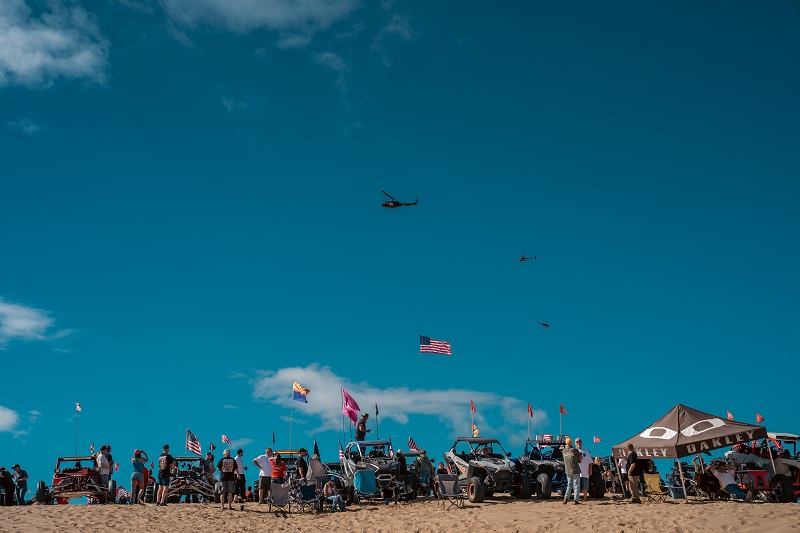
Glamis Veterans has hosted an annual celebration on the weekend closest to Veterans Day since 2004. The 2026 edition was the 23rd, taking place on November 13–14. Polaris was a partner of the event. Joseph Stout, the Bureau of Land Management’s director for California, was also in attendance.
Dune cleanup took place on Friday before the main gathering on Saturday. A plane flyover was supposed to take place but weather in San Diego grounded such aircraft, so a helicopter did so instead.
At 11:11 AM, the ceremony began. The national anthem was played, speeches were given about the history of the event, and veterans and active duty military were recognized. The main event saw the flag atop the container by replaced by a new one.
“To gather together at 11:11 and honor all of our men and women that serve this great nation and have been for 250 years, coming together in a place that we all love, to participate in the world’s largest off-road Veterans Day ceremony, it means everything,” said Crain. “The fact that people are willing to come here and participate in this completely organically is incredible.
“It’s absolutely magical and that’s what has really driven us for the last 22 years.”
References
[1] “THE DESERT TRAINING CENTER/CALIFORNIA-ARIZONA MANEUVER AREA” by George W. Howard, The Journal of Arizona History 26, no. 3 (1985): 273–94
[2] “The Triumphant Partnership: California Cities and the Winning of World War II: Presented as the Nineteenth Annual Lecture in the W. P. Whitsett California Lecture Series, California State University, Northridge, April 29, 2005” by Roger Lotchin, Southern California Quarterly 88, no. 1 (2006): 71–95
[3] “Desert Training Center: California-Arizona Maneuver Area”, brochure from the Bureau of Land Management
[4] Yuma Proving Ground by Lt. Scott Laverty, Arcadia Publishing, 2020
[5] Letter by Sgt. Gordon “Pete” Gill for “Men with the Colors!”, The Weston Chronicle, June 25, 1943
[6] “Carrier Pigeons Go AWOL at Army’s Desert Training Center” by Frank Carey (Associated Press), Lake Charles American Press, May 14, 1943
[7] “SUNNY SIDE UP UNDER DESERT SUN”, United States Army Signal Corps photo

[8] “Dr. Norton Writes of Desert Training Center”, The Columbus Herald, August 5, 1942
[9] “Congressman Gives Details On Desert Training Situation”, The Desert Sun, March 17, 1944
[10] “Continuity Seen In Military Use Of Posts Nearby”, The Sun, April 1, 1944
[11] “Desert Training Center for Thousands Becomes Ghost Town” by the Associated Press, Lake Charles American Press, May 12, 1944
[12] “EFFECTS OF SUBSTRATE DISTURBANCE ON SECONDARY PLANT SUCCESSION; MOJAVE DESERT, CALIFORNIA” by D.V. Prose, Susan K. Metzger, and H.G. Wilshire, Journal of Applied Ecology 24, no. 1 (1987): 305–13
Leave a Reply