
As the fourth quarter of Chiefs–Seahawks began, Sunday Night Football touched down at the Museum of Flight. It was part of NBC’s “SNF Sights”, a Nationwide-sponsored segment focusing on a given landmark in the home team’s city not unlike the usual B-reel footage that plays returning from commercial break.
“Such a great aeronautic influence out here,” play-by-play announcer Mike Tirico said. Seattle and the metropolitan area as a whole are aviation hubs, best known as the birthplace of Boeing. The Museum of Flight is located at King County International Airport, AKA Boeing Field, while Paine Field is the site of Boeing’s Future of Flight and the Flying Heritage & Combat Armor Museum.
The drone flew around the Aviation Pavilion located on the West Campus of the museum and is accessed via an overpass. The pavilion has several commercial and military aircraft such as the SAM 970 Boeing 707 that served as Air Force One for Presidents Eisenhower, Kennedy, Johnson, and Nixon; Tirico beckoned to “imagine all the historic conversations that occurred on that plane”. Next to AF1 are wax figures of Nixon meeting Chinese leader Zhou Enlai during his visit to the People’s Republic in 1972.
“I approved that UAS flight under the pavilion,” Twitter user Squawk the Jay told 131 Off-Road. “I think it happened back in May?”
Also on the West Campus are the Dahlberg Research Center, the Space Gallery with a Space Shuttle trainer that used to be at the Seattle Center prior to the museum’s opening, and the Vietnam Veterans Memorial Park. The park has a B-52 and a statue ddicated to veterans of the Vietnam War. The Stratofortress, named Midnight Express, is surrounded by a base with several plaques of Vietnam veterans, with those in bronze being Medal of Honor recipients and POWs like John McCain.
The East Campus is where visitors enter. The Great Gallery, Red Barn, and Personal Courage Wing make up the three biggest elements that respectively focus on the evolution of flight (obviously of humankind, but there is an exhibit analyzing how flight occurs in nature too), Boeing’s history, and the World Wars.
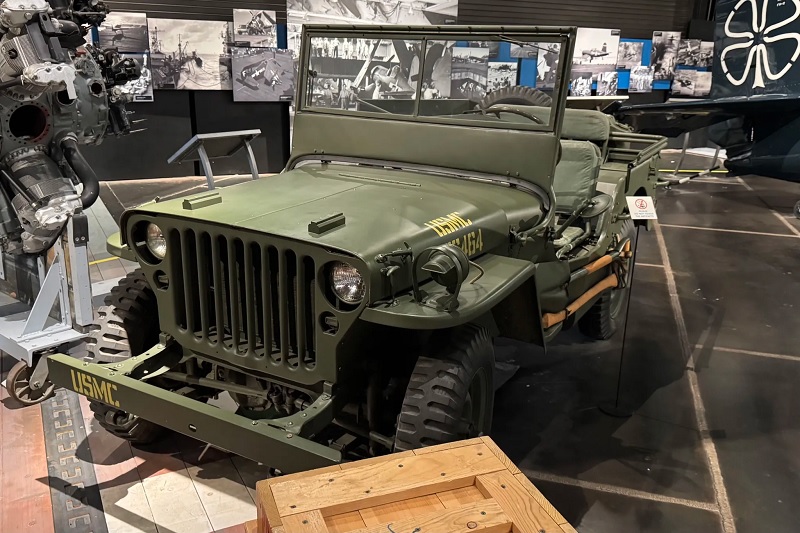
Amid all the aircraft, we at 131 gravitated toward the 1943 Ford GPW in the Personal Courage Wing. Parked next to an FM-2 Wildcat, the Jeep has an American Bantam T-3 trailer hooked to the rear. It is painted to resemble those used by the 6th Marine Division during the Battle of Okinawa.
Grant Wolfkill, a combat cinematographer who was wounded on Okinawa, bought the vehicle in 1946 and donated it to the museum in 2012. Although mainly known for his war photography, he was also a sports car racer who won the 1965 Macau Guia Race, claimed a class victory at the 1959 Macau Grand Prix, and finished runner-up overall in the 1960 and 1965 Macau GPs.[1][2]
Wolfkill even tried his hand at rallying. In 1969, he entered the First Asian Highway Rally, featuring a 2,000-mile route that ran through Laos, Thailand, Malaysia, and Singapore.[3] When China hosted the 1985 Hong Kong–Beijing Rally (555 Rally), which marked the return of international motorsports to the country since the 1907 Peking to Paris, Wolfkill showed up in a red Mazda RX-7 which he built for himself and IMSA GT driver Pierre Honegger.[4] The duo finished 15th.[5]
“No Super Bowl ever had an audience like we had in the past few days,” Wolfkill remarked.[5]
The museum began as a suggestion by Dan Coughlin, the financial editor of the Seattle Post-Intelligencer. On September 26, 1965, he wrote a column that argued:[6]
With the nation’s leading aerospace manufacturer at our backdoor, why is it that the Seattle area hasn’t ever seen fit to accentuate the positive by establishing a “Museum of Flight?”
We’re short on tourist-producing facilities. Why not a central place to show off Boeing’s contribution to the country’s airplane and space effort?
Imagine the possibilities. Generations of school kids are growing up with only a hazy idea of the early days of flight, or of the key role played by Seattle’s leading industry.
For that matter, there are hundreds of Boeing employees who’ve never seen a B17, or a B29 up close.
Few of them and even fewer among us in the general public are really aware of Boeing’s intimate connection with the first airlines and all the other “firsts” that accompanied the flowering of the air and now of the space age.
Without getting overly misty-eyed about it we’ve got it all right here if we chose to do something about it.
Of course, starting a museum is easier said than done. While Coughlin championed Boeing’s impact on aviation, the manufacturer wasn’t interested in creating one of its own. The Future of Flight wouldn’t open until 2005, and the company 40 years prior certainly didn’t have such an idea on its radar since it prioritized building planes and hardware for the growing air industry and the Space Race. That said, Boeing was happy to work with whoever wanted to tackle an endeavor.[6]
Sure enough, there was someone willing to do it. A non-profit called the Pacific Northwest Aviation Historical Foundation was founded shortly after with support from various Boeing employees and aviation enthusiasts. Boeing engineer Harl Brackin led the first meeting at the American Aviation Historical Society on October 8.[7] It received the blessing of Seattle’s Chamber of Commerce not even two weeks later, giving the foundation the right to “acquire, restore, preserve and donate” aircraft and other related items in order to create a “regional museum of flight”.[8] Kenneth R. Hopkins, director of the Washington State Capital Museum in Olympia, likewise proclaimed, “There is every reason for such a museum.”[7]
Again, if only it was that easy. The foundation had to move fast to get the museum up and running because of a major adversary looming in the form of the Smithsonian Institution.
In January 1965, the Smithsonian announced plans to build what would become the National Air and Space Museum. If Congress signed off on it in time, construction would begin in September with opening aimed at summer 1969.[9]
Hopkins feared the Smithsonian would take most of the PNW’s good aircraft for the NASM, which was bad news for both the Museum of Flight and the planes. He was a harsh critic of the existing National Air Museum, saying it “resembles an aircraft junkyard. There are planes on top of planes, some in crates, some in buildings. Very few will ever be restored because no museum could hold them all.” For this reason, the director firmly believed “historic items of any kind belong in the area where they originated or where their chief significance lies.”[7]
Boeing officials even admitted planes like the B-17 were becoming harder to find by the day, so the foundation rolled up its sleeves and got to work.[7] By November, there was already a sizable fleet and a partnership with the Museum of History & Industry to showcase 50 years of aerospace. Coughlin and the Post-Intelligencer were, naturally, ecstatic about the progress.[10]
“Much of the Free World’s aviation history was written here, but you have to scramble to find out about it today,” the paper’s November 3 issue stated.[10] “The project has immense possibilities and deserves widespread community support.”
After testing locations like Renton Municipal Airport, where the foundation did scenic flights to raise funds for the building,[11][12] the museum opened on May 1, 1968, in a 150 feet by 70 ft space by the south entrance of the Seattle Center.[13]
In 1975, the museum acquired the Red Barn, where Boeing got its start in 1909 but was eventually ditched as the company moved to bigger facilities. The Port of Seattle bought the barn in 1970 to make room for Foss Alaska’s ship container staging area.[14] It was hauled off to Boeing Field, where the foundation was trying to buy five and a half acres of land for $700,000 to build a proper museum. At the time, this space was occupied by a manufacturing plant and a topless bar.[15]
The Museum of Flight was kicked out of the Seattle Center on September 30, 1979, to make way for an amusement park operator. With the Red Barn’s restoration and construction behind schedule, the foundation improvised with temporary exhibits and tried to reach out for Congressional funding. Howard Lovering, the foundation’s director, argued that “if the Smithsonian Institution got $51 million for its big museum, then we feel we deserve something from the federal budget for our purposes.”[16]
Fortunately, Boeing was among those happy to help. $1 million was donated in 1980 to honor former chairman William McPherson Allen.[17] His successor Thornton Wilson explained in 1983, “There’s something fascinating about air and space museums. That’s certainly true in Washington, D.C., and I think it will be true here.” While he admitted the NASM would still outclass it, the “quality will be as good as any exhibit in the country.”[18]
A 35-year lease on 16.5 acres of land was secured for the Boeing Field site in March 1981.[17] After delays from a targeted spring 1982 opening and $18 million invested,[16][9] it finally opened on September 3, 1983. At the time, there were only five full-time employees (everyone else was a volunteer) and still millions more planned to continue its expansion.[20]
Seems things worked out for them in the end.
References
[1] “MACAO GRAND PRIX” by United Press International, Berwick Enterprise, November 16, 1959
[2] “Minis win by lap”, The Observer, November 28, 1965
[3] “U. S. Driver in SE Asia Race” by Reuters, Buffalo Evening News, February 19, 1969
[4] “Great Leap Forward” by Jim Donnelly, Hemmings, March 24, 2024
[5] “‘I’m a hurt champion’”, The Register-Guard, September 20, 1985
[6] “Flight Museum Needed Here” by Dan Coughlin, Seattle Post-Intelligencer, September 26, 1965
[7] “Air Museum Off Ground” by Dan Coughlin, Seattle Post-Intelligencer, October 6, 1965
[8] “‘Museum of Flight’ Backed in Chamber”, Seattle Post-Intelligencer, October 21, 1965
[9] “Designs Disclosed For Space Museum Planned for Capital”, The New York Times, January 31, 1965
[10] “Museum of Flight”, Seattle Post-Intelligencer, November 3, 1965
[11] “Wright Day Flights Offered to Public”, Seattle Post-Intelligencer, December 16, 1966
[12] “Flight Museum Designed”, Seattle Post-Intelligencer, May 19, 1967
[13] “Aviation Museum Started”, Seattle Post-Intelligencer, December 22, 1967
[14] “Boeing ‘1’ to Move” by Paul O’Connor, Seattle Post-Intelligencer, December 11, 1975
[15] “Boeing ‘Red Barn’ restored as part of museum” by the Associated Press, Tri-City Herald, September 8, 1977
[16] “$16 Million Flight Museum To Be Started in February” by Al Watts, Seattle Post-Intelligencer, September 9, 1979
[17] “Pacific Museum of Flight finds a place to land” by the Associated Press, The News Tribune, October 4, 1981
[18] “Boeing’s old ‘Red Barn’ turns into a museum” by Pamela S. Leven, Seattle Post-Intelligencer, March 22, 1983
[19] “The Red Barn is almost ready to go solo” by Archie Satterfield, The Herald, October 11, 1981
[20] “Museum of Flight spreads its wings” by Mike Oakland, The Olympian, September 4, 1983
Featured image credit: Justin Nguyen
Leave a Reply