
The DAF Bull has done plenty in its four-plus decades of existence. Racing a tank was probably not what Jan de Rooy envisioned one of those things being when he built the truck for the 1985 Paris–Dakar Rally.
It was a whirlwind week for the Bull, currently on loan from DAF de Rooy Classics to Tomasz Białkowski and his crew. Białkowski had more than impressed by placing ninth overall in his Dakar Classic debut earlier this year in the 3300, which became the first truck to win a stage outright.
With the 2027 Classic right around the corner, Kamena Rally Team spent five days traveling around Poland and showcasing the truck. “Dakar on Tour 2026” began on August 23 in Poznań before heading to Borne Sulinowo, Gdańsk, Słupsk, Kołobrzeg, and concluding at the Baja Poland in Szczecin and Drawsko Pomorskie. The Międzynarodowe Targi Poznańskie (Poznań International Fair) was first on the list, where a meet-and-greet with the crew was held.
The second stop took the Bull to a town with a very unique military history, one in which it was a major base for the two most infamous states of the 20th century.
Borne Sulinowo, along with the broader western provinces of Pomerania that are currently Polish voivodeships, was ruled by several kingdoms and empires before culminating in the present-day republic. It is nicknamed the “Forest City” (“Leśne Miasto” in Polish) because 54% of the town is covered in such trees, nearly twice as much as any other Polish municipality. Naturally, militaries saw this as a perfect place for activities.[1]
Under Prussian and German rule, what was called Groß Born was the site of an army training and exercise field. There was also a POW camp during the First World War.
Shortly after the Nazis took power, a massive training zone was planned stretching through Linde (Lipka), Gross Born, and Westfalenhof (Kłomino).[1] Adolf Hitler personally visited the area in August 1938 to oversee the construction of fortifications and military exercises. One reporter said the “might of the new Reich army” was on display and “[had] all Europe trembling with war fear”.[2][3] Historian Peter Hoffmann, on the other hand, clarified the exercise was “relatively unimportant” in the big picture.[4] When Poland was invaded a year later (incidentally, 87 years and 1 day before this article’s publication), Gross-Born was among the staging areas used.
Gross Born’s POW camp Oflag II-D was where Polish prisoners were housed, followed by French and Soviet captives. Most were Polish intelligentsia with a pulse on their country’s politics, initially blaming the Sanation movement’s ineptitude for Poland’s fall but otherwise keeping quiet as they awaited the Western Allies. After France was defeated, likeminded intellectuals and the politically inclined prisoners started meeting up together, eventually giving birth to secret groups like the Polish Workers’ Party and a more moderate take on National Democracy (as opposed to the more radical pre-war ONR; this new camp viewed Germany as the main threat rather than the USSR).[5] Outside of politics, Oflag II-D and -C produced stamps celebrating the canceled 1944 Summer Olympics as an easy way to make money.[6]
Meanwhile, an underground battalion in Western Pomerania called Odra organized by the Home Army was linking forced laborers and POWs with Polish locals.[7][8] The Gestapo caught on in spring 1944 and executed those running the ring. By Christmas, the mood was bleak as everyone was still reeling from the failure of the Warsaw Uprising and decreasing supplies.[7]
As for the Germans in the area, Erwin Rommel and Heinz Guderian both trained their units here.[1] Outside of military affairs, HSV Groß-Born—who actually played in Szczecin, then Neustettin—was making national headlines as a dominant Wehrmacht soccer team that won the 1943–44 Pomeranian division title.[9] Military sports teams were a very common sight in both World Wars, perhaps most notably being American bases that played college football teams, as a way to keep morale up and stay in shape; being in these clubs were also a nice way to avoid active duty for a while.[10] Of course, the team went belly-up when Gross Born was captured. The prisoners were “evacuated” on January 18, 1945, and the Red Army-aligned 4th Pomeranian Infantry Division (Jan Kiliński) liberated it on February 4.[7]
Much of the infrastructure was still intact as the Wehrmacht fled, and the Soviets didn’t see any reason to not put them to use following the communist takeover in 1947. The Northern Group of Armed Forces set up a garrison in the town, the largest Soviet military presence in Poland, with units like the 6th Guards Motor Rifle Division being stationed there. Barbed wire cordoned off the base from the town, though Soviet conscripts lived in the latter too as a quasi-barracks while officers and civilians had their own residential district.[1]
As the Cold War’s arms race escalated, nuclear silos were situated in nearby Brzezńica-Kolonia. With how massive and vital the military presence was for the Reds, Borne Sulinowo was removed from all maps of Poland to protect it from the outside world.[1] It was so secretive that even Polish residents couldn’t go around much, such that museum owner Wiesław Bartoszek called it a “de facto Russian territory.”[11] The warheads and missiles docked here ended up causing Samin, a highly toxic rocket fuel, to contaminate the soil. Świnoujście, another town in West Pomeranian Voivodeship that had a Soviet naval base, was similarly discovered to have high levels of polychlorinated biphenyls in its dirt.[12]
In 1956, like it did 17 years prior, those on base in Borne Sulinowo mobilized for invasion. This time, it was of the capital of the country they’re in. During the Polish October that sought to break away from Stalinist doctrine, Nikita Khrushchev summoned his soldiers at Borne Sulinowo and Żagań to march on Warsaw. Soviet officials claimed these were planned exercises, though it became apparent that the USSR was trying to strong-arm the Poles into caving by any means necessary.[13]
The Polish People’s Republic fell in 1989, but the Soviets stuck around to ensure their troops in East Germany wouldn’t be cut off from the rest of the USSR.[14] Once the death knell of the Iron Curtain sounded, the army of the now-Russian Federation left on October 21, 1992; the town fell into shambles soon after as looters took advantage of the departures. Civilian control was formally asserted on June 5, 1993, and it was designated as a city on September 15.[1]
While it’s certainly common for European cities to still bear the scars of its Nazi or Soviet occupiers, Borne Sulinowo having been under both makes it a very unusual place even by Polish standards. The former Soviet Army headquarters became a city office building, while the parade square is now used as a marketplace.[1] The town has wholly embraced the “dark side” of its past too, often using its history as a pitch for tourism. World War II reenactors are encouraged to show up in both Wehrmacht and Red Army uniforms while some public businesses show off communist imagery. Sentiment about its former Soviet and Russian presence also isn’t as acrimonious as elsewhere in Poland, though it became muted following the Russian invasion of Ukraine.[15]
“If you just look at the trees and buildings, everything here looks okay,” started Dariusz Czerniawski said in 2023, “but if you know the history of this place, it makes your skin crawl.”[15] Czerniawski has lived in Borne Sulinowo since 1993 and runs the local Muzeum Gross Born. He opined to The Hamilton Spectator that it might make moral sense to just raze the town due to its grim past, but that history of being “built by the two most brutal totalitarian systems of the last century.”[15]
Consequently, Borne Sulinowo has been the subject of several studies on how military sites in Central and Eastern Europe were reappropriated and folded into a city’s cultural heritage. Heck, the city was even the site of an international seminar on post-Cold War military zones in 2016 that examined how “‘secret’ military enclosures […] were given new symbolic meanings” as tourist stops.[16]
Borne Sulinowo has hosted the Międzynarodowy Zlot Pojazdów Militarnych military vehicle parade every August since 2004. The 2026 edition took place a week before Kamena’s arrival on August 13–16.
“[I]t would be difficult not to notice that the participants of military gatherings in Borne Sulinowo are attracted to it not only by military vehicles but also the peculiar space of the former Soviet military base,” wrote Dagnosław Demski in 2019.[17] A professor in anthropology, Demski noted the city stands out from other post-military zones like Warsaw Citadel because the past is so heavily engrained into the city. While anyone could be immersed in history at a museum or historic structure, the entire city of Borne Sulinowo is the history.
Sure, you could argue these events trivialize the military history’s by turning remembrance into a tourist attraction. There have been complaints among locals about people parading in SS and Red Army uniforms too, as well as the obvious concern about whether such festivities might inadvertently be jingoistic.
Still, as professor Dominika Czarnecka examined in 2019, the events are more like a “new memorial” to the city’s history that allow people to learn and remember the past even if it’s not through the traditional models like a park and museum would offer.[18]
“This type of practice does not involve ‘true’ reconstructions of images of the past and recreating fallen ‘heroes’, it is not about commemorating specific dates and events, but a form of ‘communion’ with the past through objects and sensory experience of the site, all of which is then filtered through popular culture,” Czarnecka wrote.[18]
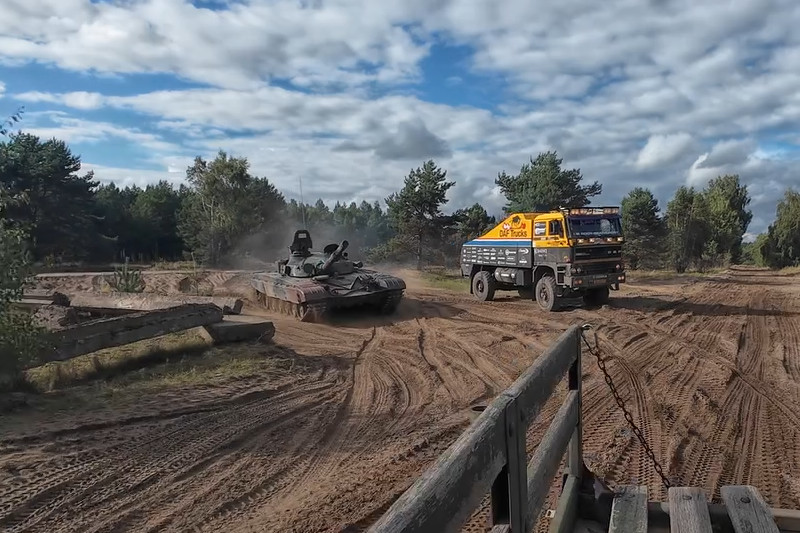
Speaking of museums, Muzeum Militarnej Historii w Bornem Sulinowie deployed tanks from its collection at the parade like a T-34-85, T-55AM, and T-72M. Kamena is no stranger to the museum, having hosted events and even rallies there in the past with the Polaris RZR.
The T-72M, a variant of the T-72 main battle tank that continues to be modernized and used today (the Polish Land Forces have its own variant called the PT-91 Twardy), was Kamil Bartoszek’s vehicle of choice when the Bull came to town. Bartoszek, the museum’s director, drove the tank alongside Białkowski in the DAF around the surrounding forests. Bartoszek led the way through the trees and dirt with Białkowski alternating between following and driving side by side.
“Something nobody’s ever done before: we’re racing tanks against Dakar trucks,” Bartoszek proclaimed before the event.
If tank biathlons taught us anything, those guys can certainly move. As well as a rally truck, though?
The museum jokingly notes the T-72M has a stronger engine at around 700–780 horsepower, but the DAF 3300 is a twin-engined machine that produces 420 hp each so it has the speed advantage. Likewise, it added the truck is obviously much lighter at ten tons compared to the tank’s 41.

After that, Kamena was off to Gdańsk Shipyard. Officially known as Lenin Shipyard in the communist era, it became a labor movement hub in the 1970s and ’80s. The team set up a booth at Ulica Elektryków (Electricians’ Street), which was since repurposed into a nightlife district with food trucks and concerts.
The remaining stops included Autos Słupsk and the Port of Kołobrzeg.
With the tour done and dusted, the Baja Poland awaited. The military flavor that the Bull got to taste in Borne Sulinowo was provided again since Saturday’s action was on the 12th Mechanised Division’s training polygon at Drawsko Pomorskie before heading back to Szczecin on Sunday.
Poligon Drawski, one of the largest training grounds in Europe, regularly hosts rallies like Rallye Breslau and the Baja Drawsko. Being an active military zone means there are several restrictions that racers must satisfy, such as needing special IDs and being forbidden from publishing on-board footage without the express written permission of the race organizer. A military shooting range was also utilized as a service park.
The rally guide stipulates:
Part of the route of 2026 AKPOL BAJA POLAND takes place on the military training areas in Szczecin and Drawsko Pomorskie. These are strictly controlled military zones with special rules for usage and behavior.
The military training areas of 12th Mechanized Brigade and CSB Drawsko is a hospitable and highly respected partner of COLUMNA MEDICA BAJA POLAND and organizer fully complies with the agreements and the requirements of the military training area and will NOT tolerate any infringement against the established rules.
WARNING:
- Rally vehicles are NOT allowed to drive on the military training area except during the rally days.
- Press vehicles are NOT allowed to drive on the military training area without special passes.
- Service vehicles are NOT allowed to drive on the military training area except using the assigned routes by the organizer.
- Drone use is forbidden on military areas.
- Spectators and other members of the teams are fully obliged to follow the orders of the organizer.
Before the Prologue, Szczecin’s mayor Piotr Krzystek invited Białkowski and navigator Dariusz Baśkiewicz to city hall along with the truck. Besides a photo op in the Bull, they and Krzystek discussed racing and the economic and cultural value that the Baja Poland brings to the city.
Like in 2025, the Bull was the zero car that opened the course for actual competitors. Even if not racing against everyone else, going through the route still made for good practice ahead of the 2027 Dakar Classic.
“Baja Poland, it’s a part of our preparation for the Dakar 2027 so it’s a chance for us to drive this big truck,” Białkowski told Cross-Country Rally News. “This year, 2026 Dakar, we were the rookies so we didn’t know anything about it, but the result was very good for us. We won the Dakar Classic in the Truck category, so we are very proud and we hope we’ll do it again in 2027.”
Białkowski hit a tree with the rear end on Sunday, which tore a tire pressure hose. Baśkiewicz got out and closed the valve stems to ensure the tires don’t lose air, which cost them 30 seconds but meant they could continue the stage to the finish.
“Someone planted the tree in the wrong place, and we had to drive into it,” new mechanic Łukasz Gogulski quipped. “I don’t think the truck even felt it.”
Whereas the Bull is a classic Dakar truck, Fesh Fesh arrived in Szczecin with the next generation as the Tatra FF8 made its competition debut. Tomáš Vrátný and Jaromír Martinec were respectively driver and mechanic as usual, but they also brought on 2025 Dakar rider Adam Peschel in his first navigation experience. The FF8, which’ll race Dakar in 2027, has a redesigned turbocharger and cooling units while the 13-liter Volvo D13 engine can produce 1,100 horsepower and 4,600 Nm of torque.
The FF8 had undergone desert testing in Merzouga in April alongside Fesh Fesh’s 2027 Dakar Classic entries. Czech president and rally raid enthusiast Petr Pavel, who christened its predecessor FF7, even got to see the truck at the Colours of Ostrava festival in late July.
Unfortunately, the FF8 ran into trouble almost immediately when a navigation error kept the team from doing the Prologue. Consequently the last crew on course on Saturday, Vrátný’s steering wheel started to stutter and cost him more time. Sunday was a smoother affair.
“Navigating a truck is something completely different from following the navigation system on a motorcycle alone,” Peschel said. “That’s why it’s great that we could start playing together already in Poland. A huge shout-out to all the truck navigators; finding your way around a mixer like this is really hard.”
Darek Łysek won the Truck class in his MMT EVO4.
Matthias Walkner certainly wishes his Can-Am was as durable as those trucks. The former Dakar bike winner has been seeing success in SSV and Challenger since making the switch to four wheels, most notably winning the latter class at the Desafío Ruta 40, but his Baja Poland ended with a mechanical issue on Saturday.
He had been the fastest SSV in the Prologue before being taken out. Unlike the Taurus with which he won the DR 40 or even any of the newer UTVs that race the SSV category these days, his Maverick XRS is an old model that he personally owns.
“Some days, staying in bed would definitely be the smarter choice,” Walkner remarked. “We gave it everything we had. All that effort, for nothing. A technical failure ended our race today. That’s racing.
“I think that was my old lady’s last chance, and she completely blew it. After all these technical problems, I guess it’s finally time to retire her. Well-kept old lady, still looking good and ready for a new owner. She loves attention, but fast and hard driving? Not really her thing.”
With Walkner out of the picture, Paulo Rodrigues took the win in SSV ahead of Ernest Kuś. It was a good race for Rodrigues who claimed every other stage. Adam Kuś dominated in Challenger.
The same couldn’t be said for other winners. Benediktas Vanagas, who finished third in Ultimate and topped the class for the FIA European Baja Cup, caught fire when the clutch failed just eight kilometers before the finish. Still, he soldiered on and brought his Toyota home in one piece.
Fellow Hilux driver Magdalena Zając, on the other hand, got t-boned by a Polaris that had taken a wrong turn and rolled twice, ending her way. The damage was so substantial that she will not be able to run the Baja Aragón.
Krzysztof Hołowczyc won the overall for the second year in a row, though he lost three and a half minutes to a wheel change on Saturday. He lamented that his margin of victory wasn’t as big as last year—6:36.1 over Michał Małuszyński this year, as opposed to 14:47.6 on Włodzimierz Grajek in 2025—but was still pleased with another crown. Hołowczyc is the undisputed king of his home baja as 2026 marked his 11th total win after 2010, 2011, 2012, 2014, 2015, 2019, 2021, 2022, 2023, and 2025.
“The car performed brilliantly, Łukasz (Kurzeja) did an excellent job, and I simply felt really good behind the wheel,” Hołowczyc commented. “11 victories at Baja Poland is something I’m extremely proud of. This rally has always been very special to me, and I’m delighted that once again we can celebrate a victory in front of the Polish fans.”
X-raid colleague Maria Gameiro got lost on the first stage and missed two waypoints, resulting in a four-minute penalty. She tried to make up the gap but had to settle for 17th overall and last among Ultimate finishers.
Mārtiņš Sesks’ maiden cross-country rally concluded with a seventh in Challenger. The 2023 European Rally Championship runner-up and WRC part-timer lost a wheel on Saturday after hitting a hole in the ground.
Aliyyah Koloc finished eighth in Ultimate, while her father Martin withdrew on the final day because his navigation tablet kept glitching out by saying he was going the wrong way.
František Brutovský was not allowed to start the race because the label on his Ford F-150 EVO’s fuel tank was ruled invalid.
Besides the EBC, the race counted for the Polish (Rajdowe Mistrzostwa Polski Samochodów Terenowych) and Czech (Mezinárodní mistrovství České republiky v Cross country rally) national series as their fifth and third rounds, respectively. It was also the sixth race on the FIA Central European Zone Cross-Country Championship.
Mariusz Wiatr, whose time was good for fourth in Ultimate among FIA drivers, was the fastest overall of everyone signed up for those three domestic series.

Credit: X-raid
FIA results
Ultimate
| Finish | Overall | Number | Driver | Navigator | Team | Vehicle | Class | Total Time | Margin |
|---|---|---|---|---|---|---|---|---|---|
| 1 | 1 | 201 | Krzysztof Hołowczyc | Łukasz Kurzeja | X-raid Team | Mini John Cooper Works Rally 3.0i | T1+ | 3:57:24.2 | Leader |
| 2 | 2 | 206 | Michał Małuszyński | Julita Małuszyńska | Michał Małuszyński | Toyota Hilux | T1+ | 4:04:00.3 | + 6:36.1 |
| 3 | 4 | 200 | Benediktas Vanagas | Aisvydas Paliukėnas | Toyota Gazoo Racing Baltics | Toyota Hilux | T1+ | 4:05:15.8 | + 7:51.6 |
| 4 | 5 | 205 | Mariusz Wiatr | Łukasz Łaskawiec | Pufy Racing | Ford F-150 EVO | T1+ | 4:06:01.1 | + 8:36.9 |
| 5 | 7 | 204 | Miroslav Zapletal | Marek Sýkora | Offroadsport | Ford F-150 EVO | T1+ | 4:12:32.9 | + 15:08.7 |
| 6 | 8 | 203 | Włodzimierz Grajek | Szymon Marciniak | Grajek Rally Team | Toyota Hilux | T1+ | 4:14:40.9 | + 17:16.7 |
| 7 | 10 | 213 | Robert Kufel | Maciej Chełmicki | Robert Kufel | Ford Ranger | T1.1 | 4:29:31.8 | + 32:07.6 |
| 8 | 11 | 209 | Aliyyah Koloc | Marcin Pasek | Buggyra ZM Racing | Red-Lined REVO GT-R | T1+ | 4:32:21.6 | + 34:57.4 |
| 9 | 13 | 207 | Tomasz Baranowski | Konrad Dudziński | Promenada Rally Team | Toyota Hilux | T1+ | 4:40:20.4 | + 42:56.2 |
| 10 | 14 | 202 | Karel Trněný | Václav Pritzl | X-Force Racing | Ford F-150 EVO | T1+ | 4:40:25.6 | + 43:01.4 |
| 11 | 16 | 211 | Vic Flip | Stefan Henken | MM Rallye | Toyota Hilux | T1+ | 4:47:54.0 | + 50:29.8 |
| 12 | 17 | 208 | Maria Gameiro | Annett Quandt | X-raid Team | Mini John Cooper Works Rally 3.0d | T1+ | 4:54:45.7 | + 57:21.5 |
| DNF | DNF | 210 | Mark Mustermann | Michael Zajc | MM Rallye | Ford Raptor | T1+ | DNF | N/A |
| DNF | DNF | 214 | Magdalena Zając | Błażej Czekan | Proxcars TME Rally Team | Toyota Hilux | T1.1 | DNF | N/A |
| DNF | DNF | 215 | Jacek Soboń | Bartosz Weyna | Jacek Soboń | Ford Ranger | T1.1 | DNF | N/A |
| DNS | DNS | 212 | František Brutovský | Norbert Liszi | Ming Racing Sports | Ford F-150 EVO | T1+ | DNF | N/A |
Challenger
| Finish | Overall | Number | Driver | Navigator | Team | Vehicle | Total Time | Margin |
|---|---|---|---|---|---|---|---|---|
| 1 | 3 | 303 | Adam Kuś | Maciej Giemza | Akpol Recykling Team | Taurus Evo Max | 4:04:51.9 | Leader |
| 2 | 6 | 305 | Bartłomiej Kotwica | Arkadiusz Jędrzejewski | Grupa PBI | Taurus T3 Max | 4:11:08.9 | + 6:17.0 |
| 3 | 9 | 302 | Marek Kubiczek | Dominik Ragiel | Marek Kubiczek | Taurus Evo Max | 4:20:32.1 | + 15:40.2 |
| 4 | 15 | 304 | Marcin Nasiłowski | Michał Goleniewski | Stec Motorsport | Taurus T3 Max | 4:47:42.9 | + 42:51.0 |
| 5 | 18 | 306 | Lőrinc Mészáros | Albert Horn | M1 Motorsport | G Rally G-Ecko | 4:57:56.5 | + 53:04.6 |
| 6 | 19 | 307 | Grzegorz Brochocki | Grzegorz Komar | Overlimit | Taurus Evo Max | 4:59:38.5 | + 54:46.6 |
| 7 | 21 | 301 | Mārtiņš Sesks | Didzis Zarins | Bairons | Viking Challenger | 10:38:09.0 | + 6:33:17.1 |
| DNF | DNF | 300 | Mattias Ekström | Emil Bergkvist | EKS | Can-Am Maverick X3 | DNA | N/A |
SSV
| Finish | Overall | Number | Driver | Navigator | Team | Vehicle | Class | Total Time | Margin |
|---|---|---|---|---|---|---|---|---|---|
| 1 | 12 | 403 | Paulo Rodrigues | Fausto Mota | Rio Seco Racing | Can-Am Maverick R | SSV1 | 4:34:42.8 | Leader |
| 2 | 20 | 401 | Ernest Kuś | Grzegorz Szymański | Ernest Kuś | Can-Am Maverick XRS Turbo RR | T4 | 6:26:23.7 | + 1:51:40.9 |
| 3 | 22 | 400 | Murat Kapanoğlu | Alexander Trendafilov | Murat Kapanoğlu | Can-Am Maverick XRS Turbo RR | T4 | 12:45:13.4 | + 8:10:30.6 |
| DNF | DNF | 402 | Matthias Walkner | Oliver Pyerin | South Racing | Can-Am Maverick XRS Turbo RR | T4 | DNF | N/A |
National class winners
RMPST
| Class | Overall | Number | Driver | Navigator | Team | Vehicle | Group | Total Time |
|---|---|---|---|---|---|---|---|---|
| Ultimate | 1 | 201 | Mariusz Wiatr | Maciej Marton | Maciej Marton | Ford F-150 | T1+ | 2:47:52.5 |
| Challenger | 3 | 300 | Adam Kuś | Maciej Giemza | Akpol Recykling Team | Taurus Evo Max | CHG | 2:54:47.3 |
| SSV | 5 | 403 | Przemysław Matulka | Adam Binięda | Can-Am Rally Team Poland | Can-Am Maverick R | SSVNat+ | 3:04:22.9 |
| UTV | N/A | 422 | Rafał Jaskuła | Denis Jaskuła | Rafał Jaskuła | Can-Am Maverick R | T4CEZ | 3:23:03.6 |
| Stock | 19 | 500 | Grzegorz Szwagrzyk | Piotr Piask | NAC Racing | Mitsubishi Pajero | STK | 4:03:36.4 |
| TH | 17 | 511 | Marcin Żukowski | Paweł Zamęcki | Marcin Żukowski | Nissan D22 | TH | 3:35:17.0 |
MMCR
| Class | Overall | Number | Driver | Navigator | Team | Vehicle | Group | Total Time |
|---|---|---|---|---|---|---|---|---|
| Ultimate | 1 | 201 | Mariusz Wiatr | Maciej Marton | Maciej Marton | Ford F-150 | T1+ | 2:47:52.5 |
| Challenger | 3 | 300 | Adam Kuś | Maciej Giemza | Akpol Recykling Team | Taurus Evo Max | CHG | 2:54:47.3 |
| SSV | 5 | 403 | Przemysław Matulka | Adam Binięda | Can-Am Rally Team Poland | Can-Am Maverick R | SSVNat+ | 3:04:22.9 |
| UTV | DNF | N/A | No Finishers | DNF | ||||
| Stock | 17 | 500 | Grzegorz Szwagrzyk | Piotr Piask | NAC Racing | Mitsubishi Pajero | STK | 4:03:36.4 |
| TH | 15 | 511 | Marcin Żukowski | Paweł Zamęcki | Marcin Żukowski | Nissan D22 | TH | 3:35:17.0 |
FIA CEZ
| Class | Overall | Number | Driver | Navigator | Team | Vehicle | Group | Total Time |
|---|---|---|---|---|---|---|---|---|
| Ultimate | 1 | 201 | Mariusz Wiatr | Maciej Marton | Maciej Marton | Ford F-150 | T1+ | 2:47:52.5 |
| Challenger | 3 | 300 | Adam Kuś | Maciej Giemza | Akpol Recykling Team | Taurus Evo Max | CHG | 2:54:47.3 |
| SSV | 5 | 403 | Przemysław Matulka | Adam Binięda | Can-Am Rally Team Poland | Can-Am Maverick R | SSVNat+ | 3:04:22.9 |
| UTV | DNF | N/A | No Finishers | DNF | ||||
| Stock | 18 | 500 | Grzegorz Szwagrzyk | Piotr Piask | NAC Racing | Mitsubishi Pajero | STK | 4:03:36.4 |
| TH | 16 | 511 | Marcin Żukowski | Paweł Zamęcki | Marcin Żukowski | Nissan D22 | TH | 3:35:17.0 |
References
[1] “BORNE SULINOWO – ANTROPOLOGIE „RODÍCÍHO SE“ MĚSTA” by Wojciech Dohnal, Adam Pomieciński, and Jan Pešina, Český Lid 98, no. 2 (2011): 191–206
[2] “Der führer bei ſeinen Soldaten”, Tolitische Rundschau, August 20, 1938
[3] “German Reich Rehearses Grim Drama Entitled ‘War’”, The San Diego Sun, September 3, 1938
[4] “Ludwig Beck: Loyalty and Resistance” by Peter Hoffmann, Central European History 14, no. 4 (1981): 332–350
[5] “POWSTANIE I DZIAŁALNOŚĆ TAJNEGO KOŁA PPR W OBOZIE POLSKICH JEŃCÓW WOJENNYCH W NIEMCZECH OFLAG II D — GROSS BORN W 1944 R.” by Wacław Morawski, Z pola walki 2, no. 34 (1966): 147–155
[6] “Olympia Auf Briefmarken: Bei Den Ersten Neuzeitlichen Olympischen Spielen Im Jahr 1896 War Die Philatelie von Der Ersten Stunde an Dabei” by Dieter Germann, Antike Welt 39, no. 4 (2008): 75–77
[7] “Ostatnia Wigilia w obozie” by Edmund Orkiszewski, Za Wolność i Lud, December 21, 1985
[8] “JESZCZE W SPRAWIE „BATALIONÓW ODRY“” by Konrad Rogaczewski, Wiez, November 1, 1975
[9] “Bessere Technik oder größere Forsche?”, Hannoverscher Kurier, June 3, 1944
[10] “PROPAGANDE ET ATTITUDES POLITIQUES DANS LES CAMPS DE PRISONNIERS: LE CAS DES OFLAGS” by Jean-Marie d’Hoop, Revue d’histoire de La Deuxième Guerre Mondiale 31, no. 122 (1981): 3–26
[11] “The abandoned Soviet nuclear missile base hidden in a Polish forest” by Małgosia Krakowska, CNN Travel, January 22, 2021
[12] “SOCIO-ENVIRONMENTAL ASPECTS OF THE STATIONING OF SOVIET ARMY IN POLAND” by Ignacy Kitowski, Peace Research 36, no. 1 (2004): 95–102
[13] “The Polish: Soviet Confrontation in 1956 and the Attempted Soviet Military Intervention in Poland” by Krzysztof Persak, Europe-Asia Studies 58, no. 8 (2006): 1285–1310
[14] “Soviets Reduce Forces in Poland, Saying They Will Decide the Pace” by Stephen Engelberg, The New York Times, April 10, 1991
[15] “In a Polish Town, Whispers Of War” by Andrew Higgins, The Hamilton Spectator, May 20, 2023
[16] “Understanding Military Zones in Central and Eastern Europe: Exclusion, Transformation and Research” by Jan Pohunek, Dominika Czarnecka, and Dagnosław Demski, Český Lid 106, no. 4 (2019): 403–407
[17] “From Military Sites to Exhibitionary Arenas in Poland and Latvia, 2015–2019” by Dagnosław Demski, Český Lid 106, no. 4 (2019): 491–514
[18] “Tourism as Remembrance Activity: The International Gathering of Military Vehicles in a Post-Military Base in Poland” by Dominika Czarnecka, Český Lid 106, no. 4 (2019): 463–490
Featured image credit: Andrzej Endriu Pabian
Leave a Reply